

For years, brands chased big numbers.
Big influencers.
Big reach.
Big splash campaigns.
And for a while, it worked.
But social media in 2026 doesn’t reward “big” the way it used to. It rewards connection. It rewards trust. And most of all, it rewards the community.
If you’re still pouring the majority of your social budget into one mega-influencer hoping for viral magic, it may be time to rethink your strategy. The real leverage now lives inside micro-communities — and brands that understand this are quietly outperforming their competitors.
Let’s break down why.
The Mega-Influencer Bubble: Why Bigger Isn't Always Better

Let’s look at the numbers. While a mega-influencer (someone with 1M+ followers) offers massive reach, their engagement rates are notoriously low—often dipping well below 1.5%.
Why? Because a massive audience is naturally diluted. A lifestyle influencer’s followers might include teenagers, retirees, fitness enthusiasts, and foodies from all over the globe. If you are selling specialized B2B software, sustainable running shoes, or a niche SaaS product, 95% of that audience simply does not care about what you are selling. You are paying a premium for wasted impressions.
Furthermore, trust is at an all-time low. Modern consumers recognize that a celebrity posting about a skincare cream is doing so for a six-figure paycheck, not out of genuine brand love.
The Mega-Influencer Model Is Losing Its Edge
Mega-influencers (think 500K to several million followers) still have value. They create awareness fast. They make noise. They can spark conversation.
But here’s the problem: awareness doesn’t automatically mean influence anymore.
Audiences are smarter. They recognize paid partnerships instantly. They scroll past polished ads. And they trust people who feel like peers far more than celebrities.
When a mega-influencer promotes five different brands in the same month, the credibility fades. Engagement drops. Conversion becomes unpredictable. And your cost per acquisition quietly climbs.
The shift we’re seeing isn’t subtle. It’s structural.
Social platforms are now designed around interest-based communities, not mass broadcasting.
What Are Micro-Communities?

Micro-communities are highly engaged, tightly-knit digital spaces organized around a very specific interest, value, or goal. Unlike traditional social media feeds governed by broad algorithms, micro-communities thrive in specialized corners of the internet.
They exist in:
- Discord Servers and Slack Channels: Where professionals, gamers, and hobbyists chat in real-time.
- Niche Subreddits: Where thousands of highly educated consumers debate the minutiae of everything from espresso machines to enterprise cybersecurity.
- Substack and Patreon Communities: Where audiences gather around specialized creators.
- Facebook and LinkedIn Groups: Dedicated to specific local markets or hyper-niche professional hurdles.
- Nano-Influencer Ecosystems: Creators with 2,000 to 20,000 followers who act as the trusted "mayors" of their specific digital neighborhoods.
The Unbeatable ROI of Going Niche
Shifting your budget toward micro-communities offers several compounding advantages:
1. Hyper-Targeted Relevance
When you sponsor a newsletter dedicated to indie game developers, or partner with a TikTok creator whose entire channel is about urban balcony gardening, you aren’t paying for “reach”—you are paying for absolute relevance. Every single person in that community is a qualified lead.
2. Unprecedented Trust and Authenticity
Micro-communities are built on peer-to-peer trust. When a product is recommended within a specialized Reddit thread or by a trusted Discord moderator, it isn’t viewed as an advertisement; it’s viewed as a helpful resource. This drives conversion rates that mega-influencers simply cannot compete with.
3. High-Quality Feedback Loops
Mega-influencers give you likes. Micro-communities give you insights. When you embed your brand in a niche community, you get real-time feedback on your product, marketing messaging, and customer pain points. It doubles as a hyper-focused focus group.
4. Cost-Effectiveness
For the cost of one fleeting post from a celebrity influencer, you can fund a comprehensive, year-long campaign partnering with dozens of micro-community leaders, hosting exclusive AMAs (Ask Me Anything), or sponsoring niche community events.
How to Identify the Right Micro-Communities
This isn’t about randomly messaging small creators. It requires strategic discovery.
Here’s where to start:
1. Look Beyond Instagram
Some of the most influential conversations are happening on:
- Discord
- Private Facebook groups
- Niche forums
- LinkedIn communities (especially B2B)
These platforms foster discussion — not just content consumption.
2. Measure Conversation, Not Just Follower Count
Follower count is vanity. Conversation is value.
Pay attention to:
- Comment depth
- Repeat interactions
- Community moderators
- Frequently referenced members
Often, the most influential person in a community isn’t the one with the biggest following — it’s the one everyone listens to.
3. Join Before You Pitch
Brands that try to “enter and sell” get ignored.
Brands that participate, listen, and contribute become trusted.
Community marketing isn’t transactional. It’s relational.
The Challenge: How Brands Get It Wrong
The biggest mistake brands make is treating micro-communities like traditional billboards. You cannot simply barge into a specialized Discord server or a niche subreddit and shout, “Buy our product!” Micro-communities are fiercely protective of their spaces. If you come across as a faceless corporation trying to exploit them, you will be ignored, banned, or worse—publicly ridiculed.
To succeed, brands must:
- Listen First: Understand the inside jokes, the jargon, and the specific pain points of the community.
- Add Value: Offer exclusive resources, discounts, or solutions without immediately asking for a sale.
- Partner with Community Leaders: Empower the moderators and nano-creators who already hold influence in the space to tell your story natively.
This requires a delicate, highly strategic approach. It requires deep research, relationship building, and native content creation.
And that is exactly where we come in.
Building Your Own Micro-Community
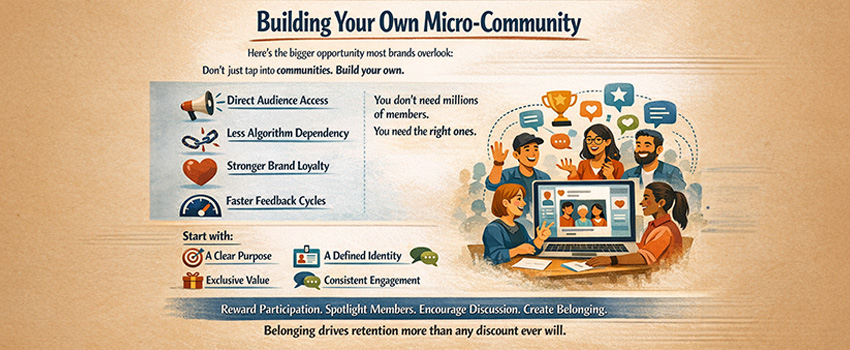
Here’s the bigger opportunity most brands overlook:
Don’t just tap into communities. Build your own.
Owned communities give you:
- Direct audience access
- Reduced dependency on platform algorithms
- Stronger brand loyalty
- Faster feedback cycles
You don’t need millions of members. You need the right ones.
Start with:
- A clear purpose
- A defined identity
- Exclusive value
- Consistent engagement
Reward participation. Spotlight members. Encourage discussion. Create belonging.
Belonging drives retention more than any discount ever will.
What Success Actually Looks Like
If you’re measuring community marketing the same way you measure ads, you’ll miss the value.
Look for:
- Repeat participation
- Organic referrals
- Increased lifetime value
- Higher conversion from warm traffic
- Positive brand sentiment
Community members often convert at higher rates — and they refer others.
That multiplier effect is where micro-community strategy truly shines.
How Web Dominance Elevates Your Community Strategy
Breaking into the right micro-communities takes more than a few influencer deals — it requires research, cultural awareness, and genuine relationship-building. That’s exactly what we do at Web Dominance.
We find your audience.
Using advanced social listening, we identify where your ideal customers are actually spending time — from niche forums to private groups and emerging platforms.
We connect you with trusted voices.
We build relationships with community leaders and nano-influencers who already have credibility, ensuring your brand shows up authentically.
We create content that fits.
Our campaigns are value-driven and native to each space, so your brand participates in the conversation instead of interrupting it.
We track real results.
From engagement to leads and sales, we make sure your community strategy delivers measurable ROI.
In short, we help you stop broadcasting — and start belonging.
The Future of Social Belongs to Communities
Social media isn’t about broadcasting anymore. It’s about gathering.
People don’t want to be marketed to. They want to belong somewhere.
Mega-influencers still have their place. But they shouldn’t dominate your strategy.
If your goal is sustainable growth — not just temporary visibility — micro-communities deserve a larger share of your social budget.
Because in today’s digital landscape, influence doesn’t scale through size.
It scales through trust.