

Artificial intelligence has rapidly evolved from an emerging technology into a core component of modern marketing.
Just a few years ago, marketers were experimenting with AI tools for basic automation and content assistance. Today, AI influences everything from SEO and content creation to customer segmentation, advertising optimization, lead generation, analytics, and customer experience.
Yet despite widespread adoption, many businesses still struggle with one critical question:
How much impact is AI actually having on marketing performance?
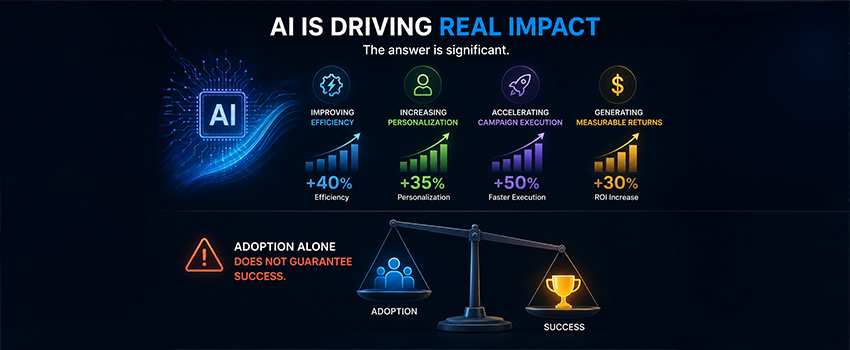
The answer is significant.
The latest research shows that AI is improving efficiency, increasing personalization capabilities, accelerating campaign execution, and generating measurable returns for businesses across industries. However, the data also reveals an important reality: adoption alone does not guarantee success.
The organizations generating the strongest results are not simply using AI tools. They are integrating AI into broader marketing strategies, workflows, and decision-making processes.
This article explores more than 50 AI marketing statistics that highlight where the industry stands today and what businesses should focus on moving forward.
Key AI Marketing Statistics at a Glance
Before diving deeper, here are some of the most important AI marketing statistics shaping the industry:
- Scrolling TikTok for recommendations
- Watching Instagram Reels for tips
- Browsing YouTube Shorts for quick insights
1. From Search to Scroll
2. Short-Form Video Is Dominating Everything
Short videos are no longer optional—they’re central.
Why?
Because they:
- Capture attention instantly
- Deliver value quickly
- Are favored by algorithms
They’re not just content—they’re distribution tools.
And businesses that understand how to use them strategically are scaling visibility faster than ever before.
3. Trust Has Replaced Reach
There was a time when marketing success meant reaching as many people as possible.
Now?
It’s about building trust with the right people.
Consumers are more skeptical than ever. They:
- Ignore obvious ads
- Question brand messaging
- Rely on real experiences and social proof
This is why:
- Personal brands are exploding
- Founder-led content is growing
- Behind-the-scenes content performs better than polished ads
People trust people and not logos.
4. Content Is the New Infrastructure
Content used to support marketing.
Now it is marketing.
Your:
- Videos
- Articles
- Social posts
- Emails
…are all part of your growth system.
Every piece of content is an entry point into your business.
5. Speed Has Become a Competitive Advantage
Marketing cycles used to take months.
Now trends rise and disappear in days.
Winning brands are:
- Testing constantly
- Creating quickly
- Adapting in real time
The faster you move, the more opportunities you capture.
The Problem: Most Businesses Are Playing an Old Game

Despite all these changes, many companies are still:
- Over-investing in slow, outdated strategies
- Treating social media as an afterthought
- Creating content without a clear system
- Focusing on visibility without conversion
This leads to:
- Wasted budgets
- Low engagement
- Inconsistent growth
The issue isn’t effort—it’s alignment with how marketing actually works today.
What Marketing Is Becoming
To understand where marketing is going, you need to look at what’s already working.
1. Marketing Will Be More Algorithm-Driven
Algorithms already decide:
- What people see
- When they see it
- How often they see it
In the future, success will depend on:
- Understanding platform behavior
- Creating content optimized for distribution
- Designing for retention and engagement
This isn’t guesswork—it’s strategy.
2. Personal Brands Will Outperform Corporate Brands
People connect with:
- Faces
- Stories
- Opinions
Not faceless companies.
That’s why founders, creators, and experts are becoming the front line of marketing.
Businesses that stay anonymous will struggle to compete with those that show personality.
3. Content Will Replace Traditional Funnels
The traditional funnel (awareness → consideration → conversion) is becoming less linear.
Instead, content itself will:
- Attract attention
- Build trust
- Educate
- Convert
All in one continuous experience.
A single short video can do what used to take multiple touchpoints.
4. AI Will Accelerate Everything
AI is already:
- Speeding up content creation
- Enhancing personalization
- Optimizing campaigns
But here’s the key:
AI won’t replace marketers—it will amplify those who know what they’re doing.
The gap between average and high-performing marketing will get wider.
5. Authenticity Will Outperform Perfection
Highly polished content is losing to:
- Real conversations
- Honest insights
- Imperfect delivery
People don’t want to be sold to.
They want to feel understood.
What This Means for Your Business
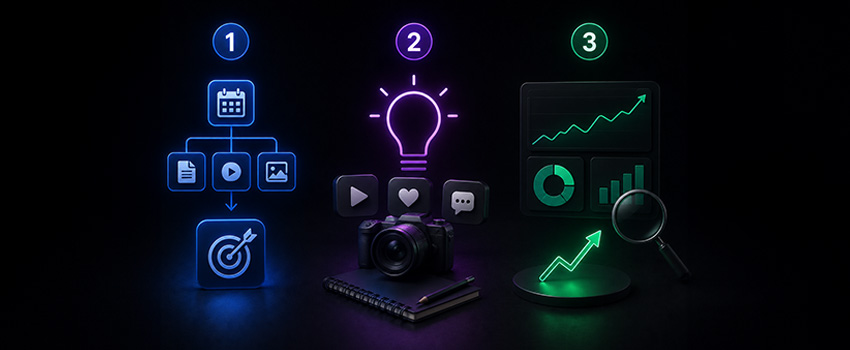
If you want to stay competitive, your marketing needs to shift in three key ways:
1. From Campaigns to Continuous Content
Stop thinking in terms of one-off campaigns.
Start building a content engine that runs every day.
2. From Promotion to Value
Instead of constantly selling, focus on:
- Educating
- Entertaining
- Informing
Value builds trust. Trust drives conversion.
3. From Guessing to Strategy
Marketing today is measurable.
Every:
- View
- Click
- Watch time
- Engagement
…tells you something.
The brands that win are the ones that analyze, adapt, and improve continuously.
Where Web Dominance Stands in This Shift

This is exactly where Web Dominance separates itself.
While many agencies are still focused on outdated tactics, Web Dominance operates at the intersection of:
- Content strategy
- Algorithm understanding
- Conversion optimization
- Digital growth systems
It’s not about “posting more.”
It’s about building a structured, scalable marketing system that:
- Captures attention
- Holds it
- Converts it
From short-form video strategy to SEO integration and full digital positioning, Web Dominance approaches marketing as a connected ecosystem—not isolated tactics.
The Businesses That Will Win Next
The next wave of successful businesses won’t necessarily be the biggest.
They’ll be the ones that:
- Understand attention better
- Move faster
- Communicate more clearly
- Build stronger trust
They’ll treat marketing not as a department—but as a core business function.
Final Thought
Marketing isn’t getting harder—it’s getting more precise.
The rules are clearer than ever:
- Attention comes first
- Trust follows
- Conversion happens naturally when both are strong
The question is no longer: “How do we promote our business?”
It’s: “How do we become impossible to ignore?”
Because in today’s landscape, the brands that figure that out don’t just compete.
They lead.