
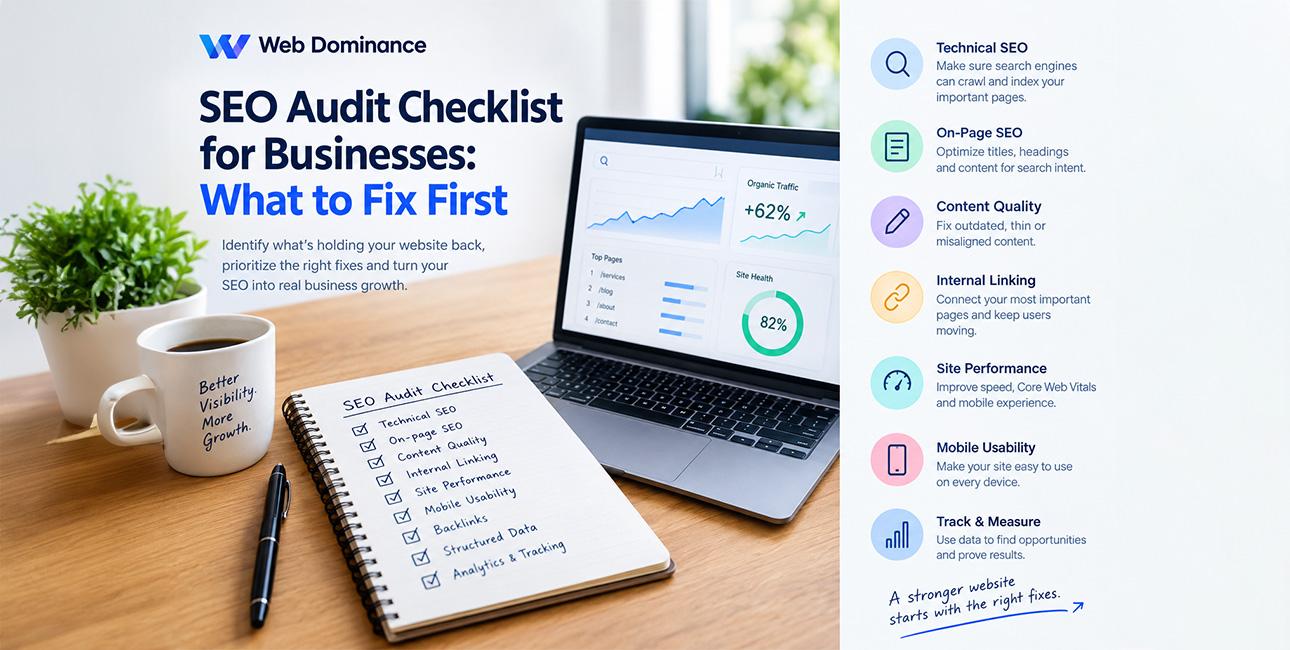
An SEO audit helps businesses identify why their website may not be performing as expected in organic search, which issues need attention, and where improvements are most likely to support business growth. The best SEO audits examine technical health, indexing, content relevance, website structure, user experience, and organic performance—not just keyword rankings or automated site scores.
However, finding problems is only the first step. The real value of an SEO audit lies in knowing which issues to fix first, why they matter, and how to measure the results.
For most businesses, the most effective approach is to resolve issues that prevent important pages from being discovered or indexed, improve pages with strong commercial potential, address content and internal linking gaps, and then prioritize broader optimization opportunities.
This checklist explains how to conduct an SEO audit, interpret the findings, and turn them into a practical action plan.
What Is an SEO Audit?
An SEO audit is a structured evaluation of a website’s ability to be discovered, crawled, indexed, understood, and surfaced in relevant search results. It also examines whether the website provides useful information and helps visitors complete meaningful actions, such as requesting a quote, booking a consultation, or making a purchase.
A comprehensive SEO audit typically covers six areas:
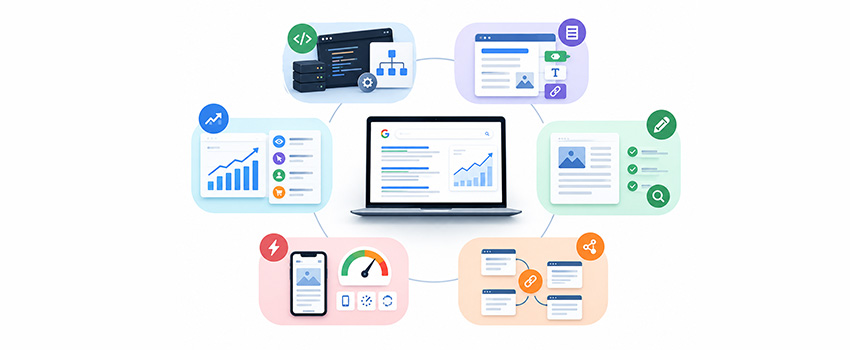
- Technical SEO: Crawlability, indexability, website architecture, redirects, canonical URLs, and technical errors.
- On-page SEO: Page titles, headings, meta descriptions, URLs, and content optimization.
- Content quality: Search intent, topical coverage, accuracy, originality, and outdated or overlapping pages.
- Internal linking: How important pages are connected and how easily visitors and search engines can discover them.
- Website experience: Mobile usability, loading performance, visual stability, and interaction responsiveness.
- Performance and conversion: Organic impressions, clicks, qualified traffic, leads, and sales.
For businesses investing in SEO, the purpose is not simply to make a website pass technical checks. It is to understand how search visibility contributes to business objectives and identify the most effective next steps.
SEO Audit Checklist: What to Check First
Not every SEO issue deserves immediate attention. A missing meta description on a low-traffic blog post, for example, is usually less urgent than an accidental noindex directive on a page responsible for generating enquiries.
Use this checklist to assess the most important areas of your website.
1. Check Whether Important Pages Can Be Crawled and Indexed
Priority: Critical when valuable pages are affected
Before optimizing individual pages, confirm that search engines can access and index the content you want people to find.
A page can contain excellent content and still receive little organic visibility if search engines cannot discover it, crawl it, or consider it eligible for indexing.
Start with these checks:
- Open Google Search Console and review the Page Indexing report.
- Use the URL Inspection tool to check important service pages, landing pages, product pages, and blog posts.
- Verify that valuable pages return the appropriate HTTP status code, normally 200 OK.
- Check that important pages are not accidentally blocked by robots.txt.
- Look for unintended noindex directives in page metadata or HTTP headers.
- Confirm that important pages can be discovered through relevant internal links.
- Review the XML sitemap and ensure it lists the canonical URLs you want search engines to consider.
- Investigate unexpected increases in excluded or non-indexed URLs.
Google’s Page Indexing report documentation explains how to identify indexing problems and distinguish genuine issues from URLs that should not appear in search results.
It is important to understand the difference between crawling and indexing. A page may be accessible to a crawler but still not be indexed. Likewise, an indexed page is not guaranteed to rank for its target searches.
What should you fix first?
Prioritize accidental indexing restrictions on important business pages, widespread server errors, broken redirects, and problems preventing key sections of the site from being discovered.
Do not try to force every URL into Google’s index. Filter pages, duplicate URLs, internal search results, and other low-value or intentionally excluded pages may not need to be indexed at all.
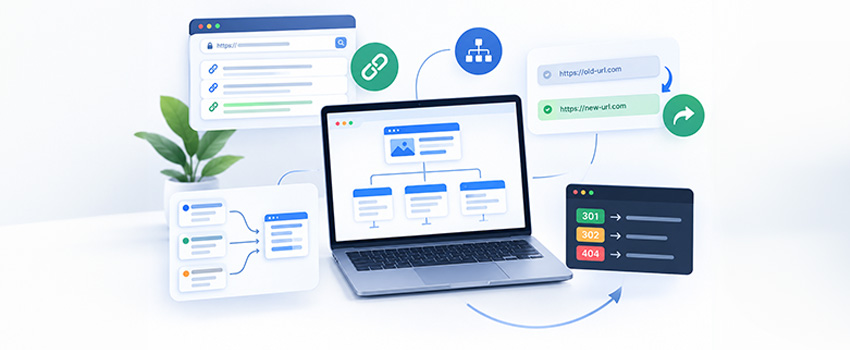
2. Audit Your Site Structure, URLs, and Redirects
Priority: High when important pages are difficult to discover or URL errors affect valuable traffic
A clear website structure helps users navigate the site and enables search engines to understand how pages relate to one another.
Review your website’s architecture and check whether the most important services, products, industries, and resources are easy to reach from relevant navigation or contextual links.
Use this checklist:
- Confirm that important pages are accessible through logical navigation.
- Review internal links pointing to URLs that return errors or redirect unnecessarily.
- Check for redirect chains and redirect loops.
- Identify duplicate or near-duplicate URLs that may compete to represent the same content.
- Check canonical tags on pages with duplicate or similar versions.
- Review URL changes made during redesigns or migrations.
- Confirm that deleted or relocated pages have appropriate status codes or redirects.
- Check that the sitemap, internal links, and canonical declarations are consistent.
For example, imagine a business moves a high-performing service page to a new URL during a redesign. If internal links still point to the old URL and the redirect is missing, visitors may encounter an error and search engines may struggle to consolidate the page’s existing signals.
In other cases, multiple URL variations may serve essentially identical content. A clear canonicalization strategy can help indicate which URL should represent the page in search results.
Google explains these principles in its documentation on canonical URLs and duplicate pages.
What should you fix first?
Start with broken URLs that affect high-value pages, incorrect redirects, inconsistent canonical signals, and structural issues that hide important pages. Avoid changing URL structures unnecessarily when existing URLs already work well.
3. Review Page Titles, Headings, and Search Intent
Priority: High for commercially important pages and pages with strong search potential
On-page SEO helps search engines and visitors understand what a page covers and whether it answers a particular question or need.
Start by reviewing your most important pages individually rather than applying identical changes across the entire website.
Check whether:
- Each important page has a descriptive, distinctive title.
- The main heading accurately reflects the page's purpose.
- Headings organize the content logically.
- The content matches the search intent behind its target queries.
- Page titles and descriptions accurately represent the content.
- Important services and products are described clearly.
- Relevant terms appear naturally where they help explain the subject.
- Calls to action reflect the visitor's likely next step.
Consider a company offering industrial equipment. A page titled “Our Solutions” may communicate little about the specific service or product it describes. A more descriptive title that identifies the equipment category and its intended application gives users a clearer reason to visit.
This does not mean every page must follow the same title formula. Titles should be written around each page’s distinct purpose and audience.
The same principle applies to keyword optimization. Repeating a phrase unnaturally throughout the content does not make a page more useful. The objective is to answer the relevant query comprehensively and accurately.
Google’s guidance on title links recommends descriptive, concise titles. Google may generate a different title link in search results if another page element better represents the page.
What should you fix first?
Prioritize pages that generate or could realistically generate qualified leads: service pages, important landing pages, high-value product pages, and established content with strong impressions but limited clicks.
4. Evaluate Content Quality, Relevance, and Coverage

Priority: High when content is outdated, misleading, incomplete, or misaligned with user needs
Publishing more content does not automatically improve organic performance. An effective content audit establishes which pages provide value, which need improvement, and which may overlap with other pages.
Review your existing content using these questions:
- Does each page serve a clear purpose?
- Does it answer the questions visitors are likely to have?
- Is the information accurate and up to date?
- Does it include useful examples, evidence, or practical guidance?
- Does it address the topic at the appropriate level of detail?
- Does the website contain multiple pages targeting essentially the same search intent?
- Are important topics missing from the website?
- Does the content provide a useful next step for readers?
Suppose a digital marketing website has several articles explaining SEO, AEO, and GEO using almost identical introductory definitions. Publishing another article with the same explanations may create unnecessary overlap.
A better approach is to give each page a distinct role. One article might explain the differences between SEO, AEO, and GEO, while another focuses on measuring AI search visibility through practical examples and reporting methods.
Likewise, an outdated article should not be updated simply by changing its publication date. Revisions should reflect meaningful improvements, such as new evidence, clearer explanations, updated examples, or more useful recommendations.
Google’s people-first content guidance emphasizes originality, usefulness, expertise, and whether readers can accomplish their goals after visiting a page.
What should you fix first?
Prioritize inaccurate content, important pages that fail to answer their intended queries, and overlapping pages that create confusion for users. Then improve relevant pages that already attract impressions or backlinks.
Do not automatically delete pages because they have low traffic. Review their purpose, links, history, and potential business value before consolidating, redirecting, or removing them.
5. Review Internal Linking and Website Navigation
Priority: High for important pages that are poorly connected
Internal links connect related pages on the same website. They help users discover additional information and help search engines identify relationships between pages.
A website may have useful service pages and valuable educational content, yet fail to connect them effectively.
Audit your internal links by checking whether:
- Important service pages receive relevant internal links.
- New blog posts link to related articles and service pages.
- Supporting articles link to relevant main guides or topic hubs.
- Anchor text describes the destination accurately.
- Important pages are not isolated from the rest of the website.
- Broken internal links have been corrected.
- Navigation labels make sense to visitors.
- Links lead to useful, relevant destinations rather than being added artificially.
For example, an article about SEO audits should link naturally to the business’s SEO service page and its audit and consultancy offering. A guide about website migrations may also link to web development services and supporting technical SEO resources.
This creates a logical journey from learning about a problem to understanding how the business can solve it.
What should you fix first?
Start with valuable service and conversion pages that receive insufficient relevant internal links. Then strengthen the links between related articles and their corresponding service pages.
Avoid forcing exact-match keywords into every link. Clear, natural anchor text is more useful to readers.
6. Test Website Speed and Core Web Vitals
Priority: High when performance problems affect important pages or user interactions
Website performance affects how quickly content becomes visible, how stable the layout feels, and how responsive the website is when people interact with it.
Begin with Google’s PageSpeed Insights and review both mobile and desktop results. Where available, examine real-user field data alongside laboratory diagnostics.
Check these potential problem areas:
- Large or unoptimized images.
- Unnecessary JavaScript and CSS.
- Slow server responses.
- Layout shifts caused by images, fonts, advertisements, or dynamically loaded elements.
- Unresponsive navigation, forms, or interactive elements.
- Mobile layouts that make important actions difficult.
A low PageSpeed Insights score is a diagnostic signal, not a complete measure of SEO performance. Likewise, a high score alone does not guarantee strong rankings or conversions.
What should you fix first?
Address issues that materially slow or disrupt key user journeys, particularly on service pages, product pages, and enquiry forms. Work with developers to prioritize fixes based on real-user data, technical feasibility, and business impact.
7. Check Mobile Usability and Conversion Paths

Priority: High when visitors struggle to complete important actions
An SEO audit should examine what happens after visitors arrive from search.
A website can attract relevant traffic but fail to support visitors because its navigation is confusing, its content is difficult to read, or its enquiry process creates unnecessary friction.
Review these areas:
- Text is readable without unnecessary zooming.
- Menus and buttons work correctly on mobile devices.
- Important information is accessible without excessive scrolling.
- Forms are easy to complete.
- Phone numbers, booking links, and enquiry options work.
- Calls to action are visible and relevant.
- Pages provide clear information about the product or service.
- Visitors can find the next step without confusion.
For example, if a service page receives relevant organic traffic but visitors struggle to locate its enquiry form, improving the page layout and form experience may be more valuable than publishing another article targeting a similar query.
Evaluate conversion performance using analytics data, form submissions, call tracking where appropriate, and user behavior.
What should you fix first?
Prioritize technical failures in contact forms, broken conversion links, mobile navigation problems, and barriers affecting high-value landing pages.
These improvements connect SEO with broader website optimization and conversion rate optimization.
8. Review Backlinks and Brand Credibility
Priority: Medium to high, depending on the website and competitive landscape
Backlinks are links from other websites to yours. Relevant, editorially earned links can help search engines discover pages and understand how other websites reference your content.
An audit should assess the quality and relevance of your backlink profile, not simply count links or focus on a third-party authority score.
Check whether:
- Reputable, relevant websites link to important resources.
- Existing backlinks point to URLs that still work.
- Valuable backlinks are being lost because of broken or redirected pages.
- Backlinks show signs of manipulative acquisition.
- Your business is represented accurately on relevant industry websites and professional profiles.
- Original research, useful resources, and project insights provide reasons for others to reference your website.
Not every unfamiliar backlink is harmful, and a large number of links from unrelated domains does not automatically indicate a penalty. Investigate patterns and context before taking action.
For businesses operating in specialized industries, clear descriptions of services, documented expertise, credible authorship, and accurate company information help establish trust with potential customers.
These signals also give search systems better information for interpreting the business and its content, although no particular backlink count or brand-mention threshold guarantees rankings or AI citations.
What should you fix first?
Resolve broken destinations for valuable backlinks and investigate evidence of deliberate link manipulation. Then focus on earning relevant references through useful resources, partnerships, original research, and genuine industry contributions.
9. Review Structured Data and Search Presentation
Priority: Medium, unless implementation errors affect an important supported search feature
Structured data is a standardized way of describing page information to search engines. Depending on the content and eligibility requirements, it can help a page qualify for supported enhanced search appearances.
During an audit, check whether relevant structured data is implemented accurately and consistently with the visible page content.
Depending on your website, appropriate types may include:
- Organization information.
- Breadcrumbs.
- Products and offers.
- Article information.
- Local business details, where applicable.
Use Google’s structured data documentation to understand supported features, required properties, and implementation guidelines.
Avoid adding markup simply because it is available. Structured data must accurately reflect the page, and valid markup does not guarantee an enhanced search result.
The same principle applies to AI search optimization. There is no universal structured data type that guarantees inclusion in ChatGPT, Google AI Overviews, or other AI-generated answers.
For SEO, GEO, and AEO alike, the foundation remains accessible pages, useful information, clear organization, accurate business details, and content that provides evidence for its claims.
What should you fix first?
Correct invalid or misleading markup that affects relevant supported features. Then implement appropriate structured data where it helps describe the actual content or business.
Which SEO Audit Tools Should Businesses Use?

You do not need dozens of tools to begin an SEO audit. A small set of complementary tools can reveal many important issues.
Google Search Console helps you review search performance, indexing, sitemap submissions, and reported technical problems.
Google Analytics 4 helps you analyze organic landing-page traffic, engagement, lead events, and sales.
PageSpeed Insights provides performance diagnostics and, where available, real-user Core Web Vitals data.
A website crawler can help identify broken internal links, redirect chains, missing titles, duplicate metadata, canonical inconsistencies, and other on-page or technical issues across larger websites.
Backlink analysis tools can help evaluate referring domains, lost links, and potential link-related risks.
The appropriate toolset depends on the size and complexity of the website. A small business site may need only a focused manual review and a few free tools. A large ecommerce site, international website, or platform with thousands of URLs may require more advanced crawling and log analysis.
Remember that tools identify potential problems; they do not automatically determine business priorities. Human review is necessary to interpret the findings and distinguish genuine issues from harmless warnings.
How Often Should a Business Conduct an SEO Audit?
The frequency depends on the website’s size, technical complexity, and rate of change.
For many businesses, a useful approach is to conduct a comprehensive audit periodically and monitor important technical and performance signals throughout the year.
Additional audits or targeted reviews are especially valuable before and after:
- A website redesign or migration.
- Significant changes to navigation or URL structures.
- Major content restructures or consolidation projects.
- Platform, CMS, or hosting changes.
- Significant organic traffic or indexing changes.
- Expansion into new markets, languages, or service categories.
Routine monitoring can identify emerging issues before they become larger problems. However, repeatedly auditing an unchanged website without implementing improvements is unlikely to provide much additional value.
An audit should be part of an ongoing optimization process, not an isolated report.
What Should an SEO Audit Report Include?
A useful SEO audit report translates findings into a clear implementation plan.
Rather than presenting a long list of technical errors, it should explain the issue, its implications, and the recommended next step.
A well-structured report includes:

- Executive summary: The most important findings and their business implications.
- Technical findings: Crawlability, indexability, redirects, canonicalization, and structural problems.
- Content findings: Search intent, quality, overlap, and opportunities to improve existing pages.
- Performance analysis: Organic visibility, landing-page traffic, conversions, and relevant trends.
- Prioritized recommendations: Issues ranked by impact, urgency, and implementation effort.
- Implementation plan: Recommended actions, responsibilities, and dependencies.
- Measurement framework: The indicators to monitor after changes are implemented.
Where possible, findings should include examples, affected URLs, supporting data, and a clear explanation of what needs to change.
The report should also distinguish confirmed issues from recommendations that require further investigation. This helps business owners make decisions without confusing automated tool warnings with demonstrated problems.
Most importantly, recommendations should connect technical work to business objectives. The goal is not to eliminate every warning in an SEO platform; it is to improve the website’s ability to attract relevant visitors and support business growth.
Turn Your SEO Audit Into a Growth Plan
An SEO audit is most valuable when it helps a business make better decisions about its website, content, and digital marketing investment.
The starting point is straightforward: make sure important pages can be discovered and indexed, identify problems affecting valuable customer journeys, improve content around real search intent, and use performance data to decide what deserves attention next.
From there, consistent implementation and measurement can help businesses build a stronger foundation for sustainable organic visibility and lead generation.
Web Dominance helps businesses assess their digital presence, identify optimization opportunities, and translate findings into actionable recommendations. Its SEO services include technical SEO, keyword research, content optimization, and on-page optimization, while its Audit & Consultancy services focus on evaluating the current position, identifying opportunities and risks, and developing practical recommendations.
Need a clearer picture of what is limiting your website’s performance? Contact Web Dominance to discuss an SEO audit tailored to your website, business priorities, and growth objectives.