If your business wants to attract more customers through search, two channels deserve serious consideration: search engine optimization (SEO) and pay-per-click (PPC) advertising. Both can connect your business with people looking for your products or services, but they work differently, require different types of investment, and support different business objectives.
The choice between SEO and PPC depends on how quickly you need results, how customers search for your offer, how much you can invest, and whether your website can convert visitors into customers.
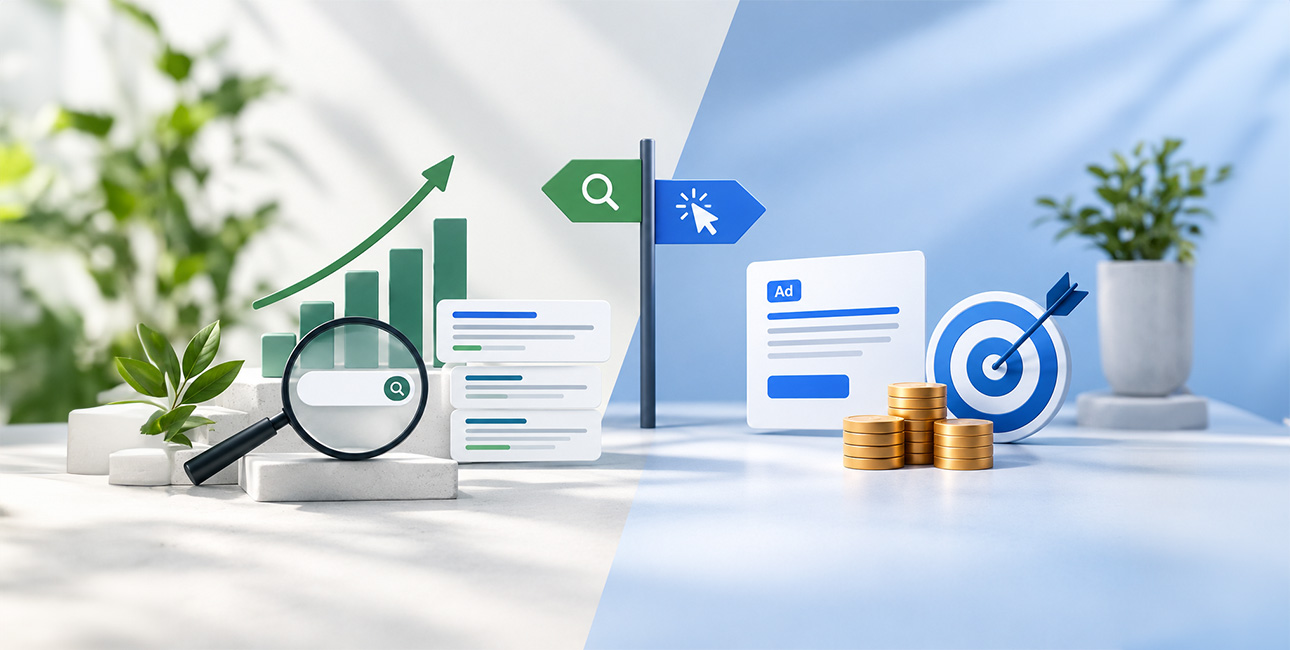
PPC is often the stronger starting point when you need to test demand or generate traffic quickly. SEO is often the better foundation when you want to build sustainable organic visibility over time. Businesses with established offers, adequate budgets, and clear measurement systems can benefit from combining both.
The important question is not simply which channel is better. It is which one deserves your investment first—and how you will know whether that investment is working.
SEO vs. PPC: What's the Difference?
SEO and PPC are two approaches to search acquisition. SEO focuses on improving your website’s visibility in organic search results, while PPC advertising lets you pay for eligible ad placements, typically paying per click in a cost-per-click campaign.
What Is SEO?
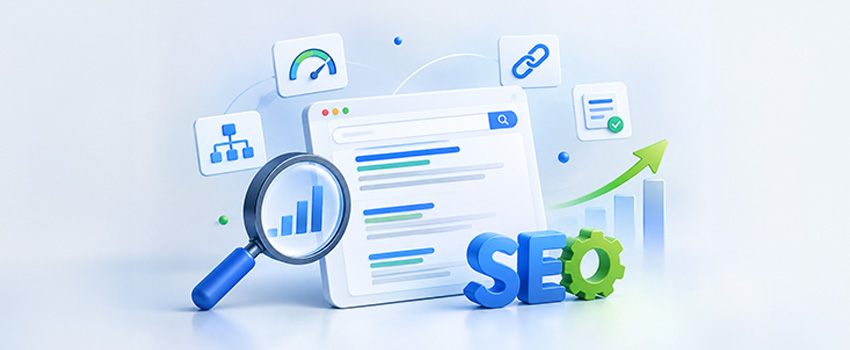
Search engine optimization is the process of improving a website so search engines can discover, understand, and surface its pages for relevant searches.
SEO involves several connected activities:
- Keyword research and search intent: Understanding what your potential customers search for and what they expect to find.
- Technical SEO: Improving crawlability, indexability, website structure, and other technical foundations.
- On-page optimization: Improving page titles, headings, internal links, and content relevance.
- Content strategy: Creating useful service pages, landing pages, and articles that answer real customer questions.
- Authority and credibility: Earning relevant references, strengthening expertise, and building trust around the business.
For example, a software company might invest in SEO to appear for searches related to its software category, specific features, implementation challenges, or comparisons between competing solutions.
Successful SEO can bring relevant visitors to a website without requiring the business to pay for every individual organic click. However, SEO is not free. Research, technical improvements, content production, and ongoing optimization all require resources, and search visibility is never guaranteed.
SEO is best understood as an investment in your website’s ability to attract relevant demand over time.
What Is PPC?
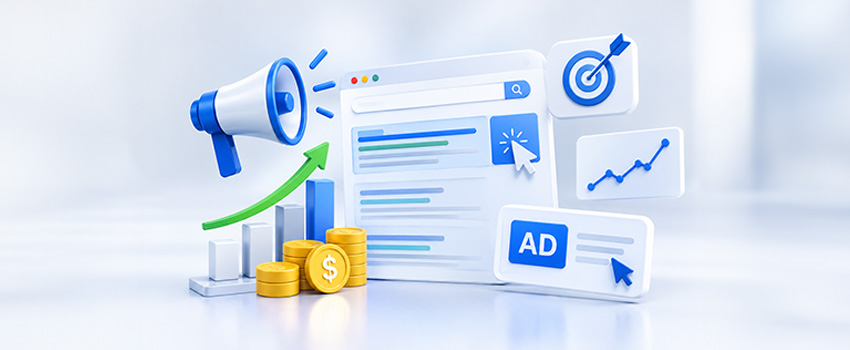
Pay-per-click advertising is a digital advertising model in which advertisers generally pay when someone clicks an ad under a cost-per-click arrangement. PPC can include search advertising and other types of paid campaigns; for a direct comparison with SEO, paid search is the most relevant starting point.
With search advertising, businesses can create campaigns targeting relevant queries and direct visitors to specific landing pages.
A PPC campaign typically involves:
- Keyword and audience research: Identifying relevant searches and potential customers.
- Campaign structure: Organizing campaigns, ad groups, locations, and targeting settings.
- Ad creation: Writing relevant ad copy that reflects user intent.
- Landing page optimization: Making sure the page matches the ad and provides a clear next step.
- Conversion tracking: Measuring enquiries, calls, purchases, or other meaningful actions.
- Ongoing optimization: Reviewing campaign performance and adjusting targeting, creative, bids, and budgets.
For example, a company launching a new service could use search advertising to reach potential customers searching for that service while its longer-term SEO strategy develops.
PPC can generate paid traffic as soon as a campaign is eligible to serve and begins receiving impressions and clicks. However, traffic does not guarantee enquiries or sales. The campaign still needs relevant targeting, a competitive offer, an effective landing page, and an economically sustainable cost per acquisition.
Should Your Business Invest in PPC First?
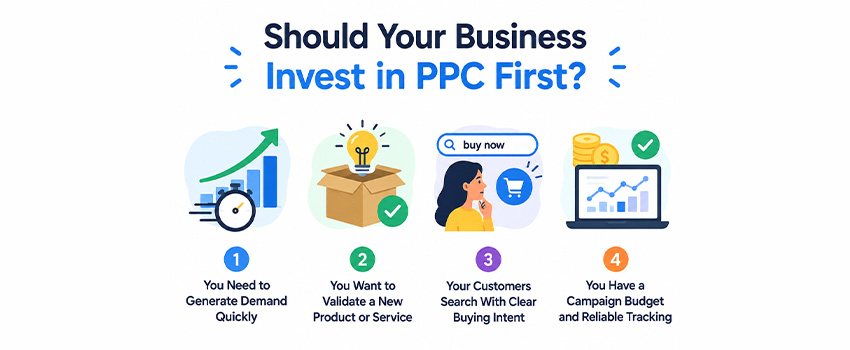
PPC may be the right first investment when your business needs to reach people actively searching for a solution and cannot rely on organic visibility to develop quickly enough.
However, speed should not be confused with guaranteed profitability. Before launching a campaign, make sure the business can convert the traffic it purchases and measure what happens after the click.
1. You Need to Generate Demand Quickly
If your business has a clear offer and needs to reach prospective customers within a short period, PPC can help you access relevant paid placements without waiting for new organic rankings.
This can be useful when launching a service, promoting an event, entering a new market, or supporting a time-sensitive campaign.
The key question is whether you can generate qualified leads or sales at a cost the business can sustain.
A campaign that attracts clicks but produces few meaningful enquiries is not successful simply because it generates traffic quickly.
2. You Want to Validate a New Product or Service
A business entering a new market may have assumptions about which features, benefits, or customer segments will generate interest.
Carefully structured PPC campaigns can help test these assumptions by measuring which searches attract engagement, which ad messages resonate, and which landing pages generate conversions.
Suppose a B2B technology company is considering launching a new consulting service. It can test different high-intent search themes and messages to understand which attract qualified enquiries.
The findings may also inform SEO priorities, including the language used on service pages, the questions addressed in articles, and the topics worth developing further.
This approach requires sufficient tracking and a clear definition of a qualified lead. Clicks alone cannot establish whether a market is commercially viable.
3. Your Customers Search With Clear Buying Intent
PPC can be particularly useful when potential customers search for solutions with strong commercial intent.
Examples include queries such as:
- "Enterprise software implementation services"
- "Industrial equipment supplier"
- "Digital marketing agency for manufacturers"
- "Emergency commercial repair service"
These are illustrative examples; actual demand, click costs, and competition must be evaluated in the relevant market.
When customers know what they need, a relevant search ad can provide a direct route to an appropriate service or product page.
Before investing, assess how many relevant searches are available, how competitive they are, what clicks are likely to cost, and how much a qualified customer is worth to your business.
4. You Have a Campaign Budget and Reliable Tracking
PPC works best when the business can allocate a realistic testing budget and distinguish valuable results from superficial engagement.
Before spending, check whether you can accurately track:
- Form submissions and qualified enquiries.
- Phone calls or bookings, where relevant.
- Purchases and transaction values.
- Lead quality and the rate at which enquiries become customers.
- Advertising spend and cost per acquisition.
Google Ads provides reporting for conversions, conversion value, cost per conversion, and return on ad spend. These metrics become more useful when conversion tracking reflects meaningful business outcomes rather than counting every interaction equally. See Google Ads’ conversion tracking guidance.
When PPC is the stronger first step: You have a validated offer or a clear hypothesis to test, relevant demand exists, your landing page is ready, and your business can measure whether the resulting leads are profitable.
Should Your Business Invest in SEO First?
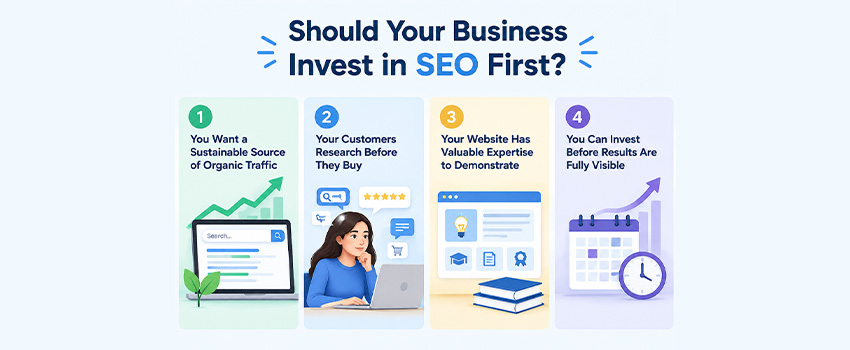
SEO may deserve priority when your business is focused on sustainable organic discovery, has useful expertise to demonstrate, and can invest in improvements before expecting meaningful results.
Unlike PPC, SEO does not purchase individual organic clicks. Instead, it develops the website’s relevance, usability, technical foundations, and content so that search engines can surface its pages for appropriate queries.
1. You Want a Sustainable Source of Organic Traffic
Businesses that want to reduce their reliance on paid acquisition can benefit from developing a strong organic search presence.
For example, a B2B service provider could create useful service pages and in-depth resources explaining customer problems, comparing solutions, and answering implementation questions.
As relevant pages earn visibility, they can attract visitors without requiring a separate advertising payment for every organic click.
However, ongoing investment is often still needed. Content can become outdated, competitors can improve their pages, and search results can change. Existing organic visibility is valuable, but it is not permanent or guaranteed.
2. Your Customers Research Before They Buy
Some purchasing decisions involve substantial research. Customers may need to understand a problem, compare options, evaluate providers, and build confidence before contacting a business.
SEO allows businesses to address these stages with content that matches different types of search intent.
A manufacturing company, for example, might develop resources around equipment selection, production challenges, technical specifications, and maintenance requirements. A consulting firm might publish guides about implementation risks, decision criteria, and expected project deliverables.
This content can serve as a useful entry point before a buyer is ready to speak with a provider.
The goal is not to publish as many articles as possible. It is to build a connected set of pages that genuinely help the intended audience make decisions.
3. Your Website Has Valuable Expertise to Demonstrate
Businesses with specialized knowledge can use SEO to make that expertise accessible to potential customers.
Useful formats include detailed service pages, practical guides, comparison articles, case studies, and original research. Content should explain what the business knows, why its recommendations are appropriate, and how the information applies to real situations.
For Web Dominance, this also means building content around the relationship between technical SEO, content strategy, business objectives, and conversion performance—not treating keyword placement as the entire job.
A strong content strategy can strengthen organic visibility and provide useful reference material for visitors evaluating the company.
4. You Can Invest Before Results Are Fully Visible
SEO is not an instant acquisition channel. Technical fixes, content improvements, and new pages can take time to affect search performance, and results depend on the website’s starting point and competitive environment.
Google notes in its SEO Starter Guide that changes may take from hours to several months to be reflected in search results, and there is no guarantee that every change will produce a noticeable effect.
That makes realistic planning essential.
If the business needs immediate revenue to remain viable, relying exclusively on SEO may create an unacceptable short-term gap. If the business can invest in a longer-term channel while measuring progress, SEO can become an important part of its acquisition strategy.
When SEO is the stronger first step: You want long-term organic visibility, your customers research before buying, your website can support useful content, and you can invest in improvements while results develop.
SEO vs. PPC Costs: Which Channel Offers Better Value?
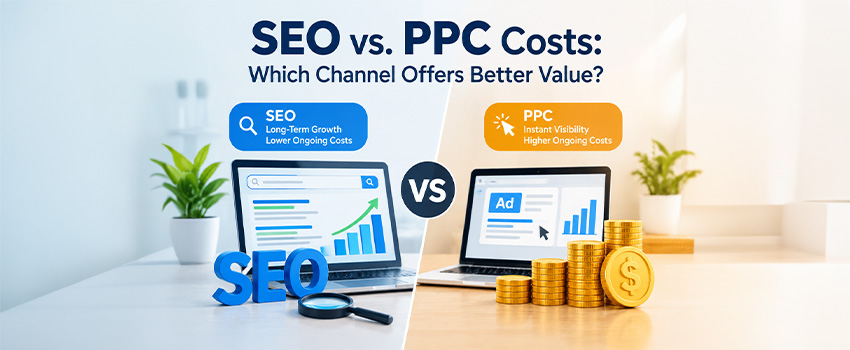
Comparing SEO and PPC costs requires more than looking at a monthly fee or the average cost of a click.
SEO typically involves a combination of technical improvements, strategy, content, expertise, and ongoing optimization. PPC usually involves media spend as well as campaign setup, management, creative work, and landing-page improvements.
The right comparison is the cost of acquiring a qualified customer and the value that customer generates.
Understand the Difference Between Cost Per Click and Cost Per Acquisition
Cost per click (CPC) tells you how much you pay, on average, for an eligible click. It does not tell you whether the visitor becomes a lead or customer.
Cost per acquisition (CPA) measures the cost of generating a defined conversion, such as a purchase or another tracked action. For lead-generation businesses, cost per qualified lead and cost per acquired customer are often more useful than the cost per form submission alone.
For SEO, businesses can calculate an estimated acquisition cost by comparing the resources invested in SEO over a defined period with the qualified leads or customers attributed to organic search. That calculation needs a consistent methodology and should account for the time required for work to deliver results.
Calculate What a Customer Is Worth
Consider a hypothetical B2B company whose average new customer generates $2,000 in gross profit contribution before marketing and other acquisition costs. If 10% of qualified leads become customers, the expected gross profit contribution per qualified lead is approximately $200.
That means $200 is the illustrative break-even acquisition cost per qualified lead before additional sales, marketing, and overhead costs are accounted for. The business would generally need to acquire leads below that threshold to retain a positive contribution after acquisition costs.
This example is not an industry benchmark or a prediction of campaign performance. It demonstrates why lead quality, close rate, customer value, and the full cost of acquisition matter.
A campaign producing inexpensive leads may be less valuable than one producing fewer, higher-quality opportunities that close at a better rate.
How SEO and PPC Fit Into GEO and AEO

Search behavior is expanding beyond conventional lists of organic results and advertisements. People increasingly encounter summarized answers, conversational interfaces, and AI-assisted discovery experiences.
For businesses, this makes it useful to distinguish between the channels that purchase visibility and the work that makes a business’s information discoverable and useful.
SEO supports organic discovery. Technical accessibility, relevant content, a clear website structure, accurate information, and demonstrable expertise provide the foundation for search visibility.
GEO and AEO focus on discoverability and representation in AI-generated answers and answer-oriented search experiences. In practice, that means producing content that directly addresses questions, supports important claims, explains concepts clearly, and presents information about the business accurately.
PPC purchases access to eligible advertising placements. It can help a business reach relevant audiences through supported paid campaigns, but paying for an ad does not guarantee that the business will be cited as a source in an organic or AI-generated answer.
For a company deciding where to invest first, these considerations should influence the broader strategy rather than create an entirely separate set of activities.
An SEO program that improves service pages, develops genuinely useful content, and establishes clear information about the company can serve multiple discovery needs. PPC can support immediate campaign goals while the business builds those assets over time.
Neither organic optimization nor paid advertising guarantees a particular AI visibility outcome. Measure them according to the actual opportunities they generate and the goals they are designed to achieve.
How to Measure SEO and PPC Performance
Once you begin investing, evaluate both channels using metrics linked to the business objective.
SEO Metrics
Track:
- Organic impressions and clicks.
- Search queries and landing-page performance.
- Qualified organic leads and sales.
- Conversion rate from organic traffic.
- Acquisition costs over a defined period.
- The performance of important service pages and supporting content.
Google Search Console is useful for understanding how a website performs in Google Search, while Google Analytics helps analyze what visitors do after reaching the site. Google explains the distinction in its Search Console and Analytics guidance.
PPC Metrics
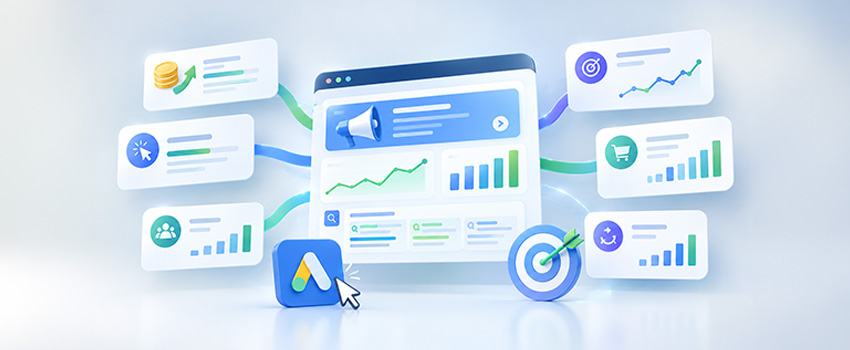
Track:
- Advertising spend and average cost per click.
- Click-through rate and relevant search terms.
- Qualified leads and purchases.
- Cost per qualified lead and cost per acquired customer.
- Conversion rate and conversion value.
- Return on ad spend (ROAS), where revenue or conversion values are tracked reliably.
Google Ads’ campaign measurement guidance explains how conversion reporting, conversion value, and cost-per-conversion metrics can support optimization.
ROAS alone does not establish profitability. Revenue needs to be considered alongside product or service margins, campaign management costs, fulfilment, and other relevant expenses.
Review Performance in Context
Do not expect SEO and PPC to follow identical timelines. PPC can generate early data, but reliable conclusions may require enough qualified conversions. SEO improvements may take weeks or months to appear in search performance.
Set a baseline before making changes, review progress consistently, and distinguish early indicators from final business outcomes.
For SEO, early indicators may include better indexability, stronger search impressions, or improved visibility for relevant queries. For PPC, early indicators may include relevant search traffic and initial conversion data. Over time, both channels should be evaluated against qualified opportunities, customers, and acquisition economics.
Make Your Next Search Marketing Investment Count
SEO and PPC are not competing answers to a single problem. They are different ways to connect your business with potential customers, and the best investment depends on what the business needs now and where it wants to go.
If you need to reach active demand quickly, PPC may provide the more suitable starting point. If you want to strengthen long-term organic visibility, SEO can help build the necessary website and content foundations. If your business has the resources and measurement systems to support both, an integrated strategy can combine near-term acquisition opportunities with longer-term organic growth.
The next step is to evaluate your current website, customer demand, acquisition economics, and growth objectives before deciding where the budget will have the greatest impact.
At Web Dominance, we connect SEO strategy, PPC campaign management, website performance, and conversion optimization to help businesses make informed digital marketing decisions.
Explore our SEO services and PPC Advertising services, or contact Web Dominance to discuss an acquisition strategy aligned with your business goals.
The structure should support different stages of the buying journey.
A first-time visitor may need to understand the product, while a returning visitor may be looking specifically for pricing, integrations, or proof that the platform works for a particular use case.