AI is no longer a “nice-to-have” in digital marketing agencies. It has become the operational backbone of modern marketing delivery.
From SEO research and content production to paid advertising optimization and client reporting, artificial intelligence is fundamentally reshaping how agencies operate, scale, and compete.
But there is a major difference between agencies that use AI tools and agencies that are built around AI workflows.
The first group saves time.
The second group wins markets.
This guide explores the best AI marketing tools for agencies in 2026 — not just as a list, but as a practical breakdown of how they fit into real agency workflows, where they create leverage, and how Web Dominance–style performance-driven agencies can use them to scale results for clients.
The Role of AI in Modern Marketing Agencies
Before diving into tools, it is important to understand what has fundamentally changed.
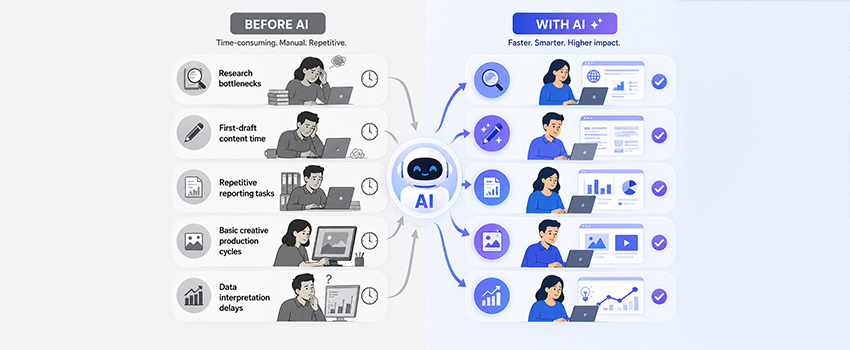
AI is not replacing marketing teams. It is replacing:
- Manual research bottlenecks
- First-draft content creation time
- Repetitive reporting tasks
- Basic creative production cycles
- Data interpretation delays
In modern agencies, AI functions across five core layers:
Strategy Layer
AI helps analyze markets, competitors, keywords, and audience intent.
Production Layer
AI accelerates content, ad creatives, landing pages, and design variations.
Optimization Layer
AI identifies performance patterns in SEO, PPC, and CRO.
Automation Layer
AI connects workflows across CRM, email, analytics, and reporting tools.
Intelligence Layer
AI transforms raw data into insights and predictions.
Agencies that integrate AI across all five layers outperform those that use it only for content generation.
ChatGPT (OpenAI)
ChatGPT is no longer just a writing assistant. For agencies, it functions as a multifunctional marketing intelligence system.
How Agencies Actually Use It
SEO Operations
- Keyword clustering from raw lists
- Search intent classification
- Content structure planning
- SERP breakdowns
- Internal linking frameworks
Content Production
- Long-form blog drafting
- Landing page copy
- Conversion-focused headlines
- FAQ generation for SEO pages
- Content repurposing (blogs → ads → social → email)
PPC and Ads
- Google Ads variations at scale
- Meta ad copy testing variations
- Hook generation for video ads
- Audience segmentation ideas
Client Strategy Work
- Marketing audits
- Positioning frameworks
- Competitor breakdowns
- Growth strategy proposals
The biggest advantage is speed of iteration.
Instead of spending 3–5 hours drafting strategy documents or content structures, agencies can generate structured outputs in minutes and refine them with human expertise.
However, high-performing agencies never publish raw AI output — they use it as a strategic accelerator, not a final product generator.
Claude (Anthropic)
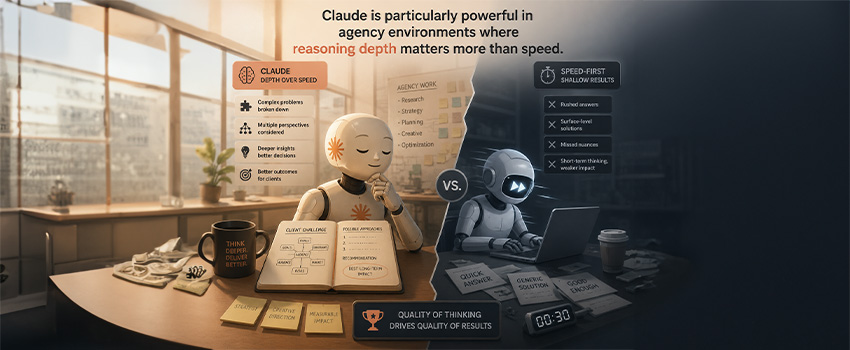
Claude is particularly powerful in agency environments where reasoning depth matters more than speed.
SEO Content Depth Analysis
Claude can analyze:
- Top-ranking pages
- Content gaps
- Missing semantic clusters
- Weak topical authority areas
Client Research Reports
Agencies use Claude to generate:
- Industry breakdowns
- Market positioning documents
- Competitor comparisons
- Buyer persona mapping
Long-Form Content Structuring
Unlike typical AI tools, Claude excels at:
- Maintaining narrative consistency
- Structuring 3,000–8,000 word articles
- Preserving logical flow across sections
Claude is especially strong in:
- Analytical writing
- Structured reasoning
- Multi-step content development
- Handling large context documents (briefs, audits, reports)
For agencies doing high-value SEO and strategy work, Claude is often used in the research and planning phase, while ChatGPT is used in production and iteration.
Jasper AI
Jasper is designed specifically for marketing teams that need consistency at scale.
Agencies working with multiple clients often struggle with:
- Tone inconsistency
- Messaging drift
- Editorial quality variation
Jasper solves this through:
- Brand voice profiles
- Content templates
- Structured workflows
Agency Use Cases
- SEO blog production pipelines
- Product landing pages
- Email marketing sequences
- Social media content calendars
- Multi-brand content scaling
Jasper reduces dependency on individual writers by creating repeatable content systems.
However, it is most effective when paired with strong editorial direction. Without strategy, Jasper becomes just another content generator.
Surfer SEO
Surfer SEO is one of the most operationally valuable tools for content-driven agencies.
Surfer analyzes:
- Top-ranking pages in Google
- Keyword density patterns
- Semantic relevance clusters
- Content structure models
Agency Workflow Integration
Step 1: Keyword Research
Identify target keyword and intent.
Step 2: SERP Analysis
Surfer breaks down:
- Common headings
- Word counts
- Entity usage
- Content structure patterns
Step 3: Content Optimization
Real-time scoring guides writers during production.
Instead of guessing what Google wants, agencies can:
- Reverse-engineer ranking pages
- Align content structure with SERP data
- Improve topical authority systematically
This significantly improves SEO success rates for client campaigns.
Semrush (AI + SEO Intelligence Layer)
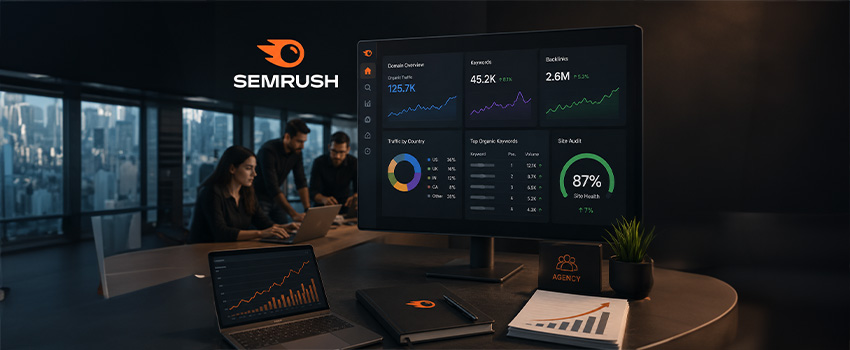
Semrush remains one of the most powerful tools for agencies managing SEO at scale.
AI-Enhanced Capabilities
- Keyword opportunity prediction
- Competitive gap analysis
- AI-driven content recommendations
- Search visibility tracking
- SERP feature monitoring
Agency Use Cases
1. Competitor Strategy Mapping
Agencies can reverse-engineer:
- Traffic sources
- Backlink strategies
- Content clusters
- Paid advertising approaches
2. Content Strategy Development
Identify:
- Missing topics
- Low-competition opportunities
- High-value keyword clusters
3. Performance Tracking
Monitor:
- Keyword movement
- Domain authority changes
- Content ROI
Semrush acts as the strategic intelligence layer for SEO agencies.
Midjourney
Midjourney is an AI visual engine for high-end creative production.
Visual identity plays a critical role in digital marketing performance.
Midjourney allows agencies to produce:
- Ad creatives
- Concept visuals
- Brand moodboards
- Blog illustrations
- Landing page visuals
Agency Value
Instead of waiting for design cycles, teams can:
- Test visual directions instantly
- Produce multiple creative concepts
- Rapidly prototype campaign visuals
Strategic Use
Top agencies use Midjourney not for final assets, but for:
- Creative exploration
- Campaign ideation
- Moodboarding for clients
- Ad concept testing
Canva AI
It is a fast execution layer for marketing teams.
Canva has evolved into a production tool for agencies handling high content volume.
- Social media content creation
- Ad creatives
- Presentations for clients
- Landing page visuals
- Marketing PDFs and reports
Why It Works in Agencies
It bridges the gap between:
- Strategy (marketers)
- Execution (designers)
Allowing faster campaign deployment without bottlenecks.
HubSpot AI
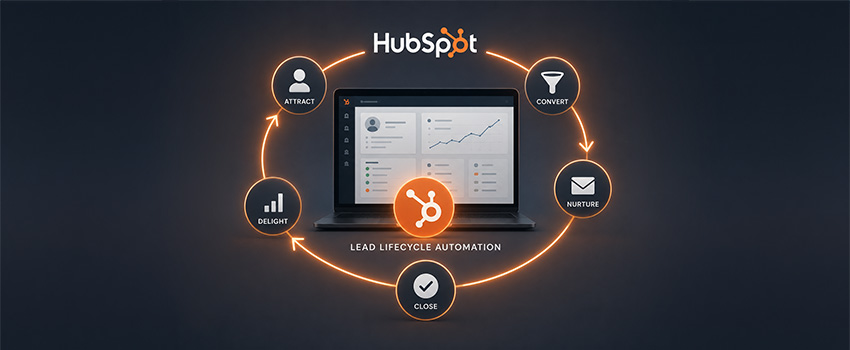
HubSpot is not just a CRM. It is a lead lifecycle automation platform.
- Lead scoring based on behavior
- Automated email nurturing sequences
- CRM pipeline optimization
- Customer segmentation
- Sales forecasting
HubSpot AI helps agencies:
- Predict lead quality
- Automate follow-ups
- Personalize communication at scale
This is critical for B2B-focused agencies handling high-value clients.
AdCreative.ai
Paid media success depends heavily on creative testing volume.
- Hundreds of ad variations quickly
- Platform-specific creatives (Meta, Google, LinkedIn)
- Conversion-focused design generation
- Predictive performance scoring
Instead of manually designing 10 ad variations, agencies can generate 100+ and test performance faster.
This improves:
- CTR
- Conversion rates
- Testing cycles
Zapier AI
Zapier connects the entire agency ecosystem.
Here are examples of automation:
- Lead form → CRM → email sequence
- Content publish → social distribution
- Client onboarding workflows
- Reporting dashboards updates
- Slack notifications for conversions
Zapier reduces:
- Manual coordination
- Operational delays
- Human error
It effectively acts as the nervous system of an AI-powered agency.
How High-Performance Agencies Combine These Tools
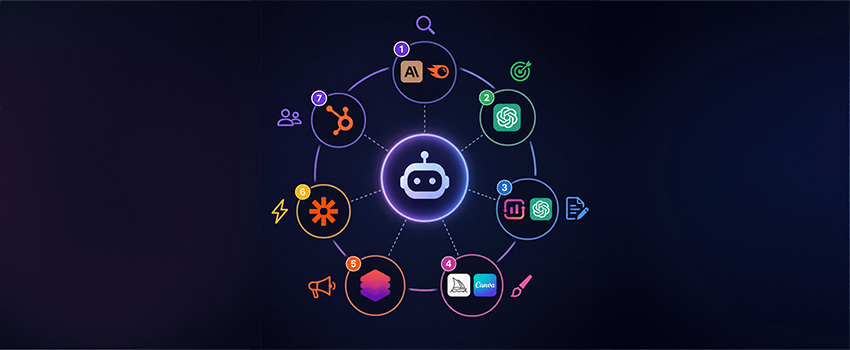
Success isn’t driven by individual tools; it’s driven by how well they work together.
- Research → Claude + Semrush
- Strategy → ChatGPT
- SEO Content → Surfer + ChatGPT
- Design → Midjourney + Canva
- Ads → AdCreative.ai
- Automation → Zapier
- CRM → HubSpot
This creates a full-cycle AI-powered marketing system.
Common Mistakes Agencies Make With AI
1. Using AI Without Strategy
Tools do not replace marketing thinking.
2. Publishing Unedited AI Content
Search engines increasingly detect low-value content.
3. Fragmented Tool Usage
Too many disconnected tools reduce efficiency.
4. Ignoring Brand Positioning
AI cannot define market differentiation.
The Future of AI in Marketing Agencies
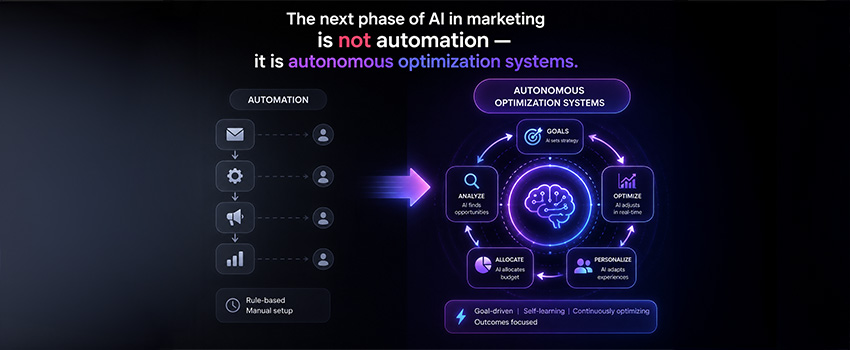
The next phase of AI in marketing is not automation. It is autonomous optimization systems.
We are moving toward:
- AI-managed ad campaigns
- Self-optimizing SEO content
- Predictive conversion systems
- Real-time personalization engines
- Fully automated reporting ecosystems
Agencies that adopt AI early will not just work faster — they will fundamentally reshape how marketing services are delivered.
Final Thoughts
AI is no longer a toolset. It is an operational model for modern agencies.
The agencies that win in the next decade will not be those that use AI occasionally, but those that redesign their entire workflows around it.
At Web Dominance, AI is integrated across strategy, SEO, content, PPC, and conversion optimization to help businesses scale faster, reduce inefficiencies, and improve measurable outcomes.
The future of digital marketing belongs to agencies that combine human creativity with AI-driven precision.