
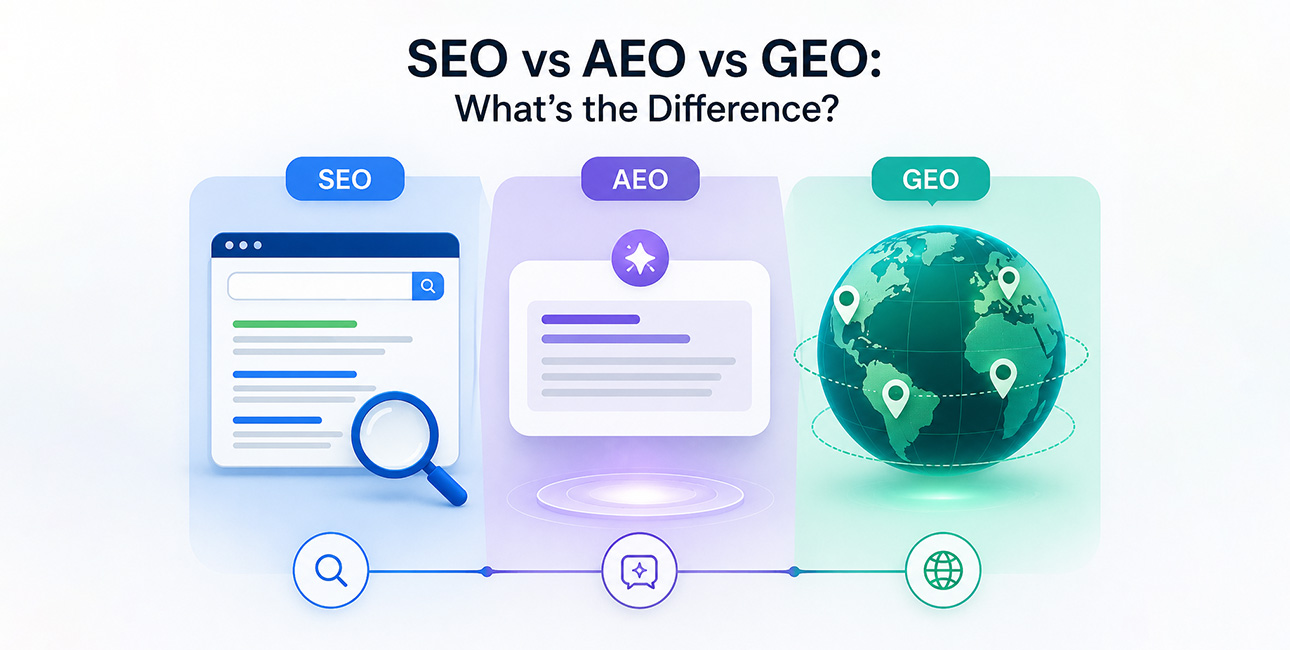
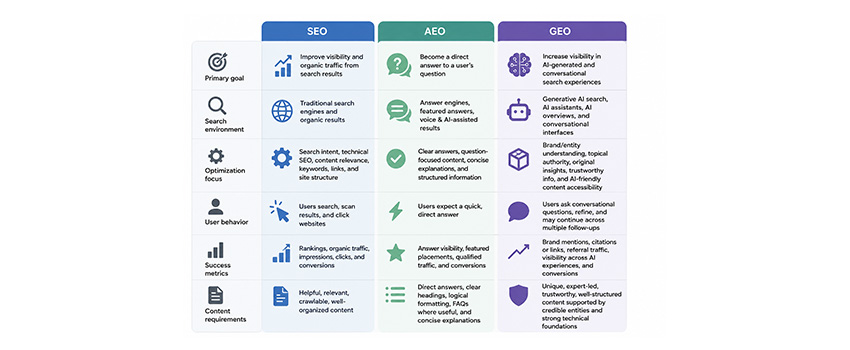
SEO, AEO, and GEO all aim to improve online visibility, but they focus on different search environments. SEO helps pages perform in traditional search results, AEO helps content become a direct answer, and GEO focuses on making brands and information more visible in generative AI search experiences.
For most businesses, the best approach is not choosing one over the others. A strong strategy combines all three.
Why SEO, AEO, and GEO Should Work Together
The boundaries between SEO, AEO, and GEO are not always strict. In fact, Google now explicitly states that its generative AI search experiences still rely on foundational SEO practices. From Google’s perspective, AEO and GEO can be viewed as different ways of describing optimization for evolving search experiences rather than completely separate replacements for SEO.
The practical difference is where and how you want to be discovered.
What Is SEO?
Search Engine Optimization (SEO) is the process of improving a website’s visibility in search engines.
SEO covers a broad range of activities, including:
- Technical website optimization
- Keyword and search intent research
- Content creation
- Internal linking
- Website architecture
- Crawlability and indexability
- Structured data where appropriate
- Authority and trust signals
The objective is not simply to rank for as many keywords as possible. Effective SEO helps a website appear when its content is relevant to what people are searching for.
Google continues to emphasize helpful, reliable, people-first content, clear technical foundations, and content that users can easily discover and understand.
For businesses, SEO remains the foundation. Without pages that search engines can crawl, understand, and index, visibility in many AI-powered search environments becomes much more difficult.
What Is AEO?

Answer Engine Optimization (AEO) focuses on making content easier to surface when users ask direct questions.
Instead of optimizing only for a phrase such as: best digital marketing strategy
AEO also considers questions such as:
- What is a digital marketing strategy?
- How does SEO improve website visibility?
- What is the difference between SEO and AEO?
- How can a business appear in AI-generated answers?
The goal is to provide a clear answer before expanding with useful context.
AEO-friendly content often includes:
- Direct answers near the beginning
- Descriptive question-based headings
- Clear definitions
- Concise explanations
- Lists and comparisons where useful
- Well-structured information
- Supporting context and evidence
However, AEO should not mean creating hundreds of shallow FAQ pages or rewriting the same answer for every possible question variation. Google specifically recommends focusing on useful, non-commodity content rather than producing large volumes of pages designed primarily to manipulate search or generative responses.
What Is GEO?
Generative Engine Optimization (GEO) generally refers to improving visibility in generative AI experiences.
This may include environments where AI systems retrieve information from the web and generate an answer using relevant sources.
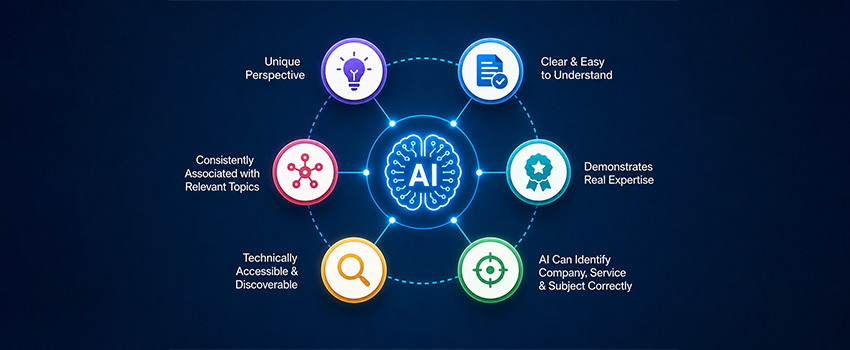
GEO places greater attention on questions such as:
- Does the content provide a unique perspective?
- Is the information clear and easy to understand?
- Does the website demonstrate real expertise?
- Is the brand consistently associated with relevant topics?
- Can the AI system identify the company, service, and subject matter correctly?
- Is the content technically accessible and discoverable?
Google’s current guidance for generative AI search emphasizes unique, valuable, non-commodity content, clear technical structure, and the continued importance of foundational SEO.
This is why GEO should not be treated as a shortcut or a collection of “AI hacks.”
For example, Google states that there are no special files or AI-specific markup required to appear in its AI search features. Existing SEO fundamentals, accessible text content, internal links, useful content, and accurate structured data remain important.
The Biggest Difference: SEO Focuses on Discovery, AEO on Answers, and GEO on AI Visibility
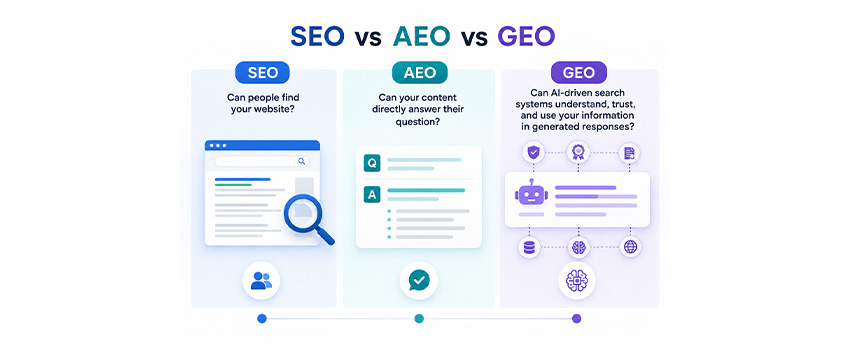
A simple way to understand the three is:
- SEO: Can people find your website?
- AEO: Can your content directly answer their question?
- GEO: Can AI-driven search systems understand, trust, and use your information in generated responses?
These approaches overlap significantly.
A well-optimized article might:
- Rank in traditional search through strong SEO.
- Answer a specific question clearly through AEO.
- Provide enough original expertise and context to become useful in generative AI search through GEO.
That is why businesses should avoid treating them as competing strategies.
How to Optimize a Website for All Three
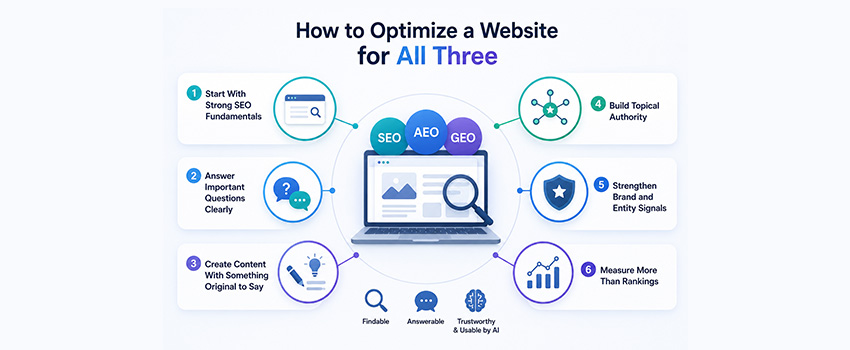
A practical strategy should combine the strongest elements of SEO, AEO, and GEO.
1. Start With Strong SEO Fundamentals
Make sure important pages are:
- Crawlable
- Indexable
- Easy to navigate
- Connected through relevant internal links
- Written in clear, accessible text
- Technically healthy
Google’s AI search documentation confirms that these existing SEO practices remain relevant for AI features such as AI Overviews and AI Mode.
2. Answer Important Questions Clearly
Don’t hide the answer under a long introduction.
Start with the key answer, then provide context, examples, and deeper information.
This improves usability and supports answer-oriented search behavior.
3. Create Content With Something Original to Say
Generic content is easy to reproduce.
Original experience, research, case studies, expert opinions, data, and practical examples can make a page more valuable.
Google’s generative AI guidance specifically recommends unique perspectives and content that goes beyond common, easily replicated information.
4. Build Topical Authority
Publish connected content around the subjects your business genuinely understands.
For Web Dominance, relevant topic ecosystems may include:
- SEO
- Content marketing
- Technical SEO
- AEO
- AI search visibility
- Generative search
- Conversion optimization
- Digital marketing strategy
Connect related articles and service pages so users and search systems can better understand the relationship between your expertise and your services.
5. Strengthen Brand and Entity Signals
Your website should clearly explain:
- Who you are
- What you do
- Which services you provide
- What topics you specialize in
- Why users should trust your expertise
Consistency across your website and relevant external sources can help create a clearer understanding of your brand.
6. Measure More Than Rankings
Traditional rankings and organic traffic remain important, but AI search creates additional visibility patterns.
Depending on the platform, businesses may also monitor:
- AI-generated mentions
- Referral traffic from AI platforms
- Source citations and links
- Brand visibility for important topics
- Conversion quality
- Search Console performance for AI features
For example, OpenAI states that public websites can appear in ChatGPT search and recommends allowing OAI-SearchBot to crawl content for discovery and inclusion in summaries and snippets.
Do You Need Separate SEO, AEO, and GEO Strategies?
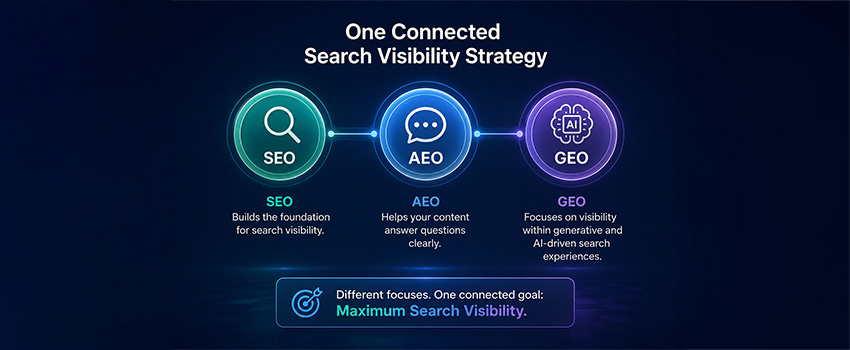
Usually, you need one connected search visibility strategy.
Creating completely separate content for SEO, AEO, and GEO can lead to duplication and unnecessary complexity.
A stronger approach is to create content that is:
- Technically accessible
- Easy to understand
- Directly useful
- Structured logically
- Supported by internal links
- Based on real expertise
- Original and trustworthy
- Relevant to your core topics
That content can support traditional rankings, direct-answer experiences, and generative AI search at the same time.
Concluding
SEO, AEO, and GEO describe different aspects of how people discover information online.
SEO builds the foundation for search visibility.
AEO helps your content answer questions clearly.
GEO focuses on visibility within generative and AI-driven search experiences.
The future of search is unlikely to be about abandoning SEO for a completely new optimization method. Instead, businesses need to expand their approach.
The strongest websites will combine solid SEO, answer-focused content, clear brand and entity signals, topical authority, and genuinely useful expertise.
For Web Dominance, that means building content and search strategies that do not simply chase rankings or AI mentions, but help the brand become a clear, credible, and discoverable source across the entire search ecosystem.