

Artificial General Intelligence — or AGI — is one of the most important and misunderstood ideas in technology today.
You’ve probably heard about AI tools that write content, generate images, recommend products, or analyze data. But those systems are not AGI. They are specialized tools designed to perform specific tasks.
AGI is something much bigger.
It refers to a future type of artificial intelligence that can think, learn, and solve problems across many different areas — just like a human can.
Let’s break it down clearly.
The Simple Definition of AGI
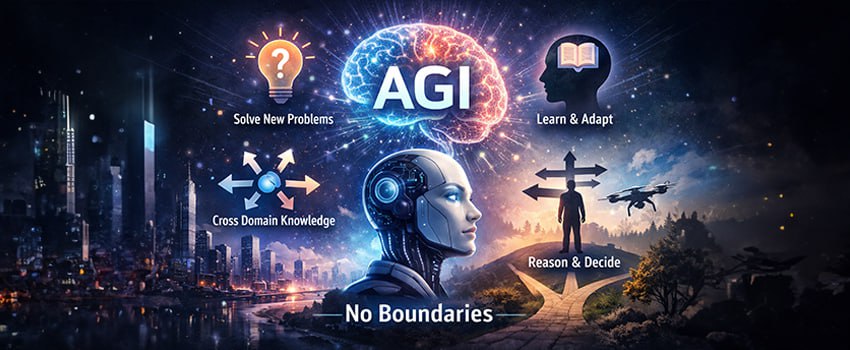
Artificial General Intelligence (AGI) is a theoretical form of AI that can:
- Understand new problems
- Learn without being retrained for every task
- Apply knowledge from one area to another
- Reason and make decisions in unfamiliar situations
- Adapt to changing environments
In short, AGI would not just perform tasks — it would understand them.
Today’s AI systems are powerful, but they are narrow. They operate inside predefined boundaries. AGI would operate without those boundaries.
Important to note: True AGI does not exist yet.
AI Today vs. AGI: What’s the Difference?
To understand AGI, you need to understand where we are today.
1. Artificial Narrow Intelligence (ANI) – What We Have Now
All current AI systems fall into this category.
Examples:
- Chatbots
- Recommendation engines
- Fraud detection systems
- Niche forums
- Language translation tools
These systems can be extremely advanced. But they are designed for specific tasks.
They cannot:
- Think independently across domains
- Fully understand context like a human
- Apply broad reasoning outside their training
They are specialists.
2. Artificial General Intelligence (AGI) – The Goal
AGI would not be limited to one function.
It could:
- Write software
- Diagnose medical conditions
- Design products
- Solve scientific problems
- Learn a new field without retraining
And it could switch between these tasks naturally.
Think of AGI as an AI system with human-level cognitive flexibility.
3. Artificial Superintelligence (ASI) – Beyond AGI
Some experts talk about a third stage: Artificial Superintelligence.
This would exceed human intelligence in every domain.
For now, both AGI and ASI remain theoretical.
Why AGI Matters
AGI is not just a futuristic idea. If achieved, it would transform nearly every industry.
Here’s why it’s such a big deal.
1. Solving Complex Global Problems
AGI could help address challenges that require multi-layered reasoning, such as:
- Climate modeling
- Advanced drug discovery
- Global logistics optimization
- Energy efficiency planning
Unlike today’s AI, AGI could connect insights across disciplines.
2. Accelerating Scientific Discovery
AGI could analyze data, form hypotheses, test solutions, and refine strategies — almost like a research team working at digital speed.
This could dramatically shorten innovation cycles.
3. Transforming Business Operations
Imagine AI that can:
- Strategize marketing campaigns
- Write and optimize code
- Analyze legal contracts
- Develop product roadmaps
- Identify market opportunities
All without being confined to a single task.
AGI would function more like a digital executive than a tool.
4. Personalized Education and Healthcare
AGI could adapt to individual learning styles, diagnose medical conditions more holistically, and design personalized treatment plans.
Its ability to reason across different types of data would be a game changer.
Are We Close to AGI?
There is no universal agreement.
Some researchers believe major breakthroughs could happen within the next decade. Others argue that true human-level intelligence is still decades away.
The challenge is not just computing power. It’s understanding how intelligence actually works.
We still don’t fully understand human cognition. Replicating it in machines is extremely complex.
The Biggest Challenges in Building AGI
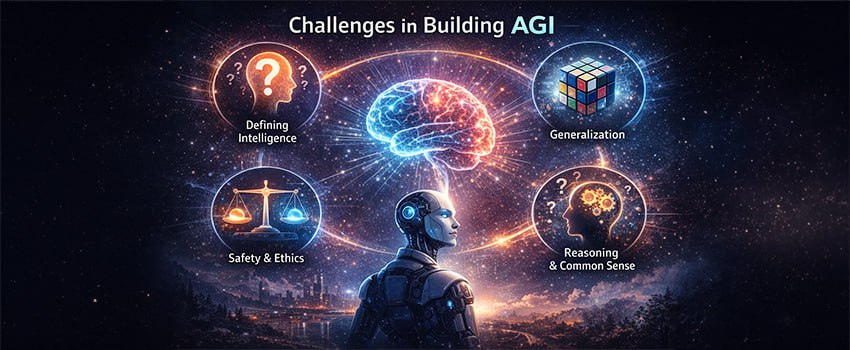
AGI is not just a bigger version of today’s AI. It requires solving deep scientific problems.
1. Defining Intelligence
What does “general intelligence” really mean?
There is no single agreed-upon definition.
2. Generalization
Current AI systems need large datasets and specific training.
AGI would need to learn broadly and transfer knowledge easily.
3. Reasoning and Common Sense
Humans use intuition and context naturally.
Machines struggle with this.
4. Safety and Ethics
If AGI can act autonomously, how do we ensure it aligns with human values?
Questions include:
- Control
- Governance
- Accountability
- Bias
- Economic disruption
These concerns are as important as the technology itself.
What AGI Means for Businesses
Even if AGI is years away, its development is already shaping the AI landscape.
Forward-thinking companies should:
- Understand the difference between narrow AI and generalized AI
- Build flexible AI strategies
- Invest in governance and ethical frameworks
- Focus on long-term adaptability, not short-term hype
Organizations that prepare early will have a strategic advantage.
At Web Dominance, this matters because digital leadership increasingly depends on intelligent systems. Whether AGI arrives in 5 years or 25, businesses that understand its implications will lead the market.
Concluding
Artificial General Intelligence represents one of the most ambitious goals in technology.
It aims to create machines that can think, learn, and adapt like humans — across any intellectual task.
We are not there yet.
But the pursuit of AGI is already reshaping artificial intelligence research, business strategy, and global policy.
The future of AI is not just about smarter tools.
It’s about smarter systems.
And AGI sits at the center of that future.