
For more than twenty years, businesses measured online success through a familiar metric:
Google rankings.
If your content appeared on the first page, you had a chance to attract traffic, generate leads, and grow your business.
Today, a fundamental shift is underway.
Millions of users are no longer browsing search results.
They are asking questions directly to AI systems like ChatGPT, Gemini, Claude, Perplexity, and Google AI Overviews.
For most websites, the answer is increasingly becoming no.
In fact, we believe that over the next few years, as AI-powered search becomes the dominant way people discover information, the majority of content published online will become effectively invisible.
Not because it is poorly written.
Not because it lacks keywords.
But because it was never designed for the way AI systems discover and retrieve information.
At Web Dominance, we call this the AI Visibility Gap.
And businesses that fail to address it risk becoming invisible to the next generation of search users.
The New Search Reality

Traditional search engines worked like libraries.
You searched for a topic.
The engine returned a list of documents.
You selected which result to read.
AI search works differently.
Instead of providing a list of resources, AI systems often provide a direct answer.
To create that answer, they retrieve information from a limited set of trusted sources.
Only a small percentage of available content is actually used.
This creates a winner-take-most environment.
If your content is selected, you gain visibility.
If it is ignored, you disappear from the conversation entirely.
Being indexed is no longer enough.
Being retrieved is what matters.
Why Most Content Was Built for the Wrong Era
The majority of content online was created for search algorithms that rewarded:
- Keyword targeting
- Backlinks
- Search volume
- Publishing frequency
- Content quantity
This produced an explosion of articles that often look like this:
- Generic introductions
- Repeated industry advice
- Rewritten competitor content
- Surface-level explanations
For years, this approach worked reasonably well.
AI systems, however, operate differently.
When a language model evaluates content, it asks a much more important question:
Does this information help answer the user’s question better than everything else available?
Many websites fail that test.
The Content Explosion Problem

Every day, millions of new articles are published.
Now AI-generated content is accelerating production even further.
The internet is becoming flooded with content that says essentially the same thing.
Consider a simple query:
“What is SEO?”
Thousands of websites provide nearly identical definitions.
From an AI perspective, most of these pages are interchangeable.
If ten thousand pages provide the same information, there is little reason to retrieve all ten thousand.
The retrieval system naturally prioritizes the most trusted, relevant, and useful sources.
Everyone else becomes invisible.
This is one of the biggest reasons so much content will disappear from AI search visibility.
It adds no unique value.
Invisible Content Problem #1: No Original Information
One of the fastest ways to become invisible is publishing content that simply repeats existing knowledge.
Many companies still treat content marketing as a volume game.
They publish articles because their competitors have articles.
The result is content without information gain.
Information gain refers to the amount of new knowledge a piece of content contributes.
For example:
Low Information Gain: “SEO helps improve website visibility.“
High Information Gain: “After analyzing 500 SaaS websites, we found that pages with structured FAQ sections received 37% more AI citations than pages without them.“
The second statement contributes something unique.
AI systems increasingly value original information because it cannot be easily replaced.
The future belongs to creators who generate knowledge, not those who recycle it.
Invisible Content Problem #2: Poor Structure
Many websites contain useful information that AI systems struggle to extract.
Large language models do not read websites the way humans do.
They process content in chunks.
They retrieve sections.
They identify patterns.
They extract answers.

If your content is poorly organized, retrieval becomes difficult.
Common problems include:
- Massive blocks of text
- Vague headings
- Missing definitions
- Unclear topic hierarchy
- Hidden answers
When AI systems cannot easily identify key information, they often move on to sources that are easier to understand.
Clarity wins.
Complexity loses.
Invisible Content Problem #3: Weak Entity Signals
AI systems increasingly think in terms of entities.
An entity can be:
- A company
- A person
- A product
- A service
- A concept
The stronger your entity signals, the easier it becomes for AI systems to understand who you are and what you represent.
Unfortunately, many businesses create confusion.
One page says: “We are a digital agency.“
Another says: “We are an AI consulting firm.“
A third says: “We are a growth marketing company.“
From the perspective of an AI model, these mixed signals reduce confidence.
If you want visibility, your identity must be unmistakable.
The internet should consistently answer:
Who are you?
What do you do?
Why are you relevant?
When these answers become clear, AI visibility improves dramatically.
Invisible Content Problem #4: Lack of Topical Authority
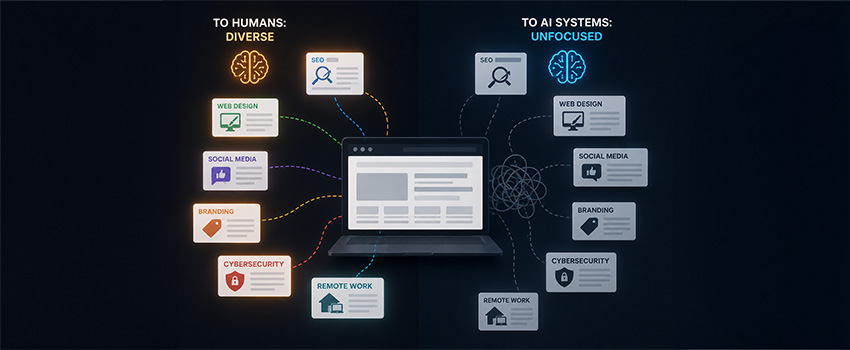
Many websites publish disconnected content.
One article about SEO.
One about web design.
One about social media.
One about branding.
One about cybersecurity.
One about remote work.
To humans, this may seem diverse.
To AI systems, it often appears unfocused.
Authority is increasingly built through topic depth rather than topic breadth.
A website that publishes fifty interconnected articles about AI visibility is more likely to be considered authoritative than a website publishing fifty unrelated topics.
AI systems trust specialists.
Generalists struggle to stand out.
Invisible Content Problem #5: Technical Barriers
Even exceptional content can become invisible if AI systems cannot access it efficiently.
Common technical issues include:
- Slow page speed
- Broken architecture
- Rendering problems
- Poor HTML structure
- Crawl restrictions
- Weak internal linking
- Breadcrumb
Many organizations invest heavily in content while neglecting discoverability.
Content cannot be cited if it cannot be understood.
Technical clarity remains one of the foundations of AI visibility.
Invisible Content Problem #6: No Trust Signals
Trust is becoming the most important ranking factor in AI-powered search.
When AI systems generate answers, they attempt to minimize uncertainty.
Sources that demonstrate credibility naturally receive more attention.
Trust signals include:
- Expert authorship
- Original research
- Case studies
- Industry recognition
- Transparent company information
- Published methodologies
- Verifiable expertise
The more evidence of trust you provide, the easier it becomes for AI systems to select your content.
Trust reduces risk.
And AI systems prefer low-risk sources.
The Shift From SEO to AI Visibility
Many businesses still optimize primarily for rankings.
But rankings are becoming only one piece of the visibility puzzle.
The future requires a broader strategy.
Traditional SEO asks:
“How do I rank higher?”
AI visibility asks:
“How do I become the best answer?”
This subtle difference changes everything.
The websites that dominate AI search are increasingly those that:
- Publish original insights
- Build topical authority
- Create machine-readable content
- Demonstrate expertise
- Strengthen entity recognition
- Earn trust across the web
Visibility is no longer just about search engines.
It is about becoming part of the knowledge layer that powers AI systems.
How to Ensure Your Content Remains Visible

The good news is that AI visibility is not random.
There are clear principles that increase your chances of being discovered and cited.
Create Original Research
Publish:
- Surveys
- Industry studies
- Benchmarks
- Data reports
- Experiments
Unique information creates defensibility.
Write for Retrieval
Structure content with:
- Clear definitions
- Direct answers
- Question-based headings
- Lists
- Frameworks
Help AI find information quickly.
Improve Technical Accessibility
Make sure your website is:
- Fast
- Crawlable
- Structured
- Well-linked
- Machine-readable
Technical friction reduces visibility.
Invest in Authority
Become known beyond your website.
Publish research.
Speak at events.
Contribute insights.
Earn mentions.
Build a recognizable entity.
Authority compounds over time.
The Future Belongs to Visible Knowledge

The internet is entering a new era.
The challenge is no longer creating content.
The challenge is creating content that AI systems can discover, understand, trust, and retrieve.
Most content will fail this test.
Not because it lacks effort.
But because it was built for yesterday’s search ecosystem.
The websites that thrive will be those that recognize a simple reality:
Visibility is no longer guaranteed by publication.
Visibility is earned through clarity, authority, trust, and unique value.
At Web Dominance, we believe businesses must begin preparing now.
Because in the age of AI-powered search, the greatest risk is not ranking lower.
The greatest risk is becoming invisible.
And invisible businesses do not get cited, discovered, or chosen.
The future belongs to organizations that become indispensable sources of knowledge.
Those are the brands AI will trust.
And those are the brands that will dominate the web.