

Search is no longer just about links and rankings. Today, users expect direct answers, not lists of blue links. This shift has given rise to a new discipline: Answer Engine Optimization (AEO).
As AI-powered systems like Google’s AI Overviews, ChatGPT, Bing Copilot, and voice assistants become primary discovery tools, brands must optimize not just to rank—but to be the answer.
This article explains what AEO is, how it works, how it differs from SEO, and how to optimize your content to appear in answer-driven results.
What Is Answer Engine Optimization (AEO)?
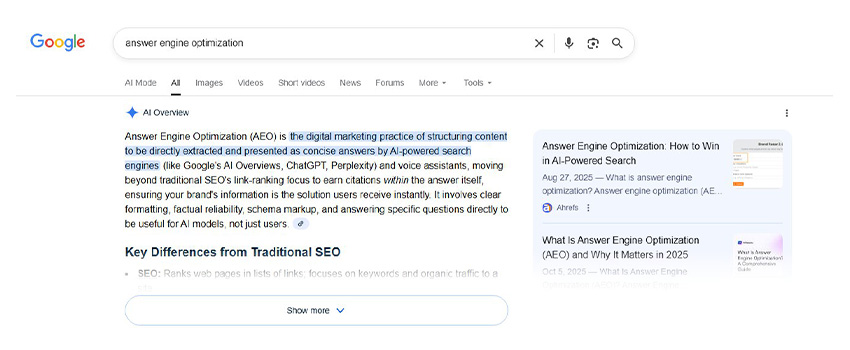
Answer Engine Optimization (AEO) is the practice of optimizing content so that AI-driven search engines and assistants can extract, understand, and present your content as a direct answer to user questions.
Instead of focusing on ranking web pages, AEO focuses on:
- Providing clear, concise answers
- Structuring information for machine comprehension
- Building trust and topical authority
AEO is essential for visibility in:
- AI-generated answers
- Featured snippets
- Voice search results
- Zero-click search experiences
Why AEO Matters Now
User behavior has changed dramatically:
- People ask full questions instead of typing keywords
- AI tools summarize information instantly
- Many searches end without a click
Answer engines prioritize:
- Accuracy
- Clarity
- Authority
- Context
If your content isn’t optimized for answers, it may never be surfaced—even if it ranks well traditionally.
How AEO Works
Answer engines rely on a combination of natural language processing (NLP), entity understanding, and contextual relevance.
Here’s how they evaluate content:
1. Question Understanding
AI systems interpret:
- User intent
- Question structure (what, how, why, when)
- Context and follow-up possibilities
2. Content Extraction
The engine scans content to find:
- Direct, well-structured answers
- Definitions and explanations
- Step-by-step guidance
3. Authority & Trust Signals
Answer engines assess:
- Topical expertise
- Brand mentions and citations
- Content consistency across sources
- Freshness and accuracy
4. Answer Presentation
If selected, your content may appear as:
- A featured snippet
- A voice assistant response
- An AI-generated summary
- A cited source inside an AI answer
AEO vs SEO: What’s the Difference?

Aspect | SEO | AEO |
Primary Goal | Rank pages | Provide direct answers |
Focus | Keywords & links | Questions & intent |
Output | Search listings | AI summaries & responses |
Metrics | Traffic, rankings | Visibility, citations, trust |
Optimization Style | Page-based | Answer-based |
SEO brings users to your content.
AEO brings your content to users.
In 2026 and beyond, successful strategies combine both.
What Types of Content Perform Best for AEO?
Answer engines favor content that is:
- Question-driven (FAQs, how-tos, explainers)
- Well-structured (clear headings, lists, short paragraphs)
- Concise but complete
- Factually accurate and up to date
High-performing formats include:
- FAQ sections
- Step-by-step guides
- Definitions and glossaries
- Comparison articles
- “How does X work?” explanations
How to Optimize Your Content for AEO
1. Write for Questions, Not Keywords
Identify real user questions:
- “What is…”
- “How does…”
- “Why is…”
- “Best way to…”
Then answer them directly and clearly.
2. Put the Answer First
Start sections with a clear, one-paragraph answer before expanding.
Example:
Answer Engine Optimization (AEO) is the process of optimizing content to appear as direct answers in AI-powered search results.
This helps AI extract your content easily.
3. Use Structured Formatting
Make content skimmable and machine-friendly:
- Clear headings
- Bullet points and numbered steps
- Short, focused paragraphs
Avoid walls of text.
4. Build Topical Authority
Answer engines trust brands that:
- Cover topics comprehensively
- Publish consistent, related content
- Demonstrate expertise over time
Think in topic ecosystems, not standalone pages.
5. Add Schema & Structured Data
Use schema markup to help machines understand:
- FAQs
- How-to steps
- Definitions
- Reviews
This increases your chances of being selected as an answer source.
6. Optimize for Conversational Language
Write the way people speak:
- Natural phrasing
- Simple explanations
- Clear logic
This is especially important for voice search and AI chat interfaces.
7. Strengthen Brand Trust Signals
Answer engines rely heavily on trust.
Build it through:
- Brand mentions and citations
- Author expertise
- Transparent sourcing
- Consistent messaging across platforms
Measuring AEO Success
Traditional analytics won’t tell the full story.
Key AEO indicators include:
- Featured snippet appearances
- AI citations and mentions
- Voice search visibility
- Brand inclusion in AI-generated answers
- Increased branded searches
Visibility matters more than clicks in an answer-first world.
AEO and the Future of Search
As AI becomes the primary interface for discovery, Answer Engine Optimization will define digital visibility.
Brands that succeed will:
- Be clear, not clever
- Be helpful, not promotional
- Be authoritative, not noisy
The goal is no longer just to rank—it’s to be trusted as the best answer.
Final Thought
AEO isn’t replacing SEO—it’s evolving it.
By optimizing for answers, context, and trust, you future-proof your content for how people search, ask, and decide in an AI-driven world.
If your content can answer, explain, and guide clearly—AI will find it.