
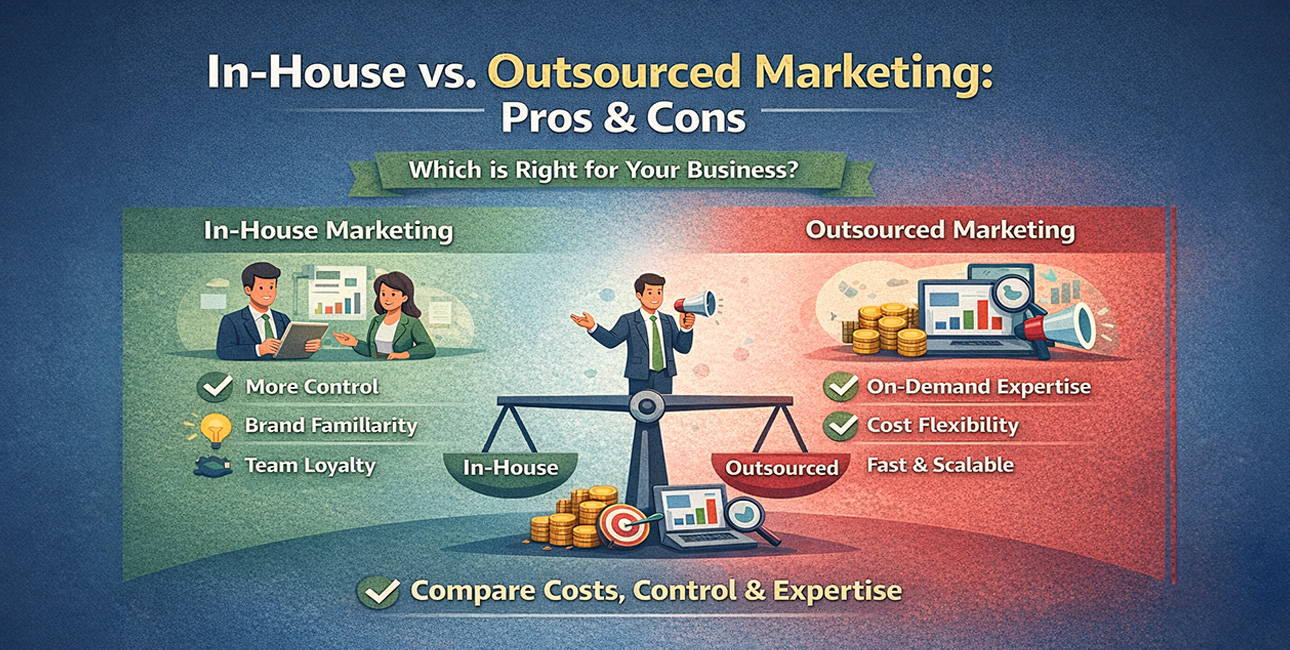
Marketing is essential for business growth — but deciding how to execute it is just as important as deciding what to do. Should you build an in‑house marketing team or hire an external agency? Both models have real benefits and drawbacks around cost, control, expertise, and scalability.
This guide breaks down the key differences, real numbers, and strategic insights to help small and medium businesses make the best choice for their goals — whether you’re launching your brand locally or scaling B2B services online.
1. What “In‑House” and “Outsourced” Marketing Really Mean
In‑House Marketing refers to hiring full‑time employees or internal teams to handle your marketing functions — from content creation to ads and analytics. It gives you direct oversight and team members fully embedded in your business culture.
Outsourced Marketing involves partnering with an external agency or freelance experts to execute your marketing strategy. Outsourcing gives access to specialized professionals without hiring full‑time staff.
Both approaches aim to achieve growth, but they differ significantly in cost, control, and expertise needed to drive results.
2. Pros of In‑House Marketing
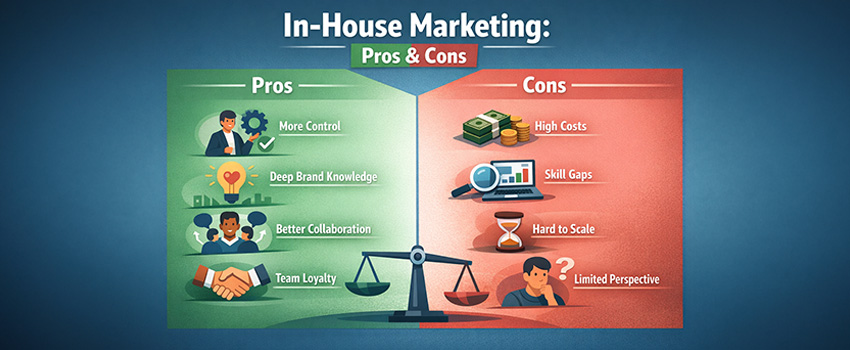
Greater Control and Flexibility
Having marketers on your payroll means decisions can be made quickly and executed immediately without the delays that sometimes come with agency approvals. Communication is direct, and you can pivot instantly based on business needs.
Deep Brand and Business Understanding
In‑house teams work exclusively for your business, which helps them absorb your brand voice, internal processes, and customer nuances. This intimate knowledge often results in campaigns that feel highly aligned with your values and objectives.
Enhanced Collaboration Across Departments
Internal teams can work closely with sales, product, and customer success teams, improving alignment across your business and speeding up strategy execution.
Long‑Term Loyalty and Consistency
Full‑time employees are likely to have stronger ownership of your marketing goals and outcomes, leading to continuity over time — which is important for brand consistency and strategic momentum.
3. Cons of In‑House Marketing
Higher Upfront and Ongoing Costs
Building and maintaining a full marketing team is expensive. Consider these typical costs for a small internal marketing department:
- Salaries and benefits: Marketing managers in the U.S. can average $70,000–$110,000/year or more, depending on experience and location.
- Tools and software: Marketing platforms like SEO tools, email automation, analytics, and design software add thousands per year to your budget.
- Recruitment and training: Finding and onboarding the right talent takes time and money.
Collectively, salaries, taxes, benefits, office space, tools, and training can easily push total marketing costs well above $150,000 annually for a small team.
Limited Skill Sets and Bandwidth
Hiring one or two marketers rarely covers all aspects of modern marketing — from SEO and content to paid ads and analytics. In‑house teams may lack depth in specialized areas, which can limit execution quality or require additional hires.
Scalability Challenges
Expanding your marketing efforts means hiring more staff — which takes time and creates onboarding overhead. This isn’t ideal when you need rapid campaign execution or seasonal spikes.
Risk of Insular Thinking
Because in‑house teams are entrenched in one company’s culture, they may lack exposure to fresh ideas and industry trends that outside specialists often bring.
4. Pros of Outsourced Marketing

Access to Specialized Expertise
Outsourcing gives you immediate access to professionals with deep expertise in areas like SEO, paid advertising (PPC), social media strategy, content creation, and analytics — without needing multiple full‑time hires.
A good agency usually offers a team of specialists, which is difficult for small businesses to replicate in‑house without significant investment.
Cost Flexibility and Lower Overhead
With outsourced teams, you only pay for what you need — this removes long‑term overhead costs like salaries, benefits, office space, and software licensing. Smaller businesses can invest strategically rather than committing to fixed payroll expenses.
Depending on geography and scope, outsourced marketing retainers can also be significantly lower than the total cost of an equivalent in‑house team — while still delivering expert execution.
Scalability and Speed
Agencies can scale efforts up or down much faster than hiring new staff. Whether you’re launching a product, entering a new market, or running seasonal campaigns, external partners can deploy resources more rapidly.
Access to Tools and Trends
Marketing agencies often have access to premium tools and stay on top of industry trends, helping deliver competitive strategies without extra cost to your business.
Fresh Perspectives and Innovation
External marketing partners bring ideas from working with different industries and markets, which can spark innovative campaigns and avoid stagnation.
5. Cons of Outsourced Marketing
Less Direct Control
When you outsource, you relinquish day‑to‑day oversight. This can lead to slower decisions if approval processes are complex or not well coordinated.
Communication Barriers
External teams may be in different locations or operate with different workflows, which can create miscommunication or delays if expectations aren’t clearly aligned.
Brand Familiarity Takes Time
Unlike in‑house staff who live and breathe your brand, agencies need time to learn your voice, goals, and audience — requiring an initial investment in onboarding and knowledge transfer.
Risk of Misalignment
If an agency doesn’t fully grasp your market or target audience, their strategies might miss the mark or drift from your core identity. Clear briefings and regular check‑ins are essential.
Potential Dependency on External Partners
Heavily relying on an external agency can be risky if the partnership ends abruptly or performance dips — which would require finding a replacement and undergoing another onboarding cycle.
6. Cost Comparison: In‑House vs. Outsourced Marketing
In‑House Marketing Costs
- Salaries & benefits for a full team (manager, content creator, analyst, designer): often $150,000+ annually for small teams.
- Tools, training, software licenses, and infrastructure add significant ongoing expenses.
- Recruitment and HR overhead.
Outsourced Marketing Costs
- Agencies charge monthly retainers or project‑based fees — often lower than the total cost of maintaining a full in‑house team.
- No benefits, no salaries, no long‑term commitments.
- You still pay for tools and media spend, but the overhead burden is significantly less.
For many SMEs, outsourcing delivers comparable or better outcomes for a fraction of the overall cost of hiring and managing an internal team.
7. Choosing the Right Approach: Key Considerations
Your Budget and Financial Strategy
- If you have the financial capacity to hire and maintain a robust internal team, in‑house may be a strategic long‑term play.
- If your focus is cost efficiency and flexibility, outsourced marketing often delivers superior ROI for SMEs.
Speed to Impact
- Agencies are generally faster to execute campaigns due to existing workflows and specialist teams.
- In‑house teams might take longer to ramp up, but offer faster internal tweaks once established.
Expertise Demand
- If your marketing requires advanced skills across multiple channels (SEO, PPC, analytics), outsourcing gives breadth without hiring multiple full‑timers.
- If your strategy hinges on deep brand understanding and consistent voice, keeping part of it in‑house is invaluable.
Control and Company Culture
- In‑house allows tighter control and integration with company values, but outsourcing offers fresh perspectives and broader innovation.
Many companies adopt a hybrid model — keeping strategic oversight and brand narratives internal, while outsourcing specialized execution (e.g., technical SEO, paid ads, creative campaigns) for better performance and cost‑efficiency.
8. How Web Dominance Can Help You
Making the right choice about marketing structure is challenging — and the wrong decision can waste time, money, and momentum. That’s where Web Dominance comes in.
Web Dominance specializes in helping SMEs analyze their marketing needs and implement the optimal blend of in‑house and outsourced strategies to accelerate growth. Whether you want:
- Strategic direction and oversight while keeping core branding in‑house,
- Full outsourced execution via an expert team of SEO, content, ads, and analytics professionals,
- Or a hybrid approach tailored to your budget and goals
Web Dominance delivers data‑driven plans, execution, and ongoing optimization so you get measurable results — without the overhead of recruiting, training, or managing a full internal team. They help you stay ahead of trends, access top marketing tools, and implement campaigns that move the needle.
To explore what model fits your business and how to scale it intelligently, Web Dominance can provide the expertise and support you need to win online.
Conclusion
Choosing between in‑house and outsourced marketing isn’t a one‑size‑fits‑all decision. If you prioritize control, brand intimacy, and deep internal collaboration, building your own team can pay dividends. But if your goal is cost efficiency, specialized expertise, fast execution, and scalability, outsourcing marketing can be more effective — especially for SMEs with tight resources.
Many successful businesses blend both models: maintaining strategic oversight in‑house and working with outside experts for execution and specialized skills.
Whatever path you choose, aligning it with your budget, business goals, and growth timeline is critical. Partnering with an experienced provider like Web Dominance can help you achieve the right balance, avoid costly missteps, and drive sustainable growth in a competitive digital landscape.