

Every marketer knows content matters — but not every marketer knows how to measure whether that content is working.
A content audit isn’t just a nice-to-have; it’s a strategic tool that reveals what’s performing, what’s outdated, and what’s holding your site back from higher rankings, engagement, and conversions. This guide walks you through how to audit your content like a pro — with a modern approach that reflects 2026 search trends, AI-driven rankings, and user expectations.
What Is a Content Audit and Why It Matters
A content audit is a structured review of all the content on your website — blogs, service pages, landing pages, FAQs, resources, and more — to assess:
- Quality and relevance
- SEO performance
- Engagement and conversions
- Alignment with business goals
The goal is to uncover weaknesses and opportunities, so you can decide:
- What to keep
- What to update
- What to merge or consolidate
- What to remove entirely
This is about maximizing the impact of your existing content, reducing waste, and giving priority to assets that drive authority and revenue.
Step 1 — Define Your Goals & Scope
Start with clarity:
1.1. Align With Business Objectives
Are you auditing to:
Boost organic traffic?
Improve conversions on key landing pages?
Clean up outdated blog posts?
Reposition content to match updated search intent?
Define measurable goals like:
- Increase organic sessions by 20%
- Reduce thin content by 30%
- Improve conversion rate on landing pages by 15%
Clear goals determine what data you collect and how you act on it.
1.2. Decide the Scope
You might audit:
- Your whole domain
- Only blogs
- Only money pages (like landing pages or conversion pages)
For large sites, start with high-impact sections — high-traffic or revenue-critical pages — then expand.
Step 2 — Build Your Content Inventory

This is your roadmap.
Create a spreadsheet (Google Sheets, Airtable, Excel) listing:
- URL
- Content type (blog, landing page, FAQ, etc.)
- Title and meta description
- Publish and last updated dates
- Word count
- Performance metrics (traffic, rankings, engagement)
Tools to help:
- Screaming Frog (site crawl)
- Google Analytics 4 (traffic & engagement)
- Google Search Console (search performance)
- Ahrefs or SEMrush (backlinks, keyword rankings)
Step 3 — Collect Performance Data
For every URL in your inventory, gather key metrics:
SEO Metrics
- Impressions and clicks
- Keyword rankings
- Backlinks and referring domains
Engagement Metrics
- Page views
- Bounce rate
- Time on page
- Pages per session
Conversion Metrics
- Form submissions
- Sign-ups
- Purchases (if applicable)
Tools like GA4 and Search Console help you gather this data, letting you spot:
- High traffic but low engagement
- High impressions with low CTR
- Pages with no traffic at all
Step 4 — Evaluate Content Quality

Now that you have data, it’s time for judgment.
4.1. SEO & Structure
Check:
- Title tags and meta descriptions for keyword alignment
- Heading structure (H1, H2, H3) for clarity
- Internal linking health (no orphan pages)
4.2. Content Relevance
Ask:
- Is this content still accurate?
- Does it match the current search intent?
- Does it serve your target audience?
4.3. Experience & Value
Quality content in 2026 must demonstrate experience, expertise, authority, and trustworthiness — often abbreviated as E-E-A-T. Confirm that content:
- Uses real insights or examples
- Links to authoritative sources
- Includes credible authorship
This is critical not just for SEO but also for AI-driven search environments.
Step 5 — Categorize & Prioritize Content
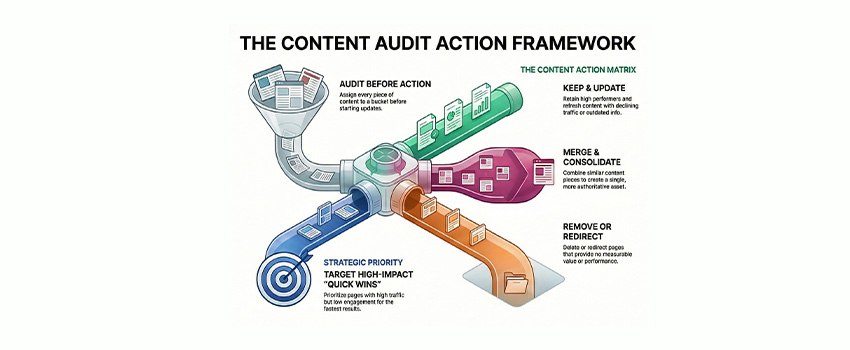
Once reviewed, assign each piece to one of four buckets:
Start with high-impact updates — pages with traffic but low engagement — as these often yield the fastest wins.
Step 6 — Build an Action Plan
A content audit without action is just an audit — not a strategy.
Create a Roadmap
- List tasks by priority
- Set deadlines
- Assign owners
Use tools like Trello, Asana, or Notion to track progress.
Examples of Actions
- Update outdated blog posts
- Optimize metadata with current target keywords
- Improve readability and add visuals
- Merge overlapping posts into comprehensive guides
- Implement 301 redirects for removed content
Regular monitoring after changes helps measure impact and keep momentum going.
Step 7 — Review Technical & User Experience Elements
A thorough audit also checks:
- Page speed and Core Web Vitals
- Mobile usability
- Schema markup
- Broken links and 404s
Fixing these enhances both user experience and search performance. Technical and UX issues often hurt engagement even when content is good.
Step 8 — Optimize for Modern Search (AI + Intent)
SEO isn’t just keywords anymore. AI-driven search engines prioritize:
- Relevance to user intent
- Topic completeness
- Context and answers depth
So when auditing content:
- Identify content that doesn’t fully answer common questions
- Add section headers that match user search queries
- Incorporate multimedia and structured data
- Ensure conversational phrasing for voice/AI search
This future-proofs your content beyond traditional SEO tactics.
Make Audits Regular, Not One-Time
Content decays over time as algorithms, intent, and business goals evolve.
Best practice:
- Quarterly mini audits
- Annual full audits
- Monthly performance monitoring
This ensures your content stays fresh, relevant, and aligned with your strategy.
Turn Content Into a Strategic Asset
A professional content audit does more than clean house — it reveals insight that shapes your entire content strategy.
By combining data, human judgment, strategic categorization, and ongoing action, you:
- Improve SEO and user experience
- Boost engagement and conversions
- Strengthen brand authority
- Drive smarter content investments
Content is one of your most valuable digital assets — treat it that way.