

For more than two decades, businesses competed for visibility in traditional search engines. The goal was simple: rank on the first page of Google, attract clicks, and convert visitors into customers.
Today, a new layer has emerged between users and websites.
Instead of browsing ten search results, people increasingly ask questions directly to AI systems such as ChatGPT, Google AI Overviews, Gemini, Claude, and Perplexity. These platforms synthesize information, generate answers, and often cite only a handful of sources.
This shift introduces a new challenge for brands:
How do you become one of the sources AI trusts enough to cite?
The answer is not a secret algorithm, a technical trick, or a single optimization tactic.
Becoming a trusted source for large language models (LLMs) requires building authority, publishing verifiable information, creating content that is easy for AI systems to understand, and establishing a reputation that extends beyond your website.
At Web Dominance, we call this the evolution from SEO to AI Visibility.
The brands that understand this shift early will own a disproportionate share of visibility in the years ahead.
Understanding How LLMs Choose Sources
Before discussing optimization strategies, it’s important to understand how modern AI systems generate answers.
Unlike traditional search engines that rank pages and present links, LLM-powered systems often retrieve information from multiple sources, evaluate relevance and credibility, and then synthesize a new response.
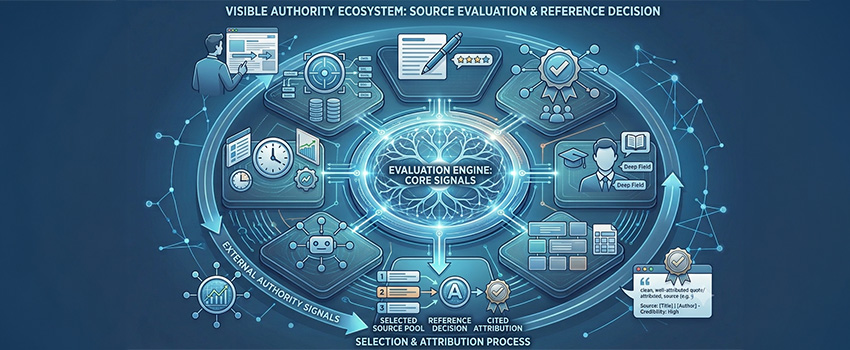
When AI search systems decide which sources to reference, they typically evaluate factors such as:
- Topical relevance
- Content quality
- Credibility signals
- Author expertise
- Structured information
- Freshness
- Accessibility to crawlers
- External authority signals
Research and industry observations consistently show that content quality, structure, authority, and discoverability play a significant role in whether a source is selected and cited by AI systems.
This means that visibility is no longer just about rankings.
It is about becoming the most trustworthy answer.
Trust Is the New Ranking Factor
Traditional SEO focused heavily on keywords.
AI visibility focuses heavily on trust.
When a language model chooses a source, it is effectively making a judgment:
“Is this information reliable enough to help answer the user’s question?“
That judgment is influenced by numerous signals.
The more evidence you provide that your content is accurate, authoritative, and useful, the more likely your content becomes part of the AI’s answer-generation process.
Trust is built through multiple layers.
Your content should demonstrate genuine subject matter expertise.
Generic articles generated solely to target keywords rarely become trusted sources.
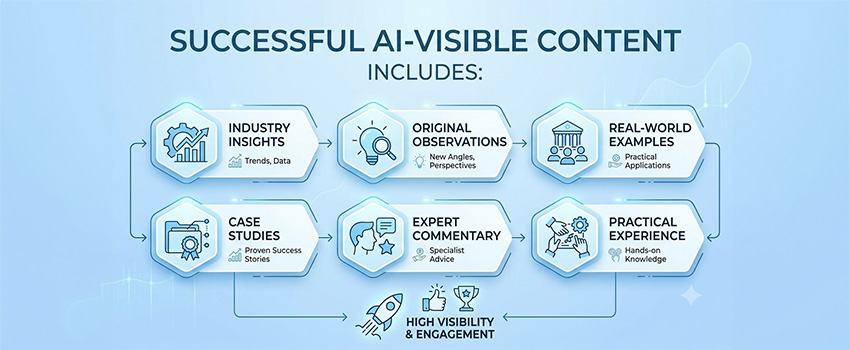
Instead, successful AI-visible content often includes:
- Industry-specific insights
- Original observations
- Real-world examples
- Case studies
- Expert commentary
- Practical experience
The goal is not to repeat what everyone else says.
The goal is to contribute something meaningful.
Create Information Gain, Not Content Volume
One of the biggest mistakes businesses make is publishing content that adds nothing new.
Many websites publish articles that simply rephrase existing information.
AI systems already have access to thousands of versions of the same advice.
Why would they choose yours?
To become a trusted source, your content must create what many AI visibility experts call information gain.
Information gain means providing:
- Original research
- Proprietary data
- Internal studies
- Survey results
- Industry benchmarks
- Unique frameworks
- First-hand experience
For example:
Instead of writing:
“SEO is important for online visibility.“
Publish:
“After analyzing 350 SaaS websites, we found that pages with dedicated FAQ sections were cited 42% more often in AI-generated answers.“
The second statement creates new value.
Unique information is significantly more likely to be cited because it cannot be easily replaced by another source.
Build Topical Authority Instead of Isolated Articles
Many companies still treat content as individual pieces.
Modern AI systems increasingly evaluate expertise at the topic level.
A single article about AI search optimization is useful.
An entire ecosystem of content covering:
- AI search
- Generative Engine Optimization (GEO)
- AI citations
- Structured data
- Semantic search
- Content architecture
- Authority building
signals deep expertise.
This is called topical authority.
Topical authority develops when your website becomes a comprehensive resource within a specific subject area.
Rather than publishing random content, build topic clusters that demonstrate depth.
Over time, AI systems begin to associate your brand with expertise in that category.
Structure Content for Extraction
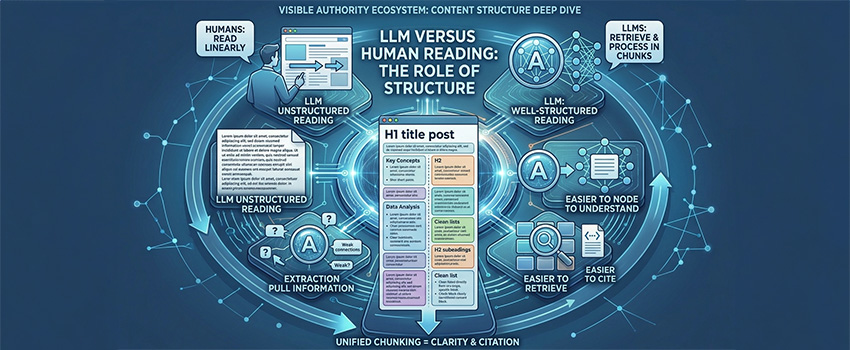
One of the most overlooked aspects of AI visibility is content structure.
LLMs don’t read websites the same way humans do.
They retrieve passages, evaluate sections, and extract information in chunks.
Well-structured content is easier to understand, retrieve, and cite.
Best practices include:
Answer Questions Directly
Start sections with concise answers.
Instead of making readers search for the answer, provide it immediately.
Example:
What is Generative Engine Optimization?
Generative Engine Optimization (GEO) is the process of improving a website’s visibility in AI-generated answers by making content easier for language models to discover, understand, and cite.
Then expand with details.
This structure creates citation-ready content.
Use Clear Headings
Question-based headings help AI systems identify content relevance.
Examples:
- What Is AI Visibility?
- How Do LLMs Select Sources?
- Why Do Some Websites Get Cited More Often?
These headings mirror user intent.
Use Lists and Tables
Structured information is easier to extract than long walls of text.
Where appropriate, organize information into:
- Bullet points
- Numbered steps
- Comparison tables
- Frameworks
Demonstrate Human Expertise
One of the strongest trust signals is demonstrating that real experts are behind the content.
Include:
- Author names
- Professional credentials
- Industry experience
- Linked profiles
- Editorial standards
Anonymous content creates uncertainty.
Expert-authored content creates confidence.
Many AI visibility studies have found strong correlations between author transparency and citation likelihood.
Invest in Technical Accessibility
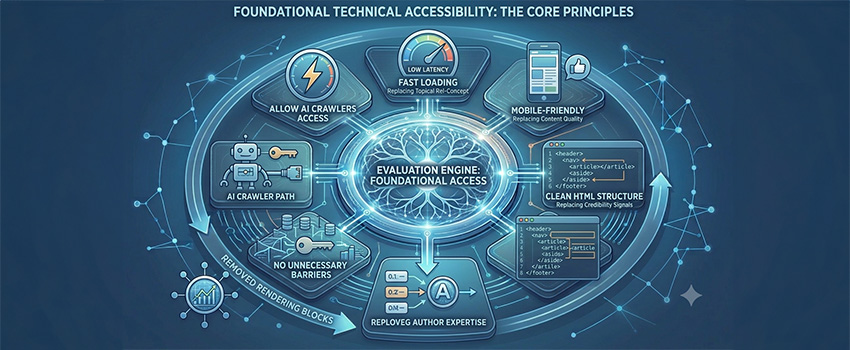
Even the best content cannot be cited if AI systems cannot access it.
Technical accessibility remains foundational.
Your website should:
- Load quickly
- Be mobile-friendly
- Use clean HTML structure
- Avoid unnecessary rendering barriers
- Allow AI crawlers access
Some AI systems use dedicated crawlers and retrieval mechanisms to discover content. Blocking these systems can reduce visibility opportunities.
Technical SEO is no longer just for search engines.
It is infrastructure for AI visibility.
Strengthen Your Entity Presence Across the Web
Trust does not come only from your website.
AI systems increasingly evaluate brands as entities.
They look for consistency across multiple sources.
This includes:
- Industry publications
- News mentions
- Podcasts
- Research citations
- Business directories
- Social profiles
- Conference appearances
The more frequently your brand appears in credible contexts, the stronger your authority signals become.
Think of authority as a network.
Your website is one node.
Every credible mention strengthens the entire graph.
Publish Original Research Regularly
If there is one tactic that consistently improves citation potential, it is original research.
Research creates assets that other people reference.
Examples include:
- Industry surveys
- Benchmark reports
- Trend analyses
- Performance studies
- Market research
These resources become citation magnets.
AI systems often prefer concrete data points because they help ground generated answers in evidence.
Instead of competing for opinions, compete for facts.
Keep Content Fresh
AI systems increasingly prioritize recent and updated information, especially in rapidly changing industries.
An outdated article signals uncertainty.
A regularly maintained resource signals reliability.
Develop a content refresh process:
- Update statistics
- Replace outdated examples
- Add new research
- Expand sections
- Improve clarity
Fresh content is more likely to remain competitive in AI retrieval systems.
Build Brand Authority Beyond Search
The future belongs to recognizable brands.
A website may rank because of optimization.
A brand gets cited because it is trusted.
Invest in:
- Thought leadership
- Industry partnerships
- Public speaking
- Podcasts
- Research initiatives
- Expert interviews
When people trust your brand, AI systems receive stronger signals that your content deserves attention.
Authority compounds.
The Future of AI Visibility
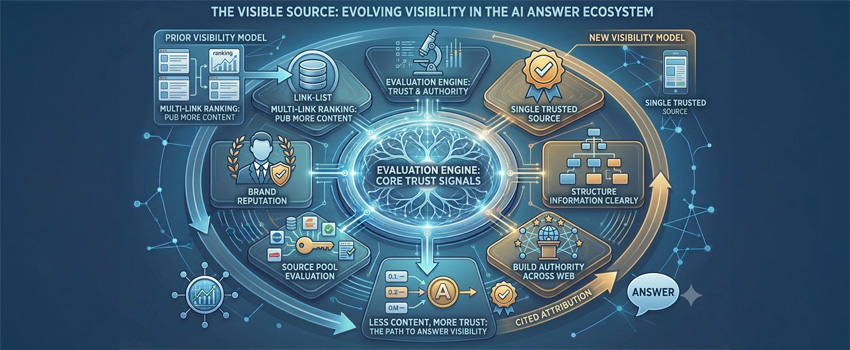
The internet is entering a new phase.
Users increasingly receive answers directly from AI systems rather than browsing lists of links.
In this environment, visibility is no longer about ranking pages.
It is about becoming the source behind the answer.
The brands that succeed will not be those that publish the most content.
They will be the brands that publish the most trustworthy content.
They will create original research.
They will demonstrate expertise.
They will structure information clearly.
They will build authority across the web.
And most importantly, they will focus on helping users rather than manipulating algorithms.
At Web Dominance, we believe this is the future of digital growth.
Search rankings may fluctuate.
Algorithms may change.
But trust remains the most durable competitive advantage.
The goal is no longer to rank.
The goal is to become the source that AI cannot afford to ignore.