
For years, websites were built primarily for two audiences:
- Humans
- Search engines
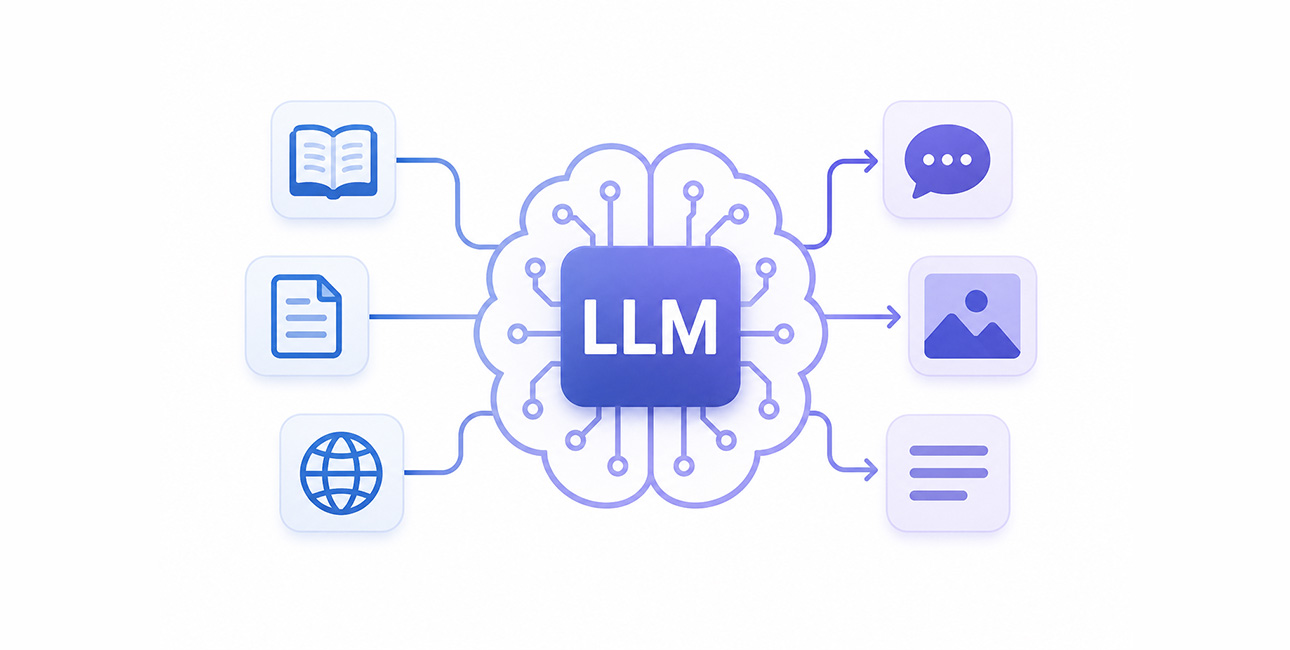
Today, there is a third audience that many businesses still overlook: Large Language Models (LLMs).
Platforms like ChatGPT, Gemini, Claude, Perplexity, Copilot, and AI-powered search engines are becoming the first stop for millions of users looking for answers, recommendations, and solutions.

When someone asks an AI system:
“What is the best AI visibility agency?”
“How does Generative Engine Optimization work?”
“Which companies specialize in AI search optimization?”
The AI must decide which sources it understands, trusts, and can confidently cite.
The problem?
Most websites are designed for human visitors but are surprisingly difficult for AI systems to interpret.
The websites that dominate AI search are not necessarily the ones with the most backlinks or the highest traffic.
They are often the websites that communicate information in the clearest possible way.
At Web Dominance, we call this LLM-Readable Architecture.
The goal is simple:
Build a website that an AI system can understand within seconds.
How LLMs Actually Read Your Website
Most website owners imagine AI systems reading pages the way humans do.
That isn’t what happens.

When an LLM accesses a website, it typically:
- Extracts page content
- Breaks it into chunks
- Identifies entities and relationships
- Determines topical relevance
- Retrieves relevant sections when answering questions
In many cases, the model never sees the page exactly as a human sees it.
It sees structured pieces of information. Those pieces become part of retrieval systems, embeddings, vector databases, and answer-generation pipelines.
This means your website must communicate meaning efficiently.
The easier your content is to parse, the easier it becomes to cite.
The New Goal: Instant Comprehension
Think about introducing yourself to someone at a networking event.
You have 10 seconds.
Would you say:
“We provide innovative digital transformation solutions leveraging next-generation methodologies.“
Or:
“We help businesses become visible in AI search engines like ChatGPT, Gemini, and Perplexity.“
The second statement wins.
Humans appreciate clarity.
AI systems require it.
The same principle applies to websites.
Every important page should immediately answer:
- Who are you?
- What do you do?
- Who do you help?
- What problem do you solve?
- Why should someone trust you?
When these answers are obvious, AI systems build confidence in your content.
Create a Clear Entity Identity
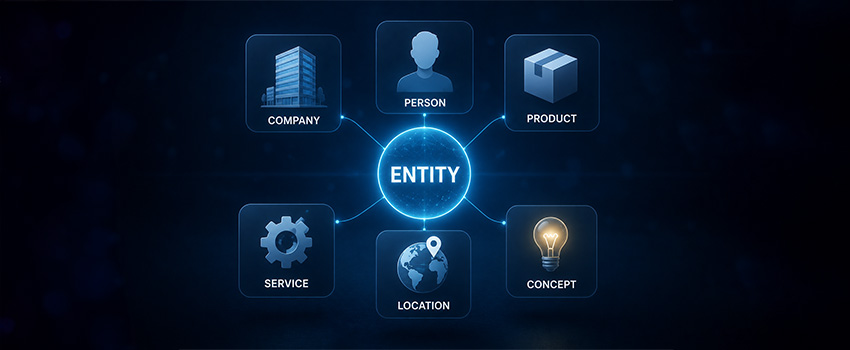
One of the most important concepts in AI visibility is the idea of an entity.
An entity is a recognizable thing:
- A company
- A person
- A product
- A service
- A location
- A concept
AI systems attempt to understand websites through entities and relationships.
If your website sends mixed signals, the model becomes less confident.
For example:
Page A says:
“Web Dominance is an SEO agency.“
Page B says:
“Web Dominance is an AI consulting company.“
Page C says:
“Web Dominance is a digital marketing platform.“
Now the model is confused.
Instead, your entity definition should remain consistent across every important page.
Example:
Web Dominance is an AI Visibility agency that helps businesses become discoverable and cited in AI-powered search systems including ChatGPT, Gemini, Claude, and Perplexity.
Repeat this message consistently.
Entity clarity dramatically improves AI understanding and retrieval confidence.
Build Every Page Around One Core Topic
Many websites fail because they try to cover everything on a single page.
Humans may tolerate this.
AI systems struggle with it.
A page should answer one primary question.
For example:
Good
“What Is Generative Engine Optimization?“
Bad
“Generative Engine Optimization, SEO, PPC, Branding, Social Media, Analytics, and Website Design“
The more focused the page, the easier it becomes for AI retrieval systems to match it to relevant user queries.
Think of every page as a single knowledge asset.
Structure Content Like an Answer
One of the biggest differences between traditional content and AI-optimized content is structure.
AI systems love content that mirrors how they generate answers.
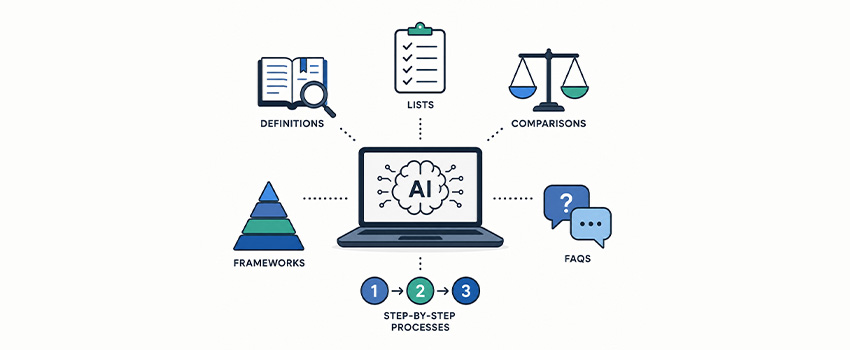
That means using:
- Definitions
- Lists
- Comparisons
- Frameworks
- FAQs
- Step-by-step processes
Instead of writing:
“Many businesses are becoming interested in AI search optimization because search behavior is changing rapidly.“
Write:
AI search optimization is the process of improving a website’s visibility in AI-generated answers.
Then expand.
Lead with the answer.
Explain afterward.
This format makes information highly extractable and citation-friendly.
Make Your Headings Do the Work
Headings are no longer just design elements.
They are navigation systems for AI.
A good heading communicates exactly what follows.
Instead of:
Our Approach
Use:
How AI Search Engines Choose Sources
Instead of:
Benefits
Use:
Why AI Visibility Matters for Business Growth
Question-based headings often perform exceptionally well because they mirror how users interact with AI systems.
Think of headings as retrieval signals.
Design Content for Chunking
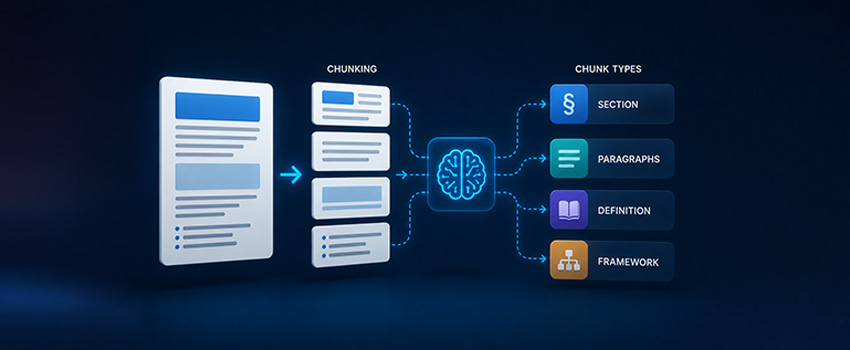
Modern AI retrieval systems typically divide content into smaller chunks before processing it.
A chunk may contain:
- A section
- A few paragraphs
- A definition
- A framework
If a section only makes sense when read with five previous sections, retrieval becomes harder.
Every section should stand on its own.
Bad example:
“Another important factor is this.“
Good example:
“Structured data helps AI systems identify entities, relationships, and content types.“
The second sentence works independently.
That’s exactly what retrieval systems prefer.
Prioritize Semantic HTML
Many modern websites sacrifice clarity for visual effects.
Heavy JavaScript frameworks, excessive animations, and complex rendering pipelines can create problems for AI crawlers.
Some retrieval systems have limited JavaScript execution capabilities, while others prefer clean HTML.
Best practices include:
- One H1 per page
- Logical H2 and H3 hierarchy
- Semantic HTML elements
- Descriptive anchor text
- Clean internal linking
The simpler your structure, the easier it is for machines to understand.
Use Structured Data Strategically
Schema markup remains an important layer of machine-readable information.
Useful schema types include:
- Organization
- Article
- FAQ
- Service
- Product
- HowTo
- Breadcrumb
These help define relationships and reduce ambiguity.
However, there is an important nuance.
Many experiments suggest that structure and content quality matter more than schema alone. Schema cannot compensate for weak or unclear content.
Think of schema as reinforcement, not a shortcut.
Add an Executive Summary to Important Pages
One increasingly effective pattern is adding a concise summary near the top of long-form content.
For example:
- LLMs prioritize clarity over complexity.
- One topic per page improves retrieval.
- Structured content increases citation potential.
- Consistent entity definitions build trust.
This helps both users and AI systems quickly understand the page.
The faster comprehension happens, the stronger the visibility potential.
Build a Strong Internal Knowledge Graph
Most businesses think of internal linking as an SEO tactic.
For AI visibility, it becomes a knowledge architecture strategy.
Every important topic should connect logically to related topics.
Example:
AI Visibility
- Generative Engine Optimization
- AI Search Optimization
- Entity SEO
- Structured Data
- Content Architecture
This creates relationship signals that help AI systems understand your expertise.
A website should feel like a connected knowledge base rather than a collection of isolated pages.
Make Trust Visible Everywhere
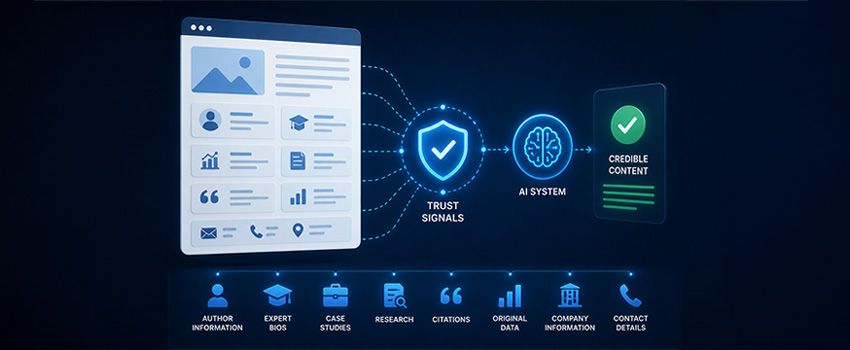
AI systems increasingly evaluate credibility.
Trust signals include:
- Author information
- Expert bios
- Case studies
- Research
- Citations
- Original data
- Company information
- Contact details
The easier it is to verify your expertise, the more likely AI systems are to consider your content authoritative.
Trust is becoming one of the strongest visibility factors in AI-powered search.
The Future Is Machine-Readable Websites
Over the next decade, websites will increasingly serve two audiences simultaneously:
Humans and AI.
The winners will not necessarily be the websites with the most pages.
They will be the websites that communicate knowledge most clearly.
The future belongs to websites that are:
- Easy to discover
- Easy to parse
- Easy to understand
- Easy to trust
- Easy to cite
At Web Dominance, we believe the next evolution of SEO is not simply ranking higher.
It is becoming the source that AI systems understand instantly and trust repeatedly.
Because in the age of AI search, clarity is no longer just a user experience advantage.
It is a visibility advantage.
And the websites that master clarity will dominate the future of the web.