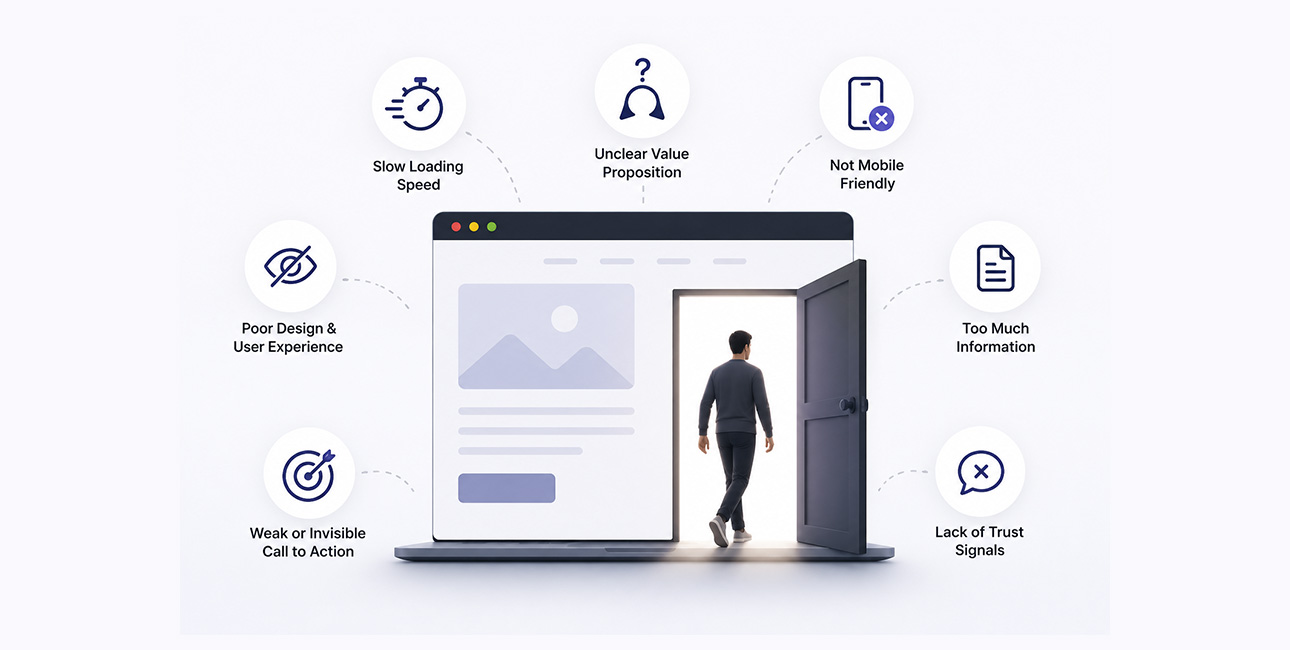
Visitors usually leave a website without converting because they cannot quickly understand the value, find what they need, trust the business, or complete the next step without friction.
The problem is not always traffic. You can attract thousands of visitors, but if the user experience, website speed, messaging, landing page, or conversion path is weak, many of those visitors will leave without contacting you, subscribing, requesting a quote, or making a purchase.
Here are the most common reasons and how to fix them.
The Main Reasons Visitors Leave Without Taking Action
The reasons are often connected. A slow website can create frustration, unclear messaging can create uncertainty, and a confusing conversion path can stop a motivated visitor from taking the next step.
1. The User Experience Creates Friction

A visitor should not have to work hard to understand your website.
If navigation is confusing, service information is buried, mobile pages are difficult to use, or the next step is unclear, visitors may simply leave.
Good UX is not only about making a website look attractive. It is about helping people complete what they came to do.
Google’s page experience guidance recommends looking at the overall experience, including Core Web Vitals, mobile usability, security, intrusive elements, and whether users can easily identify the main content.
For Web Dominance, this connects directly to conversion optimization. Its CRO process focuses on analyzing user behavior and identifying barriers that prevent users from taking action, including confusing navigation and unclear calls to action.
2. Your Website Is Too Slow
Speed can affect the first impression before a visitor even has the opportunity to read your message.
Google’s Core Web Vitals measure loading performance, responsiveness, and visual stability. Its current guidance recommends aiming for an LCP of 2.5 seconds or less, an INP below 200 milliseconds, and a CLS score of 0.1 or less for a good user experience.
A slow website can make visitors feel that the experience will be difficult or unreliable.
Web Dominance also treats speed as part of the broader conversion and user experience process. In its Eazy Canning project, the agency addressed performance alongside clear service pathways, simplified contact forms, and stronger calls to action.
3. Your Messaging Does Not Answer “Why Should I Care?”
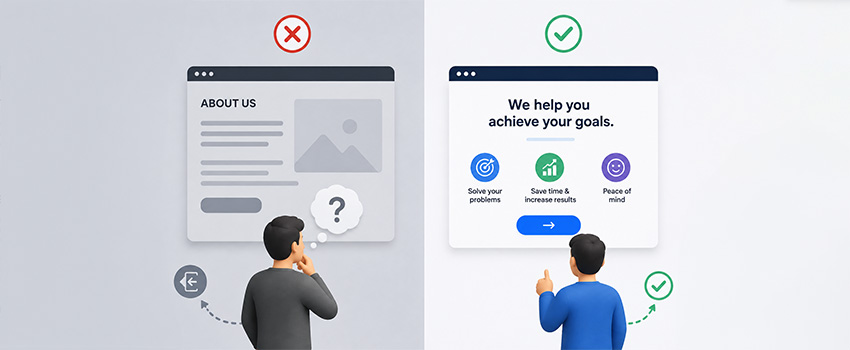
Visitors often leave because the website talks about the company without clearly explaining the value to the customer.
Generic statements such as: “We provide innovative solutions for modern businesses.”
sound professional, but they do not answer important questions:
- What exactly do you offer?
- Who is it for?
- What problem do you solve?
- Why should a customer choose you?
Strong messaging should quickly connect the visitor’s problem with your solution.
Instead of leading with vague marketing language, explain the outcome or benefit as clearly as possible.
For example:
Weak: We provide comprehensive digital solutions.
Clearer: We help businesses improve search visibility, website performance, and conversion rates through SEO, content marketing, and CRO.
The visitor should understand the value of your business within seconds not after scrolling through several sections.
4. Visitors Do Not Know What to Do Next
Even interested visitors may leave if there is no obvious next step.
A website can have excellent design and useful content but still underperform if its calls to action are unclear.
Your CTA should match the page and the user’s intent.
For example:
- Service page: Request a consultation
- Product page: Get a quote
- B2B landing page: Book a discovery call
- Guide: Download the report
“Learn More” is not always wrong, but a more specific CTA can better communicate what happens next.
Web Dominance’s CRO approach includes analyzing the customer journey and optimizing the steps that lead toward the desired action rather than treating conversion as a single button or form.
5. Your Landing Page Does Not Match the Visitor's Intent
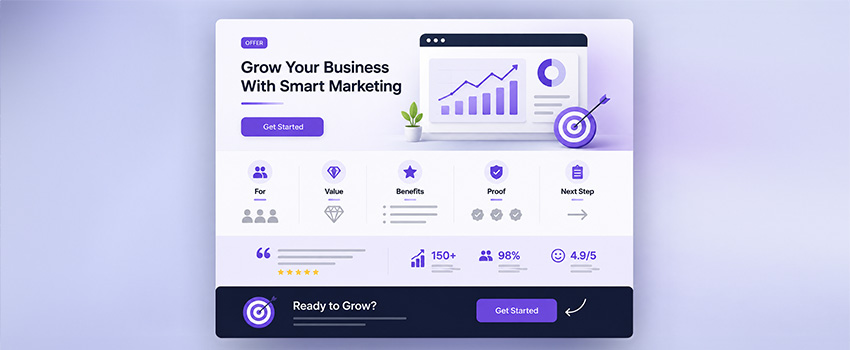
Landing pages should continue the conversation that brought the visitor there.
If someone clicks an ad about a free website audit but lands on a general homepage with ten different services, the connection between the original message and the next step becomes weaker.
A focused landing page should clearly communicate:
- The offer
- Who it is for
- The value
- Supporting proof
- What the visitor needs to do next
This is one reason landing page optimization is an important part of Web Dominance’s CRO service.
In one Web Dominance project, the introduction of purpose-built landing pages contributed to a reported fivefold increase in contact form submissions and qualified B2B inquiries.
6. Your Website Does Not Build Enough Trust
A visitor may understand your offer and still hesitate to act.
This is especially important when the service is expensive, complex, or involves a long-term business relationship.
Trust signals can include:
- Client testimonials
- Case studies
- Measurable results
- Recognizable clients or partners
- Expert insights
- Transparent processes
- Clear contact information
- Reviews or relevant certifications
Web Dominance’s own lead-generation guidance highlights trust signals, testimonials, case studies, fast loading speeds, mobile responsiveness, and simple contact forms as important components of a conversion-focused website.
7. The Conversion Process Requires Too Much Effort
Every additional step creates another opportunity for the visitor to leave.
For example:
High-friction process:
Visit page → navigate to another page → find the contact section → complete a long form → wait for confirmation.
Simpler process:
Visit the relevant page → understand the offer → complete a short form → receive confirmation.
The goal is not always to remove every field or every step. Some businesses need detailed information to qualify leads.
The question is whether every step is necessary.
A data-driven CRO process can help identify where visitors abandon the journey by using analytics, heatmaps, session recordings, and user feedback. Web Dominance specifically uses these methods to identify pain points and conversion barriers.
How CRO Helps Identify Why Visitors Leave
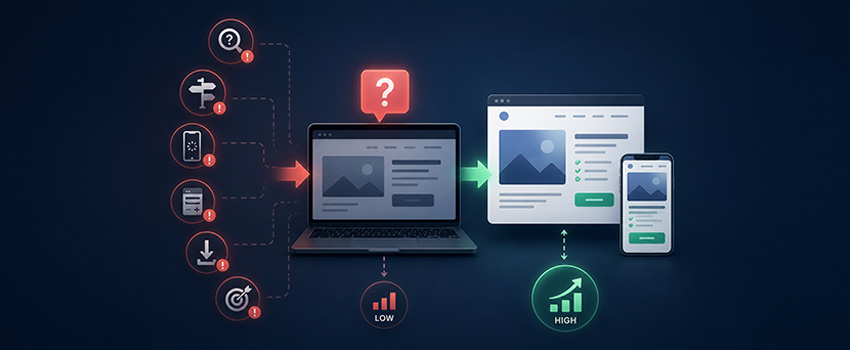
Conversion Rate Optimization is useful because website problems are not always obvious.
A business might assume that it needs more traffic when the real problem is:
- Visitors cannot find the right service
- The value proposition is unclear
- Mobile performance is poor
- A form creates too much friction
- The CTA appears too late
- The landing page does not match search or campaign intent
Web Dominance takes a data-driven approach to CRO, combining behavioral analysis, landing page optimization, performance monitoring, and ongoing testing to improve the customer journey.
A Simple Framework for Improving Website Conversions
Ask these five questions about every important page:
1. Is the purpose immediately clear?
A visitor should quickly understand what the page is about.
2. Is the value easy to understand?
Explain what the visitor gains and why it matters.
3. Can visitors find what they need?
Use clear navigation, headings, and logical content structure.
4. Is the page fast and easy to use?
Monitor real-world performance, responsiveness, and stability. Google’s Search Console and Core Web Vitals resources can help identify technical issues.
5. Is the next action obvious?
Every important page should guide the visitor toward an appropriate next step.
Final Thoughts
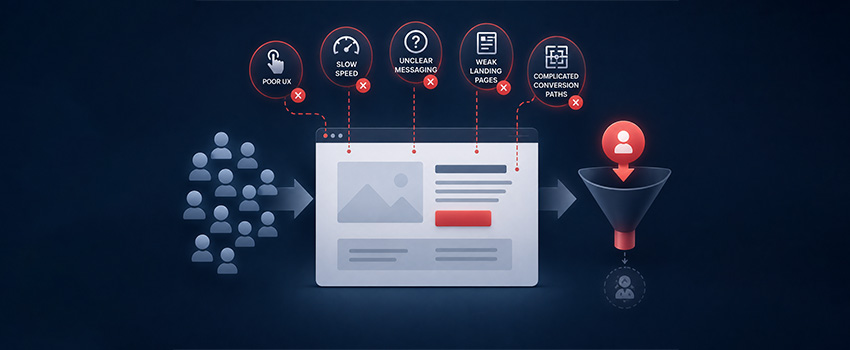
Visitors do not always leave because they are uninterested.
Sometimes, they leave because the website creates uncertainty or friction.
The most common issues—poor UX, slow speed, unclear messaging, weak landing pages, and complicated conversion paths can all prevent valuable traffic from becoming leads or customers.
That is why conversion optimization should work alongside SEO, content, UX, and web design. Getting visitors to your website is only the first step. The next challenge is giving them a clear reason and an easy path to take action.