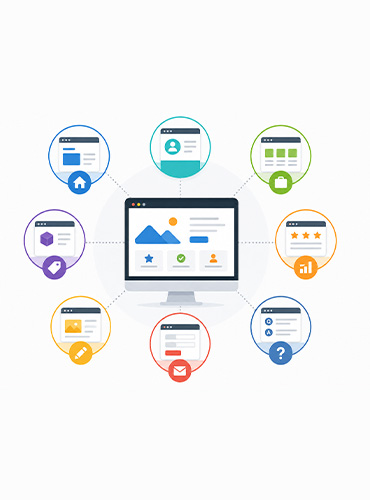
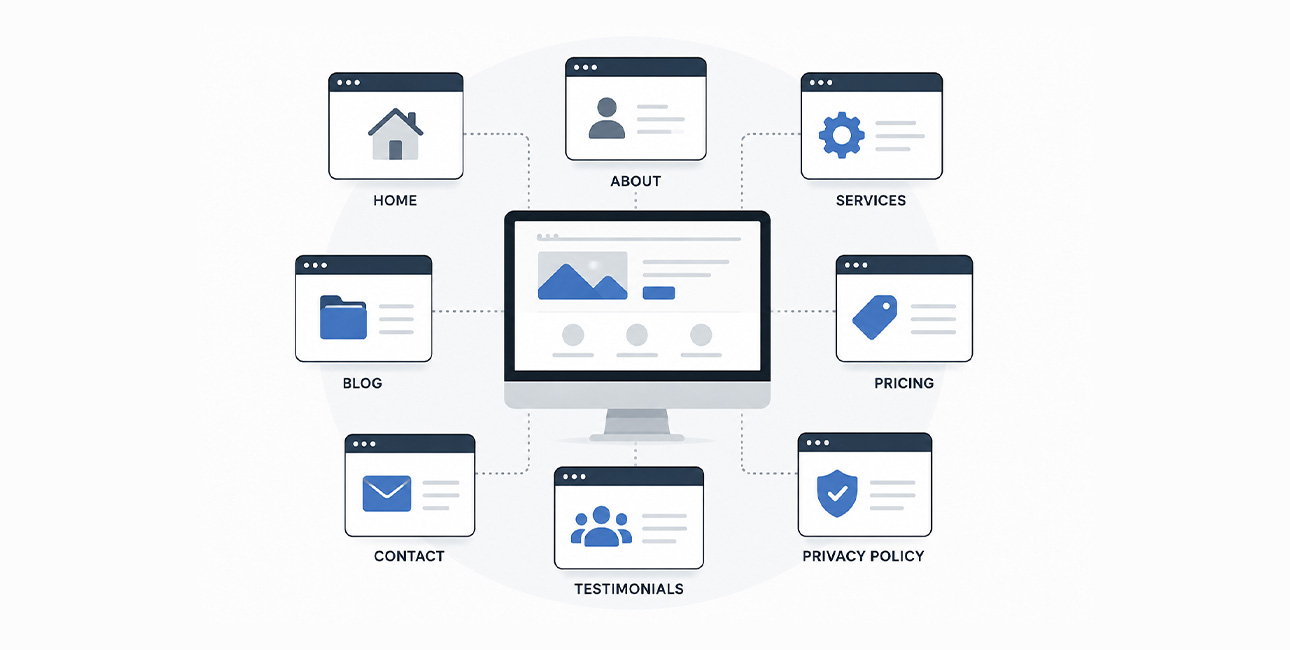
A business website should include the pages that help visitors understand who you are, what you offer, why they should trust you, and what they should do next.
For most businesses, the essential pages are:
- Homepage
- About page
- Services or product pages
- Individual service or product pages
- Case studies or proof pages
- Blog or resources
- Contact page
- FAQ
The exact structure should vary by business model. A local business does not need the same website architecture as a SaaS platform, and an e-commerce store should not organize information in the same way as a professional service company.
The goal is not to create as many pages as possible. It is to create a clear website structure that supports user experience, search visibility, trust, and conversions.
Essential Pages Every Business Website Should Consider
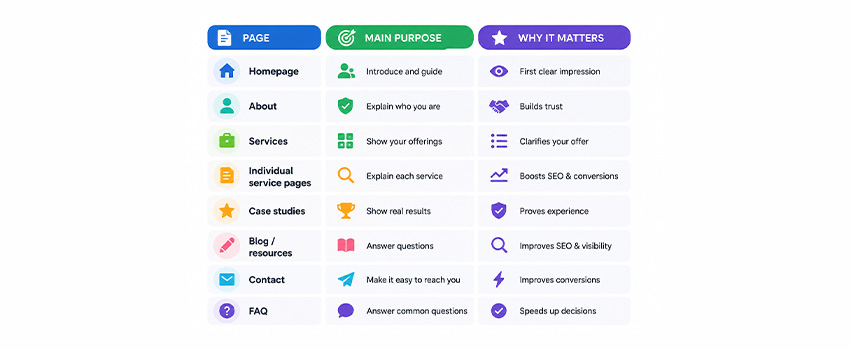
A logical structure and relevant internal links also help search engines discover and understand important pages. Google recommends creating a logical site structure and linking to important pages with concise, relevant anchor text.
Homepage
Your homepage is the central introduction to your business.
It should quickly answer:
- Who are you?
- What do you do?
- Who do you help?
- What makes your business different?
- What should the visitor do next?
A homepage does not need to explain every service in detail. Its main job is to provide a clear overview and guide visitors toward relevant pages.
For example, a digital marketing agency homepage may introduce the company and then direct users toward SEO, content marketing, CRO, case studies, and contact pages.
The Web Dominance homepage follows this broader approach by connecting visitors with the agency’s services, expertise, and next steps.
About Page
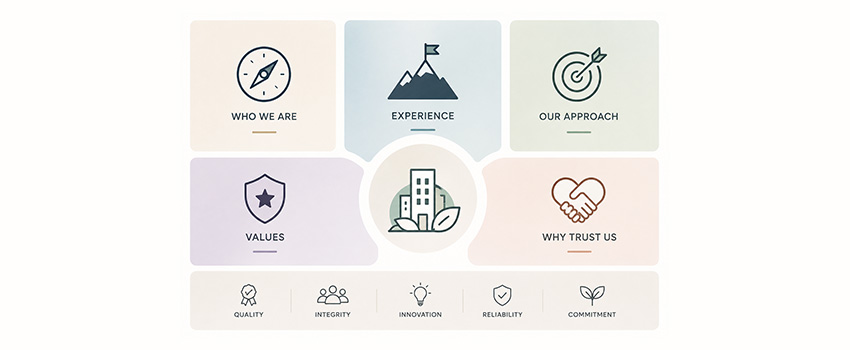
An About page should do more than tell the company’s history.
It should help answer:
- Who is behind the business?
- What experience does the team have?
- What is the company's approach?
- What values or principles guide the work?
- Why should customers trust the business?
For service businesses especially, people often choose the company behind the service—not only the service itself.
Use this page to add real context, experience, and credibility.
Services Page
A main Services page gives visitors an overview of what you offer.
For example, Web Dominance can use a central services structure to introduce areas such as:
- SEO
- Content marketing
- Conversion Rate Optimization
- Other digital marketing solutions
The page should then link to more detailed service pages.
This creates a clearer path:
Homepage → Services → Individual Service → Contact or Conversion
This type of structure can also make the relationships between important pages easier for users and search engines to understand. Google explains that internal links and page relationships help its systems understand site structure and relative page importance.
Individual Service Pages
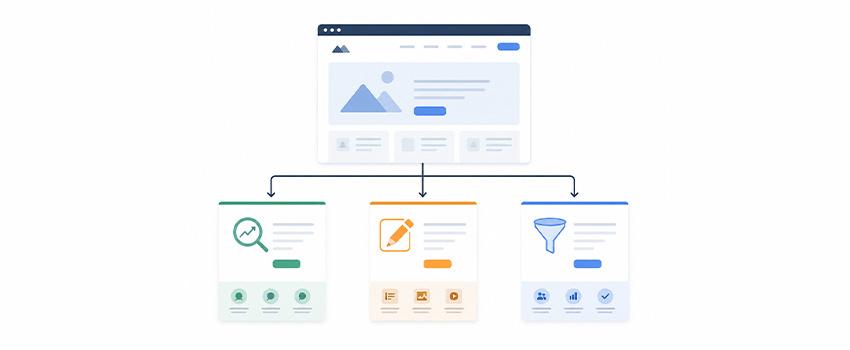
Every important service should usually have its own dedicated page.
Instead of placing everything under one general Services page, create pages that answer the specific questions potential customers have.
For example:
- SEO Services
- Content Marketing
- Conversion Rate Optimization
An individual service page can explain:
- What the service is
- Who it is for
- Which problems it solves
- What the process involves
- What makes your approach different
- Relevant results or examples
- How to get started
This structure gives each service a clear purpose.
Case Studies
Case studies provide evidence that your business can deliver results.
They can include:
- The client's challenge
- The strategy or solution
- The work completed
- Measurable results
- Key lessons or insights
This type of content can support both conversion and trust.
Instead of simply saying “We deliver great results”, a case study gives visitors something more specific to evaluate.
For an agency such as Web Dominance, project and case study pages can demonstrate how different services work in real situations.
Blog or Resources
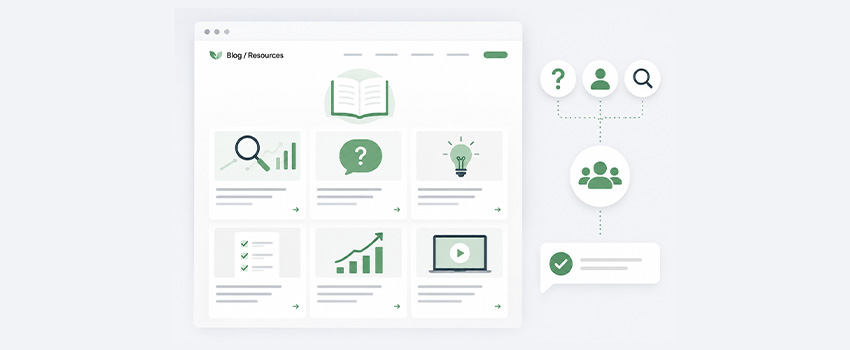
A blog or resource section can help your business answer the questions your audience is already asking.
It can support:
- SEO
- Topical authority
- Customer education
- Internal linking
- AI search visibility
- Trust and expertise
For example, a digital marketing website might build connected content around:
- SEO
- Content marketing
- AEO
- GEO
- AI search
- CRO
- Website UX
- Landing pages
The goal should not be to publish articles simply because a keyword has search volume.
Instead, create helpful resources that connect naturally to your services and expertise.
Google’s guidance emphasizes helpful, reliable, people-first content rather than content created primarily to manipulate search rankings.
Contact Page
A Contact page should make the next step simple.
Depending on the business, it may include:
- Contact form
- Email address
- Phone number
- Office location
- Business hours
- Booking options
- A short explanation of what happens after the inquiry
Do not make visitors search through the entire website to find out how to contact you.
The Contact page should also be accessible through clear navigation and relevant calls to action throughout the site.
FAQ Page
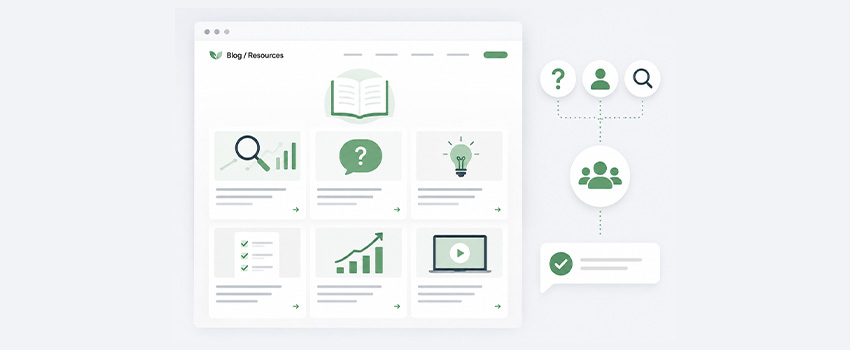
An FAQ section can answer questions that might otherwise stop someone from taking action.
Examples include:
- How does the process work?
- How much does the service cost?
- How long does it take?
- Who is the service for?
- What happens after I contact you?
- Do you work with businesses in my industry?
FAQs can exist on a dedicated page or within relevant service pages.
The most useful approach is usually to place answers close to the service or decision they relate to rather than creating FAQs simply to target every possible keyword variation.
Website Page Structure by Business Type
The right website architecture depends on what your business sells and how customers make decisions.
Service Businesses
A service business should focus heavily on clarity and trust.
A useful structure could be:
- Homepage
- Services
- Individual Service Pages
- Case Studies or Results
- About
- Contact
Individual service pages are especially important because different visitors may arrive with different needs.
Someone searching for SEO services should be able to reach an SEO-focused page rather than having to interpret a general list of everything the company offers.
E-commerce Websites
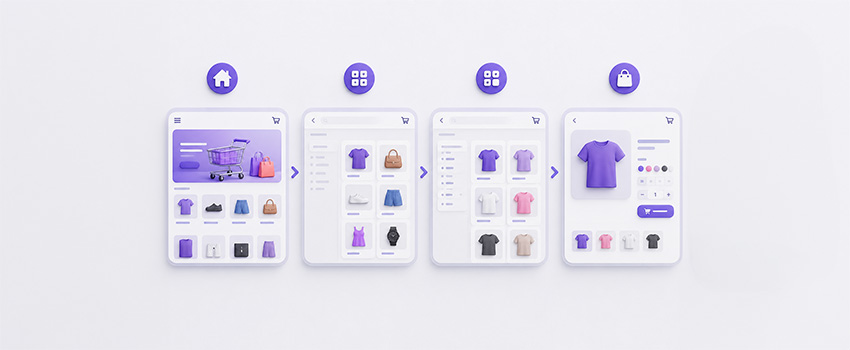
E-commerce websites need a stronger focus on product discovery.
A typical structure might include:
- Homepage
- Categories
- Subcategories
- Product Pages
Additional pages may include:
- Shipping information
- Returns and refunds
- Product guides
- Reviews
- FAQs
- Brand or About page
Google specifically recommends creating crawlable navigation that helps users and search engines move from category pages to subcategories and product pages. Important products should also be reachable through internal links rather than relying only on a site search function.
SaaS Websites
SaaS buyers often need more information before taking action.
A SaaS website may include:
- Homepage
- Product overview
- Features
- Use cases
- Industry pages
- Integrations
- Pricing
- Demo or free trial
- Case studies
- Documentation
- Resources
- FAQ
The structure should support different stages of the buying journey.
A first-time visitor may need to understand the product, while a returning visitor may be looking specifically for pricing, integrations, or proof that the platform works for a particular use case.
Local Businesses
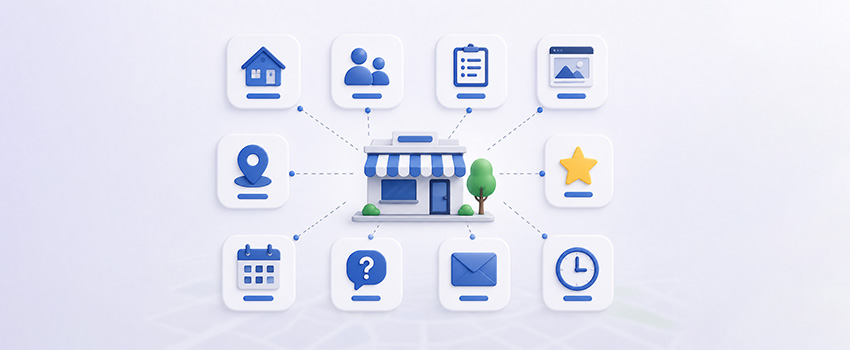
Local businesses should make essential information extremely easy to find.
The core pages may include:
- Homepage
- About
- Services
- Individual service pages
- Contact
- Location or service-area pages
- Reviews
- Booking page
- FAQ
A visitor should not have to search for basic information such as:
- Where are you located?
- Which areas do you serve?
- When are you open?
- How can I book or contact you?
Clear business information can improve both user experience and local search relevance.
How These Pages Work Together

A strong business website is not simply a collection of separate pages.
The pages should support a logical journey.
For example:
Homepage → Service Page → Detailed Service Information → Case Study or Related Resource → Contact or Consultation
Internal links help create these connections.
Google recommends ensuring that important pages are reachable through crawlable links and that anchor text clearly describes the destination.
This is also useful for AI search because a clearly structured website makes it easier for machines to understand the relationship between your services, expertise, resources, and brand.
A Simple Business Website Checklist
- Homepage
- About page
- Main Services page
- Individual pages for important services
- Case studies or proof of work
- Blog or resource hub
- Contact page
- FAQ section
- Clear internal links between related pages
- Relevant calls to action
- Logical navigation
- Mobile-friendly, fast, accessible pages
Final Thoughts
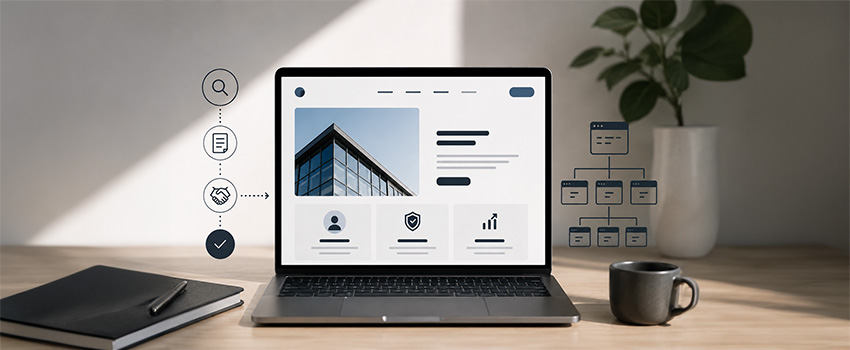
A business website does not need dozens of pages to be effective.
It needs the right pages, organized around what visitors need to know before they can trust your business and take action.
For most companies, the strongest foundation includes a clear homepage, About page, service or product pages, detailed pages for important offers, proof through case studies, helpful resources, a simple contact path, and relevant FAQs.
The exact structure should then adapt to the business model.
A service business may focus on expertise and individual services. An e-commerce website needs a strong category and product architecture. SaaS companies need to explain features, use cases, and pricing. Local businesses must make services, locations, and contact details easy to find.
The same principle applies across all of them: make it easy for people and search systems to understand what your business does and where to find the information they need.