
How to stay visible when search engines answer before users click
Search is changing faster than ever. With Google, Bing, and other platforms increasingly relying on AI-generated snippets, summaries, and answer boxes, traditional SEO tactics focused solely on ranking positions are no longer enough.
According to recent industry analyses, more than 60% of Google searches now end without a click, largely due to featured snippets, knowledge panels, and AI-powered summaries delivering answers directly on the results page.
This article explores how AI-driven snippets work, what they mean for organic traffic, and how businesses can adapt through structured data, FAQ optimization, and user-intent-focused content.
What Are AI-Driven Snippets and Why They Matter
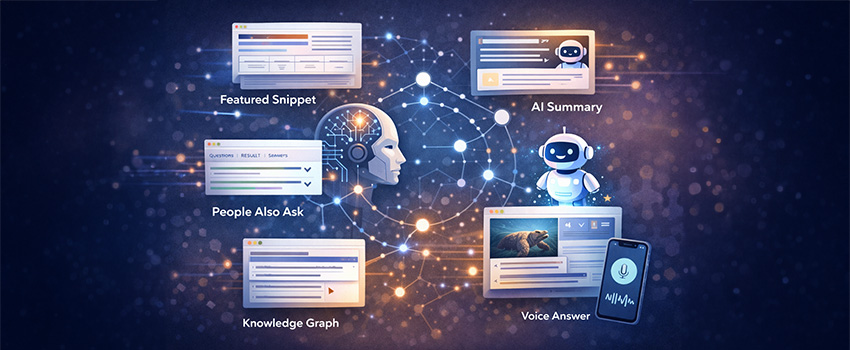
AI-driven snippets are search results where the engine uses machine learning models to extract, summarize, or generate answers directly from indexed content. These include:
- Featured snippets (paragraphs, lists, tables)
- “People Also Ask” expansions
- AI summaries and conversational answers
- Knowledge graph responses
- Voice search answers via assistants
Google has confirmed that its AI systems evaluate content based on relevance, structure, clarity, and trust signals, not just keywords. Pages that provide direct, well-formatted answers are more likely to be surfaced.
For businesses, this means visibility may come without a traditional click — but being absent from AI answers can erase brand presence entirely.
The Impact on Organic Traffic and CTR
The rise of AI-powered snippets has reshaped click-through behavior:
- Featured snippets can reduce clicks to other organic results by 20–30%
- “Zero-click” searches now account for over half of all queries
- However, pages that own the snippet often see higher brand recall and stronger downstream conversions
In other words, SEO is no longer just about driving immediate traffic — it’s about owning visibility, authority, and influence at the moment of intent.
Brands that adapt can still win. Those that don’t risk being invisible.
How AI Chooses Content for Snippets
AI systems don’t choose content randomly. They favor pages that demonstrate:
- Clear answers to specific questions
- Logical content hierarchy
- Structured formatting (lists, tables, headings)
- Strong topical relevance
- Demonstrated expertise and trustworthiness
Importantly, longer content does not automatically win. AI prefers concise, accurate answers, often pulled from sections of longer, well-organized pages.
This is where technical SEO and content strategy intersect.
Structured Data: Speaking AI’s Language
Structured data is one of the most powerful tools for helping search engines understand your content. Using schema markup tells AI systems what your content is about, not just what it says.
Why Structured Data Matters
- Helps search engines categorize and contextualize information
- Increases eligibility for rich results and snippets
- Improves accuracy of AI-generated answers
High-Impact Schema Types
- FAQPage: Ideal for question-based content and AI summaries
- HowTo: Excellent for step-by-step instructional content
- Article & BlogPosting: Clarifies authorship and topical relevance
- Product & Review: Supports commercial and transactional queries
- Organization & Author: Reinforces trust and credibility signals
Businesses that properly implement structured data consistently outperform competitors in snippet visibility, especially in competitive informational searches.
FAQ Content: Built for AI Consumption
FAQ sections are no longer optional — they are one of the most AI-friendly content formats available.
Why FAQs Work So Well
- They mirror how users phrase real search queries
- They provide direct, self-contained answers
- They are easily parsed by AI models
- They align perfectly with voice and conversational search
Best Practices for FAQ Optimization
- Use real questions based on search data, not assumptions
- Keep answers clear and concise (40–70 words is ideal)
- Place FAQs contextually, not just at the bottom of pages
- Mark them up with FAQ schema
Well-optimized FAQs often feed multiple search features at once: snippets, People Also Ask boxes, and AI summaries.
User Intent: The Core of AI-First SEO
AI systems are trained to prioritize intent satisfaction, not keyword density. This makes understanding user intent more important than ever.
The Four Core Intent Types
- Informational – “What is…”, “How does…”
- Navigational – Brand or product discovery
- Commercial – Comparison and evaluation
- Transactional – Purchase or conversion-ready queries
Content must match intent precisely. For example:
- Informational queries require explanations, definitions, and examples
- Commercial queries need comparisons, benefits, and proof
- Transactional queries require clarity, trust signals, and next steps
Pages that mismatch intent are increasingly ignored by AI systems, even if they rank traditionally.
Writing for Humans and AI
Optimizing for AI does not mean writing robotic content. In fact, AI systems increasingly reward content that is:
- Easy to read
- Logically structured
- Written in natural language
- Backed by evidence or experience
Effective AI-Ready Content Structure
- Clear H1 and H2 headings
- Short paragraphs (2–4 lines)
- Bullet points and numbered lists
- Direct answers early in each section
- Supporting depth afterward
This structure allows AI to extract summaries while still providing value to human readers who scroll deeper.
Authority, Trust, and E-E-A-T Signals

AI-driven snippets heavily rely on Experience, Expertise, Authoritativeness, and Trustworthiness (E-E-A-T).
Signals that matter include:
- Clear author attribution
- Demonstrated subject expertise
- Accurate, up-to-date information
- Brand consistency across the web
- Transparent business information
Websites that lack trust signals may still rank — but are far less likely to be chosen as AI answer sources.
Measuring Success in an AI-Snippet World
Traditional SEO metrics need adjustment. Instead of focusing only on clicks, businesses should track:
- Impression growth in Search Console
- Featured snippet ownership
- Brand mentions in AI answers
- Assisted conversions and return visits
- Engagement quality, not just volume
Visibility without clicks can still influence buying decisions later — especially in B2B and high-consideration markets.
How Web Dominance Can Help You Adapt
Preparing for AI-driven SEO requires more than surface-level optimization. It demands a strategic blend of technical SEO, content architecture, intent mapping, and data analysis.
Web Dominance helps businesses navigate this shift by:
- Structuring content for AI and rich results
- Implementing schema and structured data correctly
- Designing FAQ and intent-driven content strategies
- Aligning SEO with real business goals, not vanity metrics
- Monitoring visibility across evolving search features
Rather than chasing rankings alone, Web Dominance focuses on owning authority, relevance, and long-term visibility in a rapidly changing search landscape.
Conclusion
AI-driven snippets are redefining how users interact with search engines — and how brands must approach SEO. The goal is no longer just to rank first, but to be the answer.
By investing in structured data, building meaningful FAQs, and focusing relentlessly on user intent, businesses can stay visible and competitive even as clicks decline. Those who adapt early will gain authority, trust, and mindshare — while others fade behind AI-generated summaries.
SEO isn’t disappearing. It’s evolving. And the winners will be those who evolve with it.