
At Google I/O 2026, Google announced what Elizabeth Reid, VP of Search, called the “biggest upgrade to our Search box in over 25 years“.
Driven by the launch of the Gemini 3.5 Flash model and a new development platform called Google Antigravity, Google Search is moving away from static links and keyword matching. Instead, it is shifting toward a dynamic ecosystem of Search Agents, custom “mini apps” built on the fly, and multi-modal exploration.
A closer look at this massive shift reveals how it is fundamentally changing the way we interact with information on the web.
The Intelligent Search Box: Moving Past Keywords
For a quarter of a century, the core mechanics of Google Search remained largely unchanged: you typed a few keywords into a white box, and Google returned a list of relevant web pages. The new intelligent Search Box completely dismantles this paradigm.
The new search bar dynamically expands to accommodate multi-modal inputs, allowing you to upload text, images, files, videos, or active Chrome tabs simultaneously. Backed by Gemini 3.5 Flash, Search processes these complex inputs as a single unified query.
Instead of just guessing your next word via autocomplete, the box uses AI to anticipate your intent, suggesting deeper phrasing to help you articulate complex concepts. Furthermore, the barrier between a standard query and a deep dive has dissolved. AI Overviews and AI Mode have been fused into a single seamless flow, letting you transition into a continuous back-and-forth conversation while maintaining full context.
The Era of Search Agents
One of the most radical shifts is the introduction of Search Agents—autonomous AI assistants that work on your behalf long after you have closed your browser tab.
- Information Agents (Launching Summer 2026 for Pro/Ultra Subscribers): These agents operate in the background 24/7. Rather than forcing you to repeatedly search for updates, you give an agent a directive (e.g., "Watch for any new apartment listings matching my budget and location" or "Alert me the second this athlete drops a sneaker collaboration"). The agent continuously scans blogs, social media, news sites, and real-time data feeds, sending you structured, synthesized updates when something relevant appears.
- Agentic Booking (Rolling out to the US this Summer): Google is extending these capabilities to local services and experiences. You can give highly specific parameters, such as finding a private karaoke room for six people on a Friday night that serves late-night food. Search checks live pricing and availability across the web and provides direct checkout links. For select categories like home repair, pet care, or beauty, you can even instruct Google Search to place a voice call to the business on your behalf to finalize details.
Generative UI and On-Demand Coding
Historically, every user saw the exact same interface layout for a given search query. Thanks to Google Antigravity and the coding capabilities of Gemini 3.5 Flash, Search can now code and build a custom user interface on the fly.
Instant Educational & Visual Tools
If you query a complex scientific concept or want to visualize how a mechanical watch operates, Search doesn’t just surface text or generic videos. It rapidly builds custom layouts, assembling interactive visuals, tables, graphs, or physics simulations directly within the results page. This Generative UI feature is rolling out for free to all users.
Custom Trackers and Mini Apps
For complex, multi-week projects, like managing a home move, planning a wedding, or starting a fitness routine, Search goes a step further. It can build entirely custom dashboards or trackers that act as personal mini apps.
For instance, if you request a health and wellness tracker, Search will code the interface and connect it to live, hyper-local variables like local weather data, interactive maps, and business reviews. You can return to this customized dashboard week after week to track your progress. This mini app capability will begin rolling out in the coming months, starting with Pro and Ultra subscribers in the US.
Personal Intelligence & Universal Commerce
Google is also bridging the gap between global information and personal utility through two major integrations:
- Expanded Personal Intelligence: Available globally across nearly 200 countries and 98 languages without a subscription, users can securely connect their personal data ecosystems (Gmail, Google Photos, and soon Google Calendar) to AI Mode. This allows Search to reason across your personal schedule and files alongside global web data, built with granular user controls so you decide when and what to connect.
- The Universal Cart: Powered by Gemini, this acts as a centralized shopping hub across the Google ecosystem. You can add items to your cart while browsing Search, chatting with Gemini, watching YouTube, or reading emails. Operating in the background, the cart tracks price drops, evaluates price history, flags product incompatibilities, suggests alternatives, and coordinates with Google Wallet to optimize your credit card rewards and loyalty perks at checkout.
The Tech Powering the Shift: Gemini 3.5 Flash
The backbone of this transformation is Gemini 3.5 Flash, which has officially replaced previous models as the global default for AI Mode in Search.
According to Google’s data, Gemini 3.5 Flash rivals the intelligence of massive flagship models while sustaining the exceptional speeds required for real-time web browsing. It significantly outperforms previous models on complex agentic and coding benchmarks:
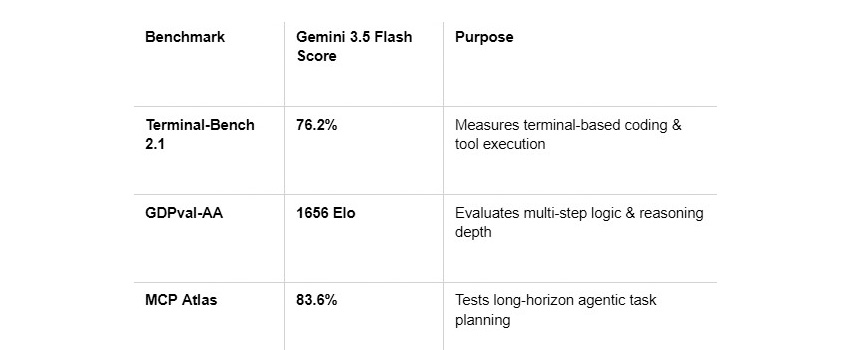
Because 3.5 Flash sits in the top-right quadrant of the Artificial Analysis index for speed and quality, Google can execute real-time coding (Antigravity) and continuous background web monitoring (Search Agents) at a fraction of the latency and computational cost of older models.
With AI Mode already surpassing one billion monthly users and search queries hitting an all-time high, this update marks a definitive pivot. Google Search is no longer a tool you use to find a webpage where work can be done; it is becoming the environment where the work itself is completed.