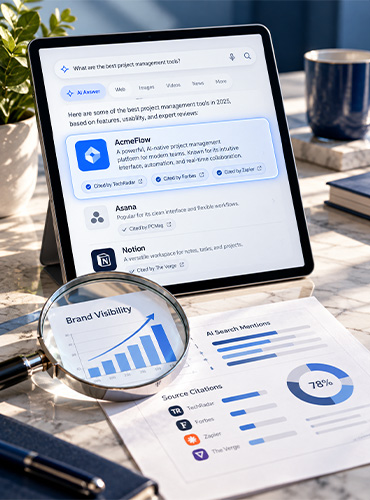

Brand visibility in AI search measures how often and how prominently a business appears in AI-generated answers, recommendations, and citations.
Platforms such as ChatGPT, Google AI Overviews, Google AI Mode, and Microsoft Copilot can mention your brand, cite your website, recommend your services, or omit your business entirely.
To measure AI search visibility, test relevant customer prompts across selected platforms and track brand mentions, website citations, information accuracy, recommendation prominence, and competitor presence. Monitor results over time and measure AI referral traffic, qualified leads, and conversions separately.
A practical GEO/AEO scorecard helps identify visibility gaps, evaluate performance, and prioritize SEO and content marketing improvements.
What Is Brand Visibility in AI Search?

Brand visibility in AI search describes how and where a business, its website, products, services, or expertise appear in answers generated by AI-powered search experiences.
Unlike traditional search results, which commonly present a list of links, AI-generated answers may synthesize information from multiple sources into a single response. Depending on the platform and query, a brand may appear in several ways.
- Brand mention: The AI system names your business in its answer, whether or not it links to your website.
- Website citation: The answer includes a link to a page on your domain as a source.
- Recommendation: The business is presented as an option, provider, product, or resource relevant to the user's question.
- Topical visibility: Your content or expertise appears in answers related to specific subjects, problems, industries, or customer needs.
- Referral traffic: A person clicks through from an AI platform to your website.
- Business impact: An AI-influenced discovery journey eventually contributes to a qualified enquiry, sale, or other meaningful conversion.
These measures are related, but they are not interchangeable.
For example, an AI assistant might mention a company when listing several digital marketing agencies but cite other websites as its sources. In another answer, it might cite a company’s educational article without recommending the company itself.
Both outcomes provide useful information, but they represent different types of visibility.
A strong GEO/AEO measurement process should therefore distinguish between being mentioned, being cited, being recommended, and attracting customers.
GEO vs. AEO: What Should You Measure?
GEO and AEO overlap in practice, and neither has a universally agreed measurement standard. The distinction is still useful when organizing your reporting.
Generative Engine Optimization (GEO) focuses on improving the likelihood that a brand or its content is understood, surfaced, referenced, or cited in generative AI experiences.
Answer Engine Optimization (AEO) focuses on making information useful and accessible in experiences that provide direct answers, summaries, and responses to specific questions.
For measurement purposes, GEO reporting can emphasize brand mentions, citations, topical presence, competitive visibility, and representation across AI platforms. AEO reporting can place greater emphasis on whether your pages provide relevant answers to target questions and whether those answers are reflected accurately in answer-oriented experiences.
However, these categories overlap. A page that answers a customer’s question clearly may support traditional SEO, AEO, and GEO simultaneously.
For a broader explanation, see Web Dominance’s guide to SEO vs. AEO vs. GEO.
The 7 Metrics Every AI Visibility Scorecard Should Track
A useful scorecard should measure more than the number of times a company name appears in an AI response. It should also assess whether the visibility reaches the right audience, represents the brand accurately, covers important topics, and improves over time.
The following seven metrics provide a practical starting point.
1. Brand Mention Rate
Brand mention rate measures how frequently your business appears in responses to a predefined set of relevant prompts.
For example, you might test questions such as:
- Which digital marketing agencies specialize in B2B growth?
- How can a manufacturing company improve organic search visibility?
- What should a business look for when choosing an SEO agency?
- Which agencies offer both SEO and content marketing?
Record whether your brand appears in each valid response.
Formula:
Brand mention rate = Responses containing a brand mention ÷ Total valid responses tested × 100
Suppose you test 40 prompts across a defined set of AI platforms and obtain 100 valid responses. If the brand appears in 24 responses, its mention rate is 24% for that specific test set.
This is a measurement of your selected prompts, not a claim that your brand appears in 24% of all AI answers on the internet.
For more meaningful insights, segment results by platform, topic, search intent, market, and language.
A high overall mention rate can conceal important gaps. Your brand may appear frequently in responses about general SEO but rarely in the commercial questions that potential customers ask before hiring an agency.
2. Website Citation Rate

Brand mentions show whether your company appears in an answer. Website citation rate reveals whether your own website is referenced as a source.
A citation is especially useful to track when the answer links directly to an article, service page, case study, or other resource that your team has created.
Formula:
Website citation rate = Valid responses citing at least one page on your domain ÷ Total valid responses tested × 100
For example, if 18 of 100 valid responses include a citation to your domain, the citation rate is 18% across that test set.
Track both the domain-level result and the URLs being cited. The pages referenced may reveal which subjects your website already covers effectively and where content opportunities exist.
A useful citation report should answer:
- Which pages receive citations most frequently?
- Which prompts or topics lead to those citations?
- Are service pages, educational articles, or case studies being referenced?
- Are citations increasing, decreasing, or remaining stable?
- Are competitors being cited for questions where your content is relevant?
Do not interpret a higher citation rate as proof of better rankings across all AI systems. Citation patterns differ by platform, prompt, context, and the sources available to the system.
3. Brand Recommendation and Answer Prominence
Not all mentions have the same commercial meaning.
A company named in a general list of industry providers is receiving a different kind of visibility from a company recommended as a suitable option for a specific customer need.
Review how the business is presented in each response.
Consider whether the AI system:
- Names the brand as a relevant option.
- Connects the business to the correct service or industry.
- Explains why the business may be appropriate for the question.
- Includes the brand in a comparison with alternatives.
- Mentions the business only incidentally, without a meaningful relationship to the user's needs.
4. Brand Accuracy and Representation
AI visibility is not automatically positive. A business may be mentioned frequently while its services, location, expertise, or positioning are represented incorrectly.
That is why accuracy should be measured alongside frequency.
For each brand mention, check whether the answer accurately describes:
- The company's name and identity.
- Its services and areas of specialization.
- The audiences or industries it serves.
- Its geographic coverage, where relevant.
- Its published expertise and documented experience.
- The evidence supporting any claims about its work.
For example, a digital marketing agency offering SEO, content marketing, PPC, and marketing strategy should not be described as a provider of services it does not offer.
Incorrect information can confuse prospective customers and undermine the value of visibility.
A practical system assigns each response one of three labels:
- Accurate: The brand is described correctly and relevantly.
- Partially accurate: The main information is correct, but important details are incomplete or misleading.
- Inaccurate: The answer includes materially incorrect information about the business.
Also record the exact statement and the source, if one is cited. This makes it easier to distinguish between outdated information on your own website, incorrect third-party information, and an unsupported AI-generated statement.
Do not assume every error comes from a weakness on your website. Investigate the evidence before deciding which corrective action is appropriate.
5. Topic and Search Intent Coverage

AI search visibility should reflect the questions that matter to your business, not only the prompts where you already appear.
Create a topic map based on your services, customers’ problems, and the decisions they make before choosing a provider.
For a digital marketing agency, relevant topic groups could include:
- SEO and technical website optimization.
- GEO, AEO, and AI search visibility.
- Content marketing and content strategy.
- Lead generation and conversion optimization.
- PPC and paid acquisition.
- Digital marketing strategy and measurement.
- Industry-specific digital growth challenges.
Within each topic, test different types of intent.
These prompts are starting examples. Build the final set around your actual target markets, services, languages, and customer questions.
Measure the percentage of prompts where your brand is mentioned or your site is cited within each topic and intent category.
This helps distinguish broad visibility from useful coverage of the subjects that influence buying decisions.
6. Competitive Citation Presence
AI-generated answers often reference several sources or present several potential providers. Tracking competitors helps you understand how your visibility compares within the specific questions you monitor.
For each relevant prompt, record:
- Which competing brands are mentioned.
- Which competing websites receive citations.
- Whether the competitor is recommended, merely listed, or referenced as a source.
- Which topic or question prompted the appearance.
- Whether your brand or website is also represented.
Where the platform provides citation-level reporting, you may be able to calculate citation share.
Citation share = Citations attributed to your domain ÷ Total citations across the measured sources × 100
For example, if a defined set of answers contains 200 citations and 20 are attributed to your website, your citation share is 10% for that particular dataset.
This calculation is meaningful only if the denominator and collection method are consistent. It should not be interpreted as a universal percentage of AI visibility or a measure of market share.
Microsoft’s AI Performance reporting in Bing Webmaster Tools includes citation reporting for supported AI experiences, with additional preview capabilities for understanding query intent, topic groups, and citation share.
Use competitive analysis to identify specific opportunities. If competitors consistently appear in answers about a subject relevant to your services, examine the pages being cited and assess whether your own content offers a useful, well-supported alternative.
8. Review Backlinks and Brand Credibility
Priority: Medium to high, depending on the website and competitive landscape
Backlinks are links from other websites to yours. Relevant, editorially earned links can help search engines discover pages and understand how other websites reference your content.
An audit should assess the quality and relevance of your backlink profile, not simply count links or focus on a third-party authority score.
Check whether:
- Reputable, relevant websites link to important resources.
- Existing backlinks point to URLs that still work.
- Valuable backlinks are being lost because of broken or redirected pages.
- Backlinks show signs of manipulative acquisition.
- Your business is represented accurately on relevant industry websites and professional profiles.
- Original research, useful resources, and project insights provide reasons for others to reference your website.
Not every unfamiliar backlink is harmful, and a large number of links from unrelated domains does not automatically indicate a penalty. Investigate patterns and context before taking action.
For businesses operating in specialized industries, clear descriptions of services, documented expertise, credible authorship, and accurate company information help establish trust with potential customers.
These signals also give search systems better information for interpreting the business and its content, although no particular backlink count or brand-mention threshold guarantees rankings or AI citations.
What should you fix first?
Resolve broken destinations for valuable backlinks and investigate evidence of deliberate link manipulation. Then focus on earning relevant references through useful resources, partnerships, original research, and genuine industry contributions.
9. Review Structured Data and Search Presentation
Priority: Medium, unless implementation errors affect an important supported search feature
Structured data is a standardized way of describing page information to search engines. Depending on the content and eligibility requirements, it can help a page qualify for supported enhanced search appearances.
During an audit, check whether relevant structured data is implemented accurately and consistently with the visible page content.
Depending on your website, appropriate types may include:
- Organization information.
- Breadcrumbs.
- Products and offers.
- Article information.
- Local business details, where applicable.
Use Google’s structured data documentation to understand supported features, required properties, and implementation guidelines.
Avoid adding markup simply because it is available. Structured data must accurately reflect the page, and valid markup does not guarantee an enhanced search result.
The same principle applies to AI search optimization. There is no universal structured data type that guarantees inclusion in ChatGPT, Google AI Overviews, or other AI-generated answers.
For SEO, GEO, and AEO alike, the foundation remains accessible pages, useful information, clear organization, accurate business details, and content that provides evidence for its claims.
What should you fix first?
Correct invalid or misleading markup that affects relevant supported features. Then implement appropriate structured data where it helps describe the actual content or business.
Which SEO Audit Tools Should Businesses Use?

You do not need dozens of tools to begin an SEO audit. A small set of complementary tools can reveal many important issues.
Google Search Console helps you review search performance, indexing, sitemap submissions, and reported technical problems.
Google Analytics 4 helps you analyze organic landing-page traffic, engagement, lead events, and sales.
PageSpeed Insights provides performance diagnostics and, where available, real-user Core Web Vitals data.
A website crawler can help identify broken internal links, redirect chains, missing titles, duplicate metadata, canonical inconsistencies, and other on-page or technical issues across larger websites.
Backlink analysis tools can help evaluate referring domains, lost links, and potential link-related risks.
The appropriate toolset depends on the size and complexity of the website. A small business site may need only a focused manual review and a few free tools. A large ecommerce site, international website, or platform with thousands of URLs may require more advanced crawling and log analysis.
Remember that tools identify potential problems; they do not automatically determine business priorities. Human review is necessary to interpret the findings and distinguish genuine issues from harmless warnings.
How Often Should a Business Conduct an SEO Audit?
The frequency depends on the website’s size, technical complexity, and rate of change.
For many businesses, a useful approach is to conduct a comprehensive audit periodically and monitor important technical and performance signals throughout the year.
Additional audits or targeted reviews are especially valuable before and after:
- A website redesign or migration.
- Significant changes to navigation or URL structures.
- Major content restructures or consolidation projects.
- Platform, CMS, or hosting changes.
- Significant organic traffic or indexing changes.
- Expansion into new markets, languages, or service categories.
Routine monitoring can identify emerging issues before they become larger problems. However, repeatedly auditing an unchanged website without implementing improvements is unlikely to provide much additional value.
An audit should be part of an ongoing optimization process, not an isolated report.
What Should an SEO Audit Report Include?
A useful SEO audit report translates findings into a clear implementation plan.
Rather than presenting a long list of technical errors, it should explain the issue, its implications, and the recommended next step.
A well-structured report includes:

- Executive summary: The most important findings and their business implications.
- Technical findings: Crawlability, indexability, redirects, canonicalization, and structural problems.
- Content findings: Search intent, quality, overlap, and opportunities to improve existing pages.
- Performance analysis: Organic visibility, landing-page traffic, conversions, and relevant trends.
- Prioritized recommendations: Issues ranked by impact, urgency, and implementation effort.
- Implementation plan: Recommended actions, responsibilities, and dependencies.
- Measurement framework: The indicators to monitor after changes are implemented.
Where possible, findings should include examples, affected URLs, supporting data, and a clear explanation of what needs to change.
The report should also distinguish confirmed issues from recommendations that require further investigation. This helps business owners make decisions without confusing automated tool warnings with demonstrated problems.
Most importantly, recommendations should connect technical work to business objectives. The goal is not to eliminate every warning in an SEO platform; it is to improve the website’s ability to attract relevant visitors and support business growth.
Turn Your SEO Audit Into a Growth Plan
An SEO audit is most valuable when it helps a business make better decisions about its website, content, and digital marketing investment.
The starting point is straightforward: make sure important pages can be discovered and indexed, identify problems affecting valuable customer journeys, improve content around real search intent, and use performance data to decide what deserves attention next.
From there, consistent implementation and measurement can help businesses build a stronger foundation for sustainable organic visibility and lead generation.
Web Dominance helps businesses assess their digital presence, identify optimization opportunities, and translate findings into actionable recommendations. Its SEO services include technical SEO, keyword research, content optimization, and on-page optimization, while its Audit & Consultancy services focus on evaluating the current position, identifying opportunities and risks, and developing practical recommendations.
Need a clearer picture of what is limiting your website’s performance? Contact Web Dominance to discuss an SEO audit tailored to your website, business priorities, and growth objectives.