

Marketing a software development company to international clients requires more than promoting technical capabilities or competing on hourly rates. It involves identifying the right markets, establishing a clear market position, building a credible digital presence, reaching decision-makers through relevant channels, and demonstrating how your services solve business problems.
For software development companies targeting North America and Europe, a successful international marketing strategy should combine market research, website optimisation, international SEO, GEO/AEO, content marketing, LinkedIn, targeted advertising, and relationship-building. These activities need to work together to attract qualified prospects and support them throughout the decision-making process.
Technical expertise may convince a potential client that your company can build a product. However, your marketing must also demonstrate why that client should trust your team, how you approach complex projects, what makes your delivery model suitable, and what business value your services can provide.
Why Marketing to International Clients Is Different for Software Development Companies
Selling software development services internationally presents challenges that go beyond attracting website visitors. Potential clients are evaluating a business relationship, often involving significant budgets, technical dependencies, sensitive information, and long-term commitments.
A company competing for contracts in the United States, Germany, or the United Kingdom may face established local agencies, international consultancies, and outsourcing providers from several other regions. Having competitive development rates or a skilled engineering team is not necessarily enough to stand out.
Several factors make international client acquisition particularly demanding.
Competition and differentiation: International buyers can compare hundreds of providers offering similar services. Claims such as “experienced developers”, “high-quality software”, and “innovative solutions” are unlikely to distinguish one company from another. Businesses need to communicate specific expertise, relevant experience, and clear commercial advantages.
Trust without a local presence: Prospective clients may have limited knowledge of a foreign development company. They need evidence that the provider can communicate effectively, manage projects reliably, protect information, and deliver according to agreed requirements.
Different buyer expectations: Companies in different markets may have different expectations regarding pricing transparency, documentation, project management, communication, contracts, and delivery standards. Marketing should reflect the concerns of the intended audience rather than assuming that every international buyer evaluates providers in the same way.
Multiple decision-makers: A software development contract may involve a founder, CTO, product manager, procurement specialist, finance department, and security team. Each stakeholder evaluates the potential partnership from a different perspective.
Mixology Digital’s 2025 B2B Buyer Report, based on a survey of 511 buyers from the UK and US, found that 76% of respondents involved more than three people in vendor purchasing decisions. The report also found that 42% considered case studies and success stories the most influential content type during their decision-making process. These findings illustrate why software development marketing must support more than one decision-maker and provide credible evidence at different stages of the buying journey.
Define Your Ideal International Client Before Choosing Marketing Channels
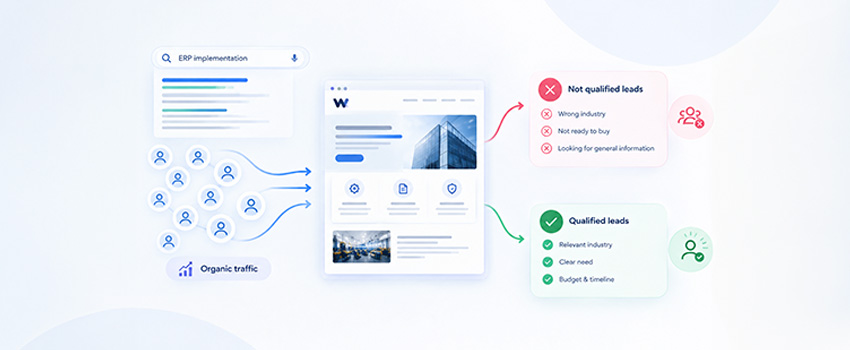
One of the most important decisions in international marketing is determining which clients the company actually wants to attract.
Software development providers often promote themselves to a broad audience, mentioning multiple technologies, industries, company sizes, and services. Although this may appear to increase their potential reach, it can make their positioning less distinctive and their marketing budget less efficient.
A more effective approach begins with defining an ideal customer profile (ICP). An ICP describes the type of organisation most likely to benefit from your services and become a valuable, long-term client.
Start by evaluating the following factors:
- Geographic markets: Identify countries where your company can realistically compete, communicate, and deliver services. Consider market demand, time-zone compatibility, language requirements, and commercial expectations.
- Industry specialisation: Assess whether your experience is particularly relevant to fintech, healthcare, e-commerce, SaaS, manufacturing, logistics, or another sector.
- Company size: Decide whether your services are better suited to startups, scale-ups, medium-sized businesses, or enterprises.
- Project requirements: Identify the types of engagements you want to attract, such as custom software development, cloud migration, DevOps automation, AI integration, or dedicated development teams.
- Decision-makers: Understand who initiates the search, who evaluates technical capabilities, who controls the budget, and who approves the final agreement.
- Commercial suitability: Establish the minimum project size, expected budget, engagement duration, and resource requirements that make a potential opportunity commercially worthwhile.
For example, instead of targeting every business in the United States and Europe, a software development company might focus on European SaaS businesses with 50–250 employees that need cloud infrastructure optimisation and ongoing DevOps support.
This narrower profile creates a more useful marketing direction. Website messaging can address SaaS infrastructure challenges, SEO can target relevant DevOps queries, and LinkedIn campaigns can reach founders, CTOs, and engineering leaders in the selected market.
It also makes it easier to identify which opportunities are unsuitable before investing significant sales resources.
Build a Clear International Positioning Strategy
Positioning explains why a potential client should choose your software development company instead of another provider.
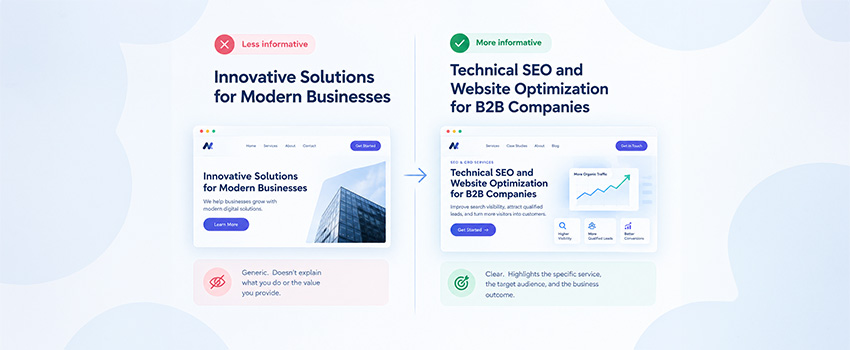
A strong positioning strategy connects technical capabilities with a recognisable business need. Rather than presenting a long list of programming languages and technologies, explain what your company helps clients achieve and why your approach is relevant.
Consider the difference between these statements:
Generic positioning:
“We provide high-quality software development services using modern technologies and experienced developers.”
More specific positioning:
“We help growing SaaS companies modernise cloud infrastructure and automate deployment processes to improve delivery efficiency and operational reliability.”
The second statement identifies an audience, a service area, and business-relevant outcomes. It gives prospective clients a clearer reason to investigate the company.
Software development businesses can differentiate themselves in several ways:
Industry expertise: Focus on particular industries where your team understands the relevant workflows, technical requirements, and business challenges.
Technical specialisation: Establish authority around particular technologies or services, such as cloud engineering, AI integration, DevOps automation, enterprise software, or legacy system modernisation.
Delivery model: Explain whether clients can engage your company through dedicated development teams, project-based development, staff augmentation, managed services, or ongoing technical consultancy.
Business outcomes: Connect your capabilities to measurable priorities, such as improving system scalability, reducing manual processes, accelerating product development, or modernising outdated infrastructure.
Delivery reliability: Demonstrate how your company manages communication, project planning, quality assurance, documentation, and ongoing support.
Your value proposition should also be reflected consistently across the website, company profiles, case studies, advertising, and sales materials.
Avoid positioning every service as equally important. A company may offer web development, mobile applications, DevOps, AI integration, and technical consulting, but its marketing should still establish a clear primary specialisation.
Build a Website That Converts International Visitors into Leads
For international prospects, a software development company’s website often functions as its first substantial introduction. It must explain the company’s expertise, answer common evaluation questions, establish credibility, and make the next step straightforward.
A website that lists services without demonstrating their value may attract visitors but leave them uncertain about whether the company is suitable for their project.
An effective website should include several essential elements.
Clear service pages
Each major service should have a dedicated page explaining:
- What the service involves.
- Which businesses need it.
- What problems it addresses.
- How the company approaches delivery.
- Which technologies or platforms are relevant.
- What clients can expect from the engagement.
- How to discuss a potential project.
For example, a DevOps outsourcing page should explain the types of infrastructure and deployment challenges the team addresses, its automation capabilities, and how its services fit into a client’s existing engineering operations.
Industry-specific landing pages
Industry pages help explain how technical services address sector-specific requirements.
A healthcare software development page, for instance, may discuss interoperability, data protection, system integration, and the complexity of healthcare workflows. A fintech page could focus on secure transaction processing, scalability, integrations, and reliability.
These pages should provide genuinely relevant information rather than simply replacing an industry keyword in otherwise identical copy.
Detailed case studies
Case studies demonstrate how the company applies its technical expertise in real business situations. They should explain the original challenge, the solution, the implementation process, and measurable results wherever those results can be disclosed.
Credibility and trust signals
International buyers need reasons to trust a company they may never have met in person. Useful trust signals include:
- Verified client testimonials and reviews.
- Relevant project examples.
- Developer and leadership experience.
- Industry certifications, where applicable.
- Clear information about delivery processes.
- Documented security and quality practices.
- Transparent contact information.
- Information about company locations and working arrangements.
Certifications and compliance claims should only be displayed when they are current, relevant, and verifiable.
Conversion-focused design
Visitors should not have to search for ways to contact the company. Place clear calls to action throughout the website, such as “Discuss Your Project”, “Request a Technical Consultation”, or “Explore Our Development Services”.
Keep enquiry forms focused on information that helps qualify the opportunity, such as project requirements, expected timelines, and contact details. Avoid requesting excessive information before a prospect has established interest.
Website performance, mobile usability, navigation, and content structure also influence how easily international visitors can evaluate the business.
The objective is to create a website that works as both a credibility resource and a practical lead-generation channel.
Use International SEO to Reach Buyers Actively Searching for Software Development Services
International SEO helps software development companies reach businesses actively searching for development partners, technical solutions, and specialised IT services.
Unlike channels that primarily introduce a brand to potential customers, organic search can connect companies with prospects who already have a defined requirement.
The first step is understanding what potential clients search for and why.
Develop a market-specific keyword strategy
Search behaviour can differ between countries and languages. Buyers may use different terminology to describe similar services, and the level of commercial competition can vary considerably between markets.
A keyword strategy for the United States may prioritise “software development outsourcing”, while a campaign targeting Germany might need German-language terms and locally appropriate business terminology.
The right choice should be supported by keyword research, competitor analysis, and an understanding of local demand.
Build an effective international website structure
International SEO requires more than translating existing website content.
Companies should decide whether their website needs different language versions, country-specific pages, or both.
For multilingual websites, Google recommends using separate URLs for language versions and implementing hreflang annotations to help Search identify the relevant alternatives. A website targeting different regions may also require localised information about services, business operations, and market-specific requirements.
For example:
- example.com/en/ — English-language content.
- example.com/de/ — German-language content.
- example.com/en-us/ — US-specific English content, where genuine regional distinctions justify it.
The correct structure depends on the company’s actual markets and content requirements. Creating separate country pages without meaningful regional value can lead to repetitive content rather than a useful international presence.
Strengthen technical SEO and topical authority
Technical SEO provides the foundation for search visibility. Review crawlability, indexing, website speed, mobile performance, page structure, metadata, canonical URLs, internal links, and international targeting signals.
Next, develop connected content around the company’s core services.
For example, a company specialising in DevOps could create a central DevOps service page supported by articles about cloud infrastructure automation, CI/CD implementation, DevOps outsourcing costs, infrastructure monitoring, and common cloud migration challenges.
Internal links between these pages help visitors explore related information and establish a clearer relationship between the company’s services and areas of expertise.
Finally, build authority through relevant industry publications, original research, professional partnerships, and legitimate editorial mentions. Focus on relevance and credibility rather than acquiring large numbers of low-quality links.
Optimise for AI Search and Generative Search Experiences
International buyers increasingly have access to AI-powered search and answer experiences when researching software development partners. This creates additional opportunities for companies to make their expertise discoverable beyond traditional search listings.
Two commonly used terms describe this area:
Answer Engine Optimization (AEO) focuses on making information clear, structured, and useful for platforms that provide direct answers to user questions.
Generative Engine Optimization (GEO) refers to improving a brand’s visibility across generative AI search experiences, where platforms may synthesise information from multiple sources and present relevant businesses or websites.
For software development companies, the practical objective is to make their expertise easy to understand, verify, and connect with relevant services.
Useful activities include:
- Publishing direct answers to specific technical and commercial questions.
- Explaining services, technologies, and delivery models consistently.
- Demonstrating expertise through detailed case studies and technical articles.
- Maintaining accurate company information across relevant professional and industry platforms.
- Supporting performance claims with evidence and clear context.
- Creating interconnected content that establishes expertise in relevant subject areas.
- Using descriptive headings, concise definitions, comparison tables, and well-organised page structures.
For example, instead of publishing an article that simply promotes DevOps services, explain what DevOps outsourcing involves, which businesses benefit from it, what the engagement typically includes, how to evaluate providers, and which factors influence costs.
This gives both prospective clients and information retrieval systems a clearer understanding of the company’s expertise.
However, GEO and AEO should not be treated as guaranteed ranking techniques. Google’s current guidance explains that traditional SEO fundamentals remain relevant to its generative search features and that there are no additional technical requirements or special optimisations that guarantee inclusion in AI Overviews or AI Mode.
Google also explicitly describes AEO and GEO as terms used for work focused on AI search visibility, while framing generative search optimisation within its broader SEO guidance.
Use Content Marketing to Demonstrate Technical Expertise and Build Trust
Content marketing gives software development companies an opportunity to demonstrate knowledge before a potential client enters a sales conversation.
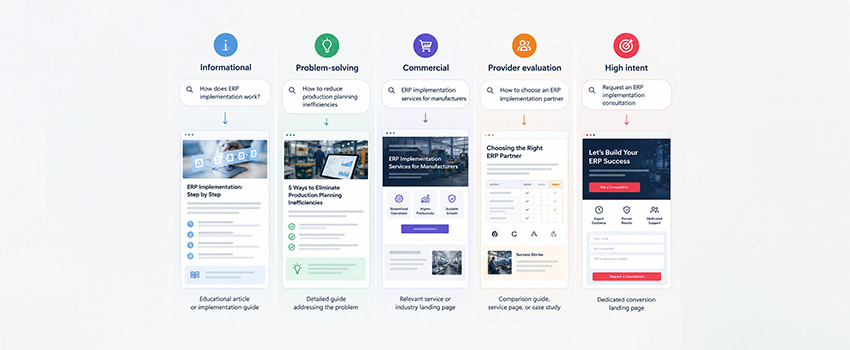
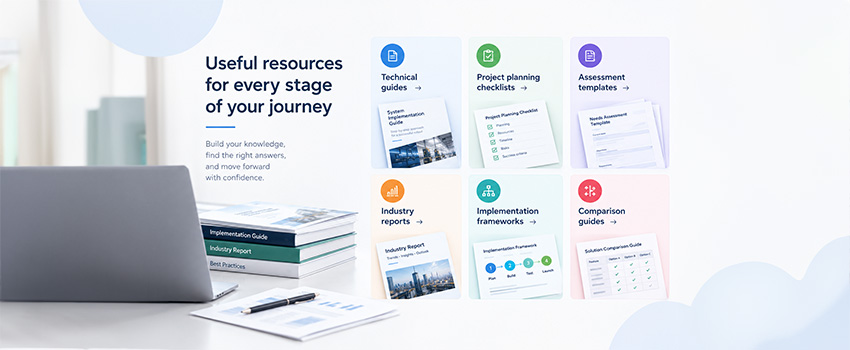
The most useful content addresses questions that arise when businesses evaluate technical solutions, plan projects, compare providers, and estimate investment requirements.
Instead of publishing general technology news or articles designed primarily to increase website traffic, create content around the actual problems your target clients are trying to solve.
Examples include:
Educational and technical content:
- What Is DevOps Automation and When Does a Business Need It?
- How Cloud Migration Works for Growing SaaS Companies.
- What to Consider Before Modernising a Legacy Software System.
- How AI Integration Can Improve Existing Business Workflows.
Commercial investigation content:
- How Much Does Custom Software Development Cost?
- In-House Developers vs. Software Development Outsourcing.
- How to Choose a Software Development Outsourcing Partner.
- Dedicated Development Teams vs. Project-Based Development.
Industry-specific content:
- Software Development Challenges in the Fintech Industry.
- How Healthcare Companies Approach Software Integration.
- What Manufacturing Businesses Should Consider Before Automating Operations.
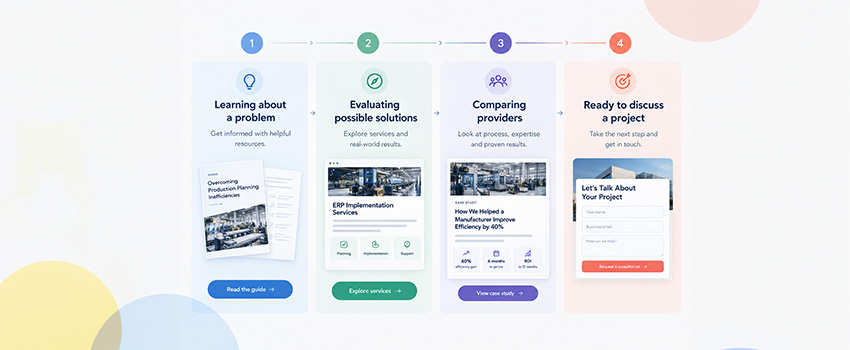
The content strategy should reflect the different stages of the buying journey.
Research from LinkedIn and Edelman also highlights the value of thought leadership in B2B marketing. Their 2024 research found that 75% of surveyed decision-makers and C-suite executives said a particular piece of thought leadership had led them to research a product or service they had not previously considered.
For software development businesses, this demonstrates why useful technical insights can influence demand before prospects are actively searching for a development partner.
Turn Case Studies into International Sales Assets
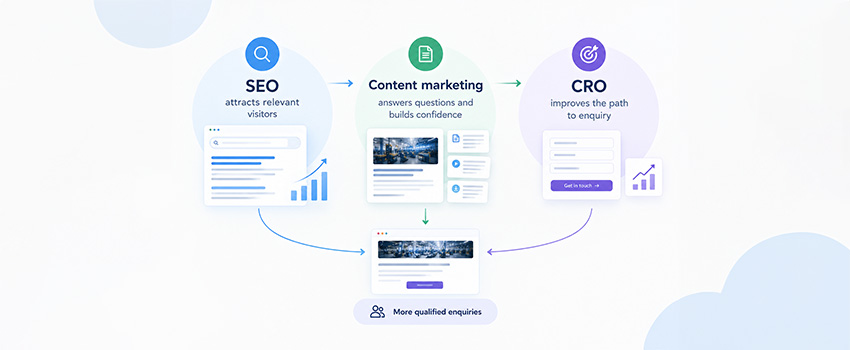
SEO, content marketing, and conversion rate optimization perform different functions, but their impact is closely related.
SEO attracts relevant visitors. It helps search engines discover your pages and connect them with appropriate queries.
Content marketing answers questions and builds confidence. It gives prospects the information they need to understand their problem, compare solutions, and evaluate your expertise.
CRO improves the path to enquiry. It examines user behavior and conversion barriers, then uses evidence to improve important interactions and landing pages.
Consider a B2B consulting company that publishes a guide addressing a specific operational challenge. SEO helps relevant prospects discover the guide. The content explains the problem and introduces potential approaches. A related service page describes the consulting offer, supported by a relevant case study and a clear consultation option.
If visitors read the guide but rarely reach the service page, internal linking or calls to action may need improvement. If they reach the service page but do not enquire, investigate the page’s relevance, credibility, offer, and form experience.
Each observation leads to a different response. This is why simply increasing traffic is not always the right next step.
10. Measure Qualified Leads, Not Just Conversions
Lead generation needs a measurement system that connects website activity with sales outcomes.
Start by defining the actions you want to measure, such as successful enquiry submissions, consultation bookings, quote requests, or product demonstrations.
Then distinguish between a conversion event and a qualified sales opportunity.
A completed form confirms that someone submitted information. It does not establish that the person fits your target audience or has a legitimate purchase need.
Track the lead through subsequent stages where possible:
- Website visitor
- Enquiry submitted
- Lead reviewed
- Qualified lead
- Sales opportunity
- Customer acquired
Your definitions should reflect the actual business and sales process. For example, a qualified lead may need to meet certain service requirements, while a sales opportunity may require confirmed budget, project scope, or a scheduled sales discussion.
Google Analytics 4 supports measuring meaningful actions as key events. Its documentation explains how to configure and report on lead-generation form submissions: Measure key events with Google Analytics.
Where possible, connect analytics with your CRM so that website sources can be evaluated alongside lead qualification and closed sales.
Useful metrics include:
- Organic sessions to relevant landing pages.
- Completed enquiry submissions.
- Conversion rate by landing page and channel.
- Qualified leads from organic search.
- Lead-to-opportunity and lead-to-customer rates.
- Cost per qualified lead, where relevant costs can be measured.
- Revenue associated with acquired customers.
Review these metrics together. More form submissions are not necessarily better if lead quality deteriorates or the sales team spends more time on irrelevant enquiries.
How to Calculate Your B2B Website Lead Generation Performance
A simple calculation can help identify whether your website is attracting visitors and converting them into meaningful enquiries.
Consider this illustrative example:
A B2B website receives 5,000 organic sessions in a month. Those sessions generate 40 enquiry submissions, of which 12 meet the company’s lead qualification criteria.
The calculations would be:
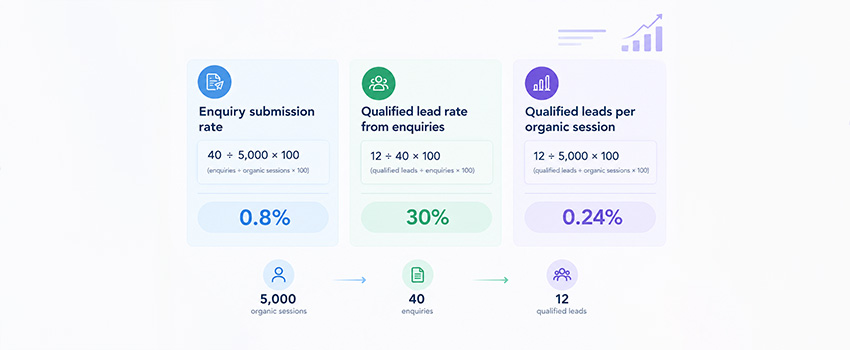
These numbers are hypothetical and are not industry benchmarks or expected results for Web Dominance clients.
They demonstrate why measuring only form submissions can be misleading. If organic sessions increase but the number of qualified leads remains unchanged, the business should investigate traffic relevance, conversion barriers, and lead qualification.
Likewise, if enquiry volume stays stable but the proportion of qualified leads improves, the website may be attracting a more relevant audience or communicating the offer more effectively.
The goal is to understand the full path from organic discovery to a meaningful business opportunity.
Turn Your Website Into a More Effective B2B Lead Generation Channel
Generating qualified B2B enquiries from organic traffic requires more than improving search rankings or increasing website visits. It requires a connected approach that attracts the right audience, answers their questions, demonstrates credibility, and gives them a clear route toward contacting your business.
Start by identifying the pages and search queries most relevant to your target customers. Improve the information those visitors encounter, remove unnecessary friction from the enquiry process, and connect website analytics with lead qualification and sales data.
Over time, this approach helps your business make better decisions about SEO priorities, website development, content investment, and conversion optimization.
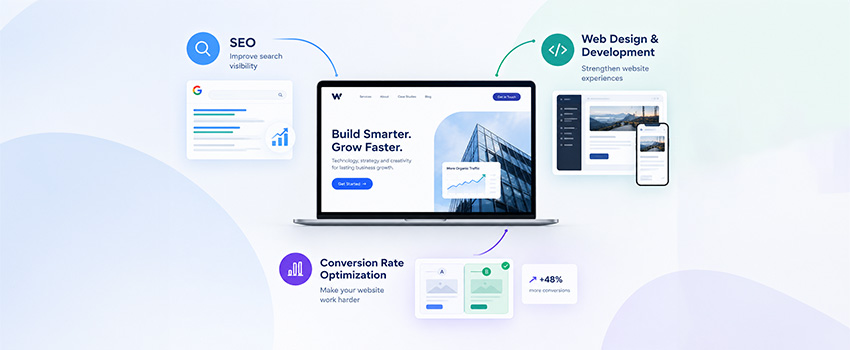
At Web Dominance, we bring together SEO, Web Design & Development, and Conversion Rate Optimization to help businesses improve search visibility, strengthen website experiences, and make their digital presence more effective.
Want to understand how your website can generate more qualified enquiries? Contact Web Dominance to discuss your website, organic search performance, and opportunities to improve your B2B lead generation strategy.