
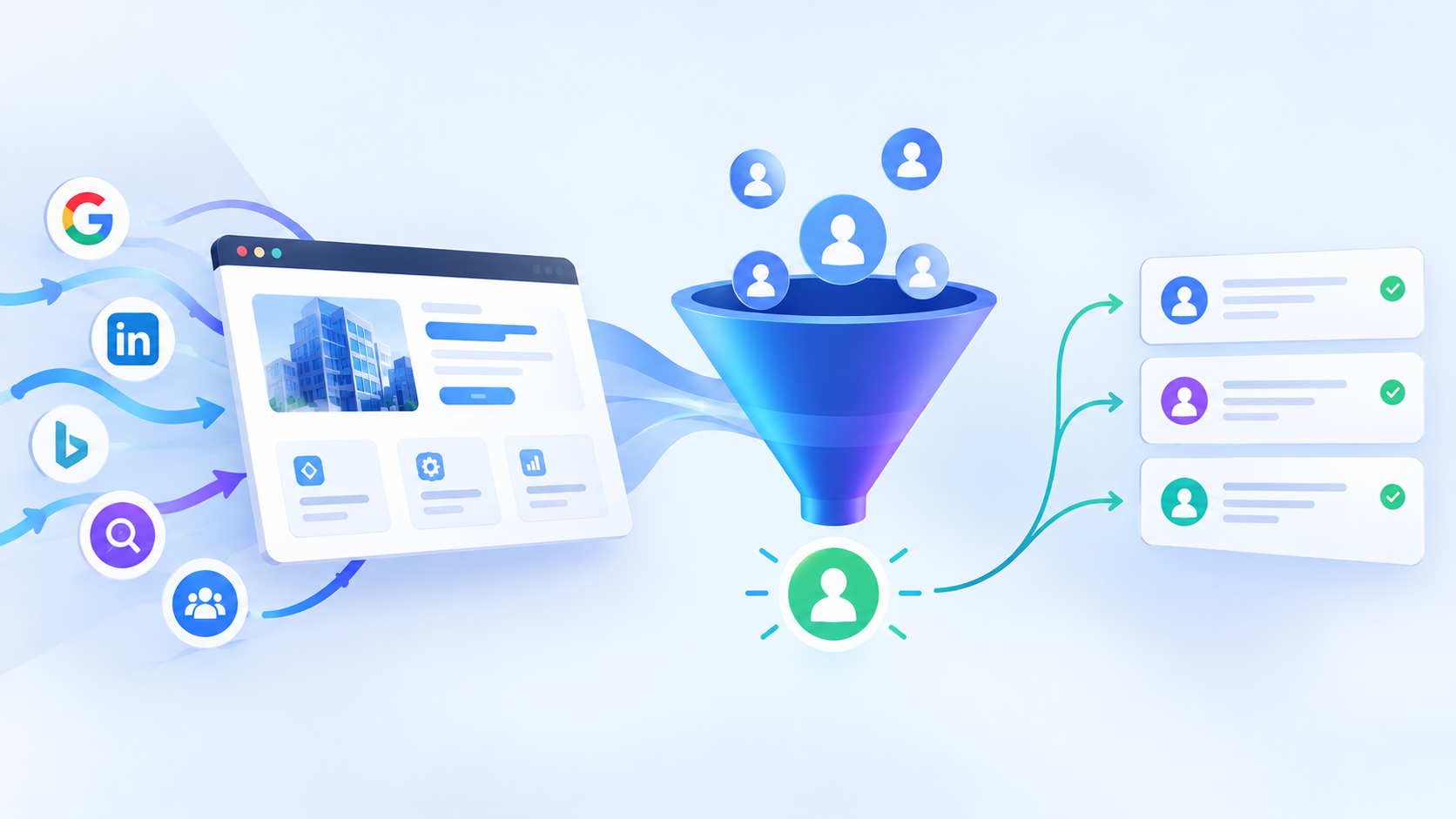
For B2B companies, attracting organic traffic is only the first step toward generating new business. A website can rank for relevant keywords and attract visitors without producing enough qualified enquiries. The key is attracting the right audience, building trust, communicating value, and making the next step clear.
To turn organic traffic into qualified B2B enquiries, businesses need to align SEO with search intent, create relevant landing pages, demonstrate credibility, simplify enquiry forms, and measure lead quality—not just website visits.
This requires three connected disciplines: SEO to attract relevant visitors, web design to communicate value and guide the customer journey, and conversion rate optimization (CRO) to remove barriers to action.
When these elements work together, your website becomes more than a traffic source. It supports the sales process by helping potential customers evaluate your expertise and take the next step.
What Is B2B Website Lead Generation?
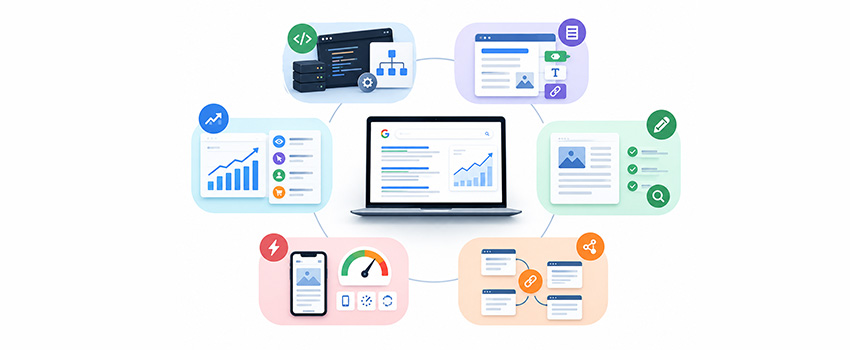
B2B website lead generation is the process of attracting potential business customers to a website and encouraging them to take an action that allows your company to begin a relevant business conversation.
Depending on your business model, these actions may include requesting a consultation, asking for a quote, booking a product demonstration, submitting a project brief, or contacting your sales team.
However, not every enquiry represents a valuable opportunity.
A qualified B2B enquiry comes from a prospect who meets your business’s relevant qualification criteria, such as having a genuine need for your solution, fitting your target customer profile, operating in a market you serve, or having a realistic potential to become a customer.
The precise criteria depend on your sales process. A software company may prioritize businesses with a particular team size or technical requirement, while a professional services firm may focus on project scope, budget, and decision-making authority.
This distinction matters because a website that generates many irrelevant enquiries may create more work for the sales team without contributing proportionately to revenue.
The goal is therefore not simply to increase form submissions. It is to attract relevant prospects and make it easier for them to move from initial interest to a meaningful sales conversation.
Why Organic Traffic Does Not Always Generate Qualified Leads
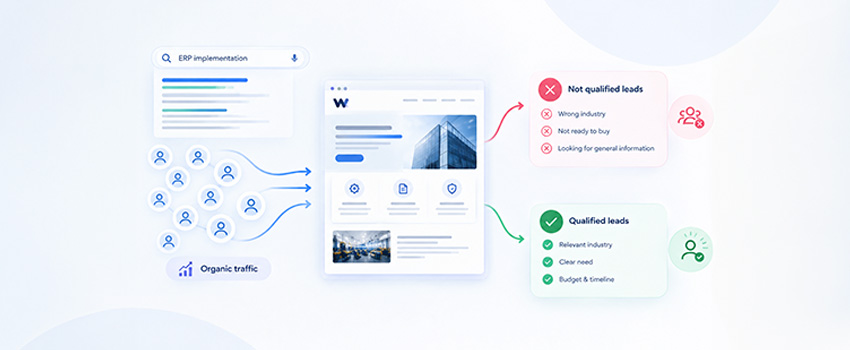
Organic traffic can grow while business results remain unchanged. This usually means that one or more parts of the customer journey need closer examination.
1. Your Website Attracts the Wrong Audience
Ranking for a keyword does not automatically mean that the people searching for it are potential customers.
For example, a company offering enterprise software implementation might attract significant traffic through a general article explaining what enterprise software is. However, some visitors may be students, researchers, or people looking for free software rather than implementation services.
The article may still provide value, but it serves a different purpose from a page targeting businesses evaluating implementation partners.
What to do: Evaluate organic landing pages alongside the queries that bring visitors to them. Distinguish informational searches from searches indicating a commercial need, and build a content strategy that supports both discovery and purchasing decisions.
2. Your Service Pages Do Not Address Buyer Concerns
B2B purchases often involve more consideration than a straightforward consumer purchase. Prospects may need to understand the scope of a service, assess implementation risks, compare providers, and establish whether a potential partner understands their industry.
A service page that only lists capabilities may not provide enough information for these decisions.
What to do: Explain the business problems your services solve, who they are for, what the engagement involves, and how prospects can evaluate whether your approach fits their needs. Address relevant concerns about implementation, integration, timelines, and responsibilities where applicable.
3. Your Value Proposition Is Unclear
Visitors should be able to understand what your business offers, whom it helps, and why the offer may be relevant to them.
Generic statements such as “We deliver innovative digital solutions” provide little information about the specific outcome a business can expect.
A more informative message explains the service and intended value clearly, without promising results that cannot be substantiated.
What to do: Review the opening section of your homepage and important service pages. Replace vague descriptions with specific explanations of your offering, target audience, and business relevance.
4. Your Website Does Not Build Enough Trust
B2B prospects may be reluctant to submit an enquiry if they cannot assess the experience or reliability of the provider.
A polished design alone does not establish credibility. Visitors may also need relevant case studies, customer testimonials, team expertise, transparent processes, and clear business information.
What to do: Support your claims with evidence. Show relevant project examples, explain the work completed, and provide accurate details about your expertise. Where you present results, include enough context for readers to understand what was measured and what contributed to the outcome.
5. The Enquiry Process Creates Unnecessary Friction
Even interested prospects can abandon the process if a form is difficult to use, asks for too much information, or offers no clear explanation of what will happen after submission.
What to do: Check your forms on desktop and mobile devices. Remove unnecessary fields, make required information clear, provide an appropriate next step, and ensure that successful submissions are tracked correctly.
Web Dominance explores these types of barriers in its article on why visitors leave a website without taking action.
How to Turn Organic Traffic Into Qualified B2B Enquiries
A reliable B2B lead generation strategy connects search visibility, useful content, clear service pages, and a frictionless conversion process.
1. Target Search Intent, Not Just Keyword Volume
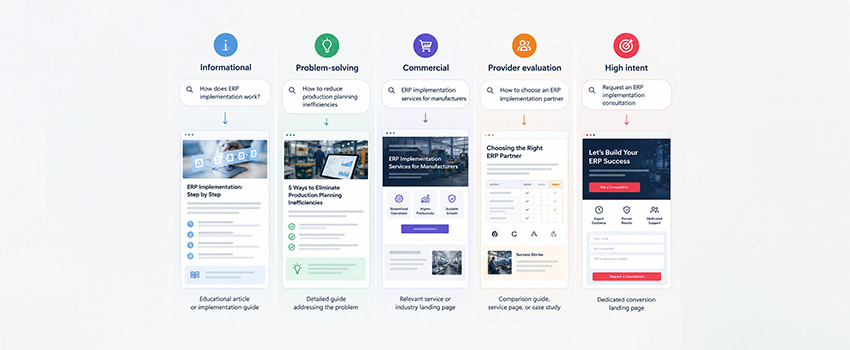
Keyword research should identify what potential customers want to accomplish when they search.
For B2B lead generation, it helps to organize keywords into three broad groups.
Search intent:
- Informational
- Problem-solving
- Commercial
- Provider evaluation
- High intent
These are illustrative examples. The right keywords depend on the services you offer and how your target customers search.
Informational content helps prospects understand a problem. Commercial pages help them assess solutions. Service and landing pages give interested visitors a clear way to make contact.
Your content strategy should support these different needs without creating multiple pages that compete to answer essentially the same question.
For example, a B2B agency might attract visitors through a guide to technical SEO, then direct interested readers to its SEO service page and relevant project examples.
Explore Web Dominance’s SEO services for the role of keyword research, technical SEO, and content optimization in attracting relevant organic visitors.
2. Create Dedicated Landing Pages for Important Services and Industries
A general homepage is rarely the best destination for every search query.
When visitors arrive from a specific query, they should find a page that addresses that need directly.
A strong B2B website often includes dedicated pages for:
- Individual services or solutions.
- Important customer industries.
- Specific use cases or business problems.
- Relevant case studies and projects.
- Consultation, quotation, or demonstration requests.
Suppose an industrial engineering company serves food manufacturers, pharmaceutical businesses, and packaging facilities. Each audience may have different operational requirements and evaluation criteria.
A single generic service page may struggle to explain all of these differences clearly. Carefully planned industry pages can provide more relevant information, provided each page offers substantive, audience-specific value rather than simply swapping industry names.
Each landing page should answer four basic questions:
- What does the business offer?
- Who is the solution for?
- Why should the visitor consider this provider?
- What should the visitor do next?
For guidance on planning the right pages, read What Pages Should a Business Website Include?.
3. Write Headlines That Communicate Business Value
Your main headline is often one of the first pieces of information a potential customer reads. It should communicate the purpose of the page without forcing visitors to interpret vague marketing language.
A useful headline identifies the service, audience, problem, or outcome that matters most.
For example:
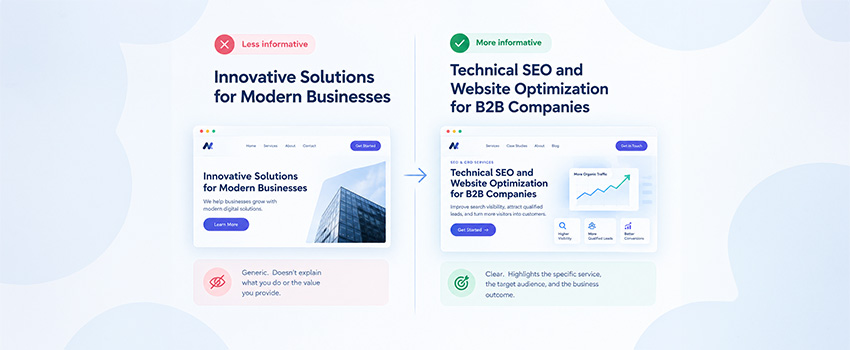
Less informative: Innovative Solutions for Modern Businesses
More informative: Technical SEO and Website Optimization for B2B Companies
The second example gives visitors a clearer idea of what the business offers and whether it is relevant to their needs.
Supporting text can then explain the company’s approach, relevant expertise, and next steps.
Avoid making unsubstantiated promises such as guaranteed lead growth or first-page rankings. Business outcomes depend on market conditions, implementation, competition, and other factors.
Instead, provide concrete details about the work you do, the problems you address, and the evidence that supports your claims.
4. Build Trust With Case Studies and Evidence
Case studies help B2B prospects evaluate a provider’s capabilities before initiating contact.
A useful case study explains the client’s original challenge, the work performed, the reasoning behind the approach, and the results that can be substantiated.
Consider including:
- The business or project context.
- The challenge being addressed.
- The strategy and implementation.
- The relevant deliverables.
- The outcome and measurement period.
- Any important limitations or factors that influenced the result.
For example, if a project involved redesigning a website and improving SEO, explain the relationship between the technical changes, content improvements, and observed performance. Do not attribute every improvement to a single activity unless the evidence supports that conclusion.
Where confidentiality permits, identify the client and provide supporting details. Where it does not, describe the project accurately without inventing identifying information.
Place relevant case studies near the service descriptions they support. This allows prospects to move naturally from learning about a service to evaluating your experience.
For Web Dominance, the project portfolio can provide relevant examples for visitors assessing the agency’s work.
5. Design Calls to Action Around Buyer Intent
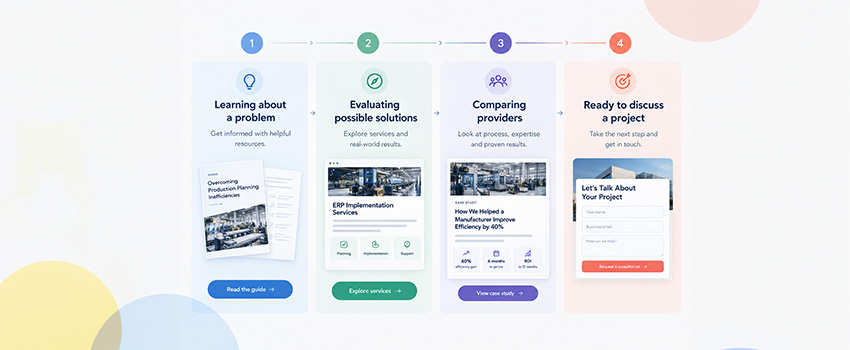
Not every visitor is ready to request a consultation. Some are still learning about the problem, while others are actively comparing providers.
Your calls to action should reflect these different stages.
Visitor stage:
- Learning about a problem
- Evaluating possible solutions
- Comparing providers
- Ready to discuss a project
The language should explain what the visitor can expect.
For example, “Discuss Your SEO Goals” is more specific than “Click Here“. A B2B software provider might offer “Book a Product Demo”, while a manufacturing supplier might use “Request a Technical Consultation“.
Avoid overwhelming visitors with multiple competing calls to action in the same section. Establish a clear primary action, with secondary options when they serve a genuine purpose.
The objective is to help visitors take an appropriate next step—not to pressure every visitor into submitting a form immediately.
6. Make Your Enquiry Forms Easy to Complete
A B2B enquiry form should collect enough information to begin a useful conversation without creating unnecessary work.
The appropriate length depends on the complexity of your sales process.
A straightforward service enquiry may require only a name, business email, company, and message. A complex project consultation may also require details about the service needed, project scope, or expected timeline.
Before adding another field, ask whether the information is necessary at this stage and whether it materially improves qualification.
Check that your forms:
- Work correctly on desktop and mobile devices.
- Use clear labels and validation messages.
- Explain which fields are required.
- Provide an understandable privacy notice.
- Confirm successful submission.
- Communicate what happens next.
- Send the enquiry to the right team or CRM workflow.
Test the entire process regularly. A form that looks functional but fails to deliver submissions can undermine an otherwise effective lead generation strategy.
For longer or more complex forms, assess whether the additional qualification value justifies the extra effort required from visitors.
7. Offer Useful Resources for Prospects Who Are Not Ready to Contact You
B2B buying journeys can involve research and internal discussions before a company is ready to engage a provider.
Educational resources can help you establish credibility and maintain a relationship with prospects who are not yet prepared to request a consultation.
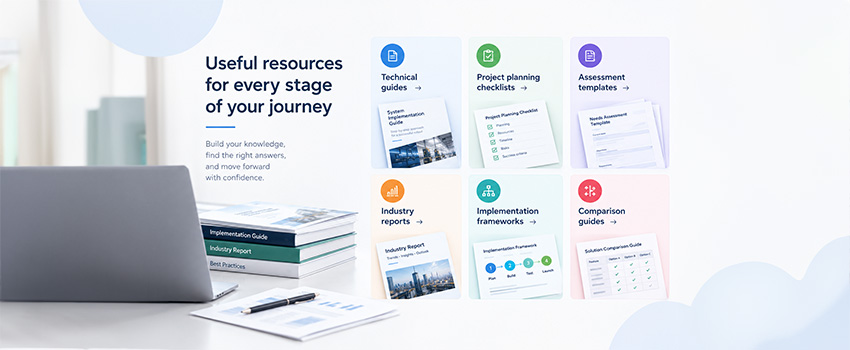
Depending on your industry, useful assets may include:
- Technical guides.
- Project planning checklists.
- Assessment templates.
- Industry reports.
- Implementation frameworks.
- Product or service comparison guides.
A resource should address a defined problem and provide genuine value. Avoid creating downloads that simply repackage generic information or demand contact details for material that does not justify the exchange.
If you use a gated resource, consider whether asking for an email address makes sense for the value offered. Explain how the information will be used and follow applicable privacy requirements.
Track resource downloads separately from sales enquiries. Someone downloading a general educational guide may be interested in the topic without being ready to purchase.
8. Improve Website Speed, Mobile Usability, and Accessibility
Technical performance and user experience are important parts of a lead generation website.
If pages load slowly, navigation is confusing, text is difficult to read, or forms do not work properly on mobile devices, visitors may struggle to complete their intended actions.
Review:
- Mobile navigation and page layouts.
- Loading performance and Core Web Vitals.
- Readability, contrast, and form labels.
- Broken links and technical errors.
- Enquiry form behavior across devices.
- Accessibility of important interface elements.
- The consistency of the experience from search result to landing page.
Google’s SEO Starter Guide explains foundational practices for helping search engines discover and understand website content. Its guidance on helpful, people-first content also emphasizes usefulness, reliability, and a satisfying visitor experience.
These practices support organic search and usability, but no single technical improvement guarantees a ranking increase or a higher conversion rate.
9. Connect SEO, Content Marketing, and CRO
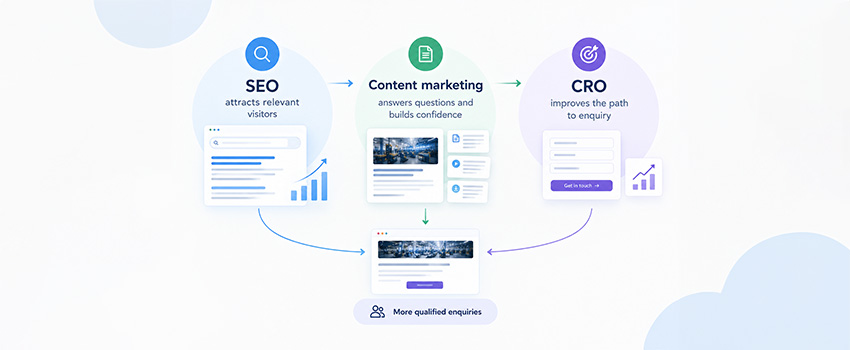
SEO, content marketing, and conversion rate optimization perform different functions, but their impact is closely related.
SEO attracts relevant visitors. It helps search engines discover your pages and connect them with appropriate queries.
Content marketing answers questions and builds confidence. It gives prospects the information they need to understand their problem, compare solutions, and evaluate your expertise.
CRO improves the path to enquiry. It examines user behavior and conversion barriers, then uses evidence to improve important interactions and landing pages.
Consider a B2B consulting company that publishes a guide addressing a specific operational challenge. SEO helps relevant prospects discover the guide. The content explains the problem and introduces potential approaches. A related service page describes the consulting offer, supported by a relevant case study and a clear consultation option.
If visitors read the guide but rarely reach the service page, internal linking or calls to action may need improvement. If they reach the service page but do not enquire, investigate the page’s relevance, credibility, offer, and form experience.
Each observation leads to a different response. This is why simply increasing traffic is not always the right next step.
10. Measure Qualified Leads, Not Just Conversions
Lead generation needs a measurement system that connects website activity with sales outcomes.
Start by defining the actions you want to measure, such as successful enquiry submissions, consultation bookings, quote requests, or product demonstrations.
Then distinguish between a conversion event and a qualified sales opportunity.
A completed form confirms that someone submitted information. It does not establish that the person fits your target audience or has a legitimate purchase need.
Track the lead through subsequent stages where possible:
- Website visitor
- Enquiry submitted
- Lead reviewed
- Qualified lead
- Sales opportunity
- Customer acquired
Your definitions should reflect the actual business and sales process. For example, a qualified lead may need to meet certain service requirements, while a sales opportunity may require confirmed budget, project scope, or a scheduled sales discussion.
Google Analytics 4 supports measuring meaningful actions as key events. Its documentation explains how to configure and report on lead-generation form submissions: Measure key events with Google Analytics.
Where possible, connect analytics with your CRM so that website sources can be evaluated alongside lead qualification and closed sales.
Useful metrics include:
- Organic sessions to relevant landing pages.
- Completed enquiry submissions.
- Conversion rate by landing page and channel.
- Qualified leads from organic search.
- Lead-to-opportunity and lead-to-customer rates.
- Cost per qualified lead, where relevant costs can be measured.
- Revenue associated with acquired customers.
Review these metrics together. More form submissions are not necessarily better if lead quality deteriorates or the sales team spends more time on irrelevant enquiries.
How to Calculate Your B2B Website Lead Generation Performance
A simple calculation can help identify whether your website is attracting visitors and converting them into meaningful enquiries.
Consider this illustrative example:
A B2B website receives 5,000 organic sessions in a month. Those sessions generate 40 enquiry submissions, of which 12 meet the company’s lead qualification criteria.
The calculations would be:
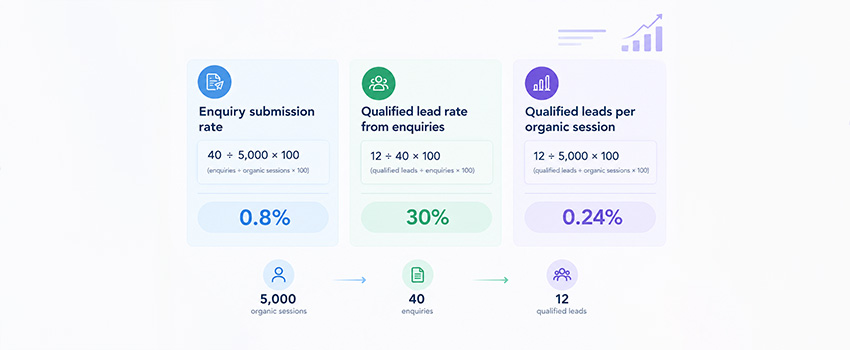
These numbers are hypothetical and are not industry benchmarks or expected results for Web Dominance clients.
They demonstrate why measuring only form submissions can be misleading. If organic sessions increase but the number of qualified leads remains unchanged, the business should investigate traffic relevance, conversion barriers, and lead qualification.
Likewise, if enquiry volume stays stable but the proportion of qualified leads improves, the website may be attracting a more relevant audience or communicating the offer more effectively.
The goal is to understand the full path from organic discovery to a meaningful business opportunity.
Turn Your Website Into a More Effective B2B Lead Generation Channel
Generating qualified B2B enquiries from organic traffic requires more than improving search rankings or increasing website visits. It requires a connected approach that attracts the right audience, answers their questions, demonstrates credibility, and gives them a clear route toward contacting your business.
Start by identifying the pages and search queries most relevant to your target customers. Improve the information those visitors encounter, remove unnecessary friction from the enquiry process, and connect website analytics with lead qualification and sales data.
Over time, this approach helps your business make better decisions about SEO priorities, website development, content investment, and conversion optimization.
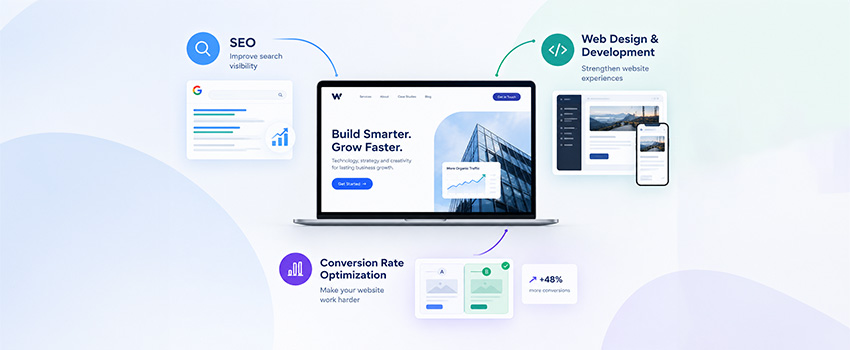
At Web Dominance, we bring together SEO, Web Design & Development, and Conversion Rate Optimization to help businesses improve search visibility, strengthen website experiences, and make their digital presence more effective.
Want to understand how your website can generate more qualified enquiries? Contact Web Dominance to discuss your website, organic search performance, and opportunities to improve your B2B lead generation strategy.