

Brand visibility in AI search measures how often and how prominently a business appears in AI-generated answers, recommendations, and citations.
Platforms such as ChatGPT, Google AI Overviews, Google AI Mode, and Microsoft Copilot can mention your brand, cite your website, recommend your services, or omit your business entirely.
To measure AI search visibility, test relevant customer prompts across selected platforms and track brand mentions, website citations, information accuracy, recommendation prominence, and competitor presence. Monitor results over time and measure AI referral traffic, qualified leads, and conversions separately.
A practical GEO/AEO scorecard helps identify visibility gaps, evaluate performance, and prioritize SEO and content marketing improvements.
What Is Brand Visibility in AI Search?

Brand visibility in AI search describes how and where a business, its website, products, services, or expertise appear in answers generated by AI-powered search experiences.
Unlike traditional search results, which commonly present a list of links, AI-generated answers may synthesize information from multiple sources into a single response. Depending on the platform and query, a brand may appear in several ways.
- Brand mention: The AI system names your business in its answer, whether or not it links to your website.
- Website citation: The answer includes a link to a page on your domain as a source.
- Recommendation: The business is presented as an option, provider, product, or resource relevant to the user's question.
- Topical visibility: Your content or expertise appears in answers related to specific subjects, problems, industries, or customer needs.
- Referral traffic: A person clicks through from an AI platform to your website.
- Business impact: An AI-influenced discovery journey eventually contributes to a qualified enquiry, sale, or other meaningful conversion.
These measures are related, but they are not interchangeable.
For example, an AI assistant might mention a company when listing several digital marketing agencies but cite other websites as its sources. In another answer, it might cite a company’s educational article without recommending the company itself.
Both outcomes provide useful information, but they represent different types of visibility.
A strong GEO/AEO measurement process should therefore distinguish between being mentioned, being cited, being recommended, and attracting customers.
GEO vs. AEO: What Should You Measure?
GEO and AEO overlap in practice, and neither has a universally agreed measurement standard. The distinction is still useful when organizing your reporting.
Generative Engine Optimization (GEO) focuses on improving the likelihood that a brand or its content is understood, surfaced, referenced, or cited in generative AI experiences.
Answer Engine Optimization (AEO) focuses on making information useful and accessible in experiences that provide direct answers, summaries, and responses to specific questions.
For measurement purposes, GEO reporting can emphasize brand mentions, citations, topical presence, competitive visibility, and representation across AI platforms. AEO reporting can place greater emphasis on whether your pages provide relevant answers to target questions and whether those answers are reflected accurately in answer-oriented experiences.
However, these categories overlap. A page that answers a customer’s question clearly may support traditional SEO, AEO, and GEO simultaneously.
For a broader explanation, see Web Dominance’s guide to SEO vs. AEO vs. GEO.
The 7 Metrics Every AI Visibility Scorecard Should Track

A useful scorecard should measure more than the number of times a company name appears in an AI response. It should also assess whether the visibility reaches the right audience, represents the brand accurately, covers important topics, and improves over time.
The following seven metrics provide a practical starting point.
1. Brand Mention Rate
Brand mention rate measures how frequently your business appears in responses to a predefined set of relevant prompts.
For example, you might test questions such as:
- Which digital marketing agencies specialize in B2B growth?
- How can a manufacturing company improve organic search visibility?
- What should a business look for when choosing an SEO agency?
- Which agencies offer both SEO and content marketing?
Record whether your brand appears in each valid response.
Formula:
Brand mention rate = Responses containing a brand mention ÷ Total valid responses tested × 100
Suppose you test 40 prompts across a defined set of AI platforms and obtain 100 valid responses. If the brand appears in 24 responses, its mention rate is 24% for that specific test set.
This is a measurement of your selected prompts, not a claim that your brand appears in 24% of all AI answers on the internet.
For more meaningful insights, segment results by platform, topic, search intent, market, and language.
A high overall mention rate can conceal important gaps. Your brand may appear frequently in responses about general SEO but rarely in the commercial questions that potential customers ask before hiring an agency.
2. Website Citation Rate

Brand mentions show whether your company appears in an answer. Website citation rate reveals whether your own website is referenced as a source.
A citation is especially useful to track when the answer links directly to an article, service page, case study, or other resource that your team has created.
Formula:
Website citation rate = Valid responses citing at least one page on your domain ÷ Total valid responses tested × 100
For example, if 18 of 100 valid responses include a citation to your domain, the citation rate is 18% across that test set.
Track both the domain-level result and the URLs being cited. The pages referenced may reveal which subjects your website already covers effectively and where content opportunities exist.
A useful citation report should answer:
- Which pages receive citations most frequently?
- Which prompts or topics lead to those citations?
- Are service pages, educational articles, or case studies being referenced?
- Are citations increasing, decreasing, or remaining stable?
- Are competitors being cited for questions where your content is relevant?
Do not interpret a higher citation rate as proof of better rankings across all AI systems. Citation patterns differ by platform, prompt, context, and the sources available to the system.
3. Brand Recommendation and Answer Prominence
Not all mentions have the same commercial meaning.
A company named in a general list of industry providers is receiving a different kind of visibility from a company recommended as a suitable option for a specific customer need.
Review how the business is presented in each response.
Consider whether the AI system:
- Names the brand as a relevant option.
- Connects the business to the correct service or industry.
- Explains why the business may be appropriate for the question.
- Includes the brand in a comparison with alternatives.
- Mentions the business only incidentally, without a meaningful relationship to the user's needs.
4. Brand Accuracy and Representation
AI visibility is not automatically positive. A business may be mentioned frequently while its services, location, expertise, or positioning are represented incorrectly.
That is why accuracy should be measured alongside frequency.
For each brand mention, check whether the answer accurately describes:
- The company's name and identity.
- Its services and areas of specialization.
- The audiences or industries it serves.
- Its geographic coverage, where relevant.
- Its published expertise and documented experience.
- The evidence supporting any claims about its work.
For example, a digital marketing agency offering SEO, content marketing, PPC, and marketing strategy should not be described as a provider of services it does not offer.
Incorrect information can confuse prospective customers and undermine the value of visibility.
A practical system assigns each response one of three labels:
- Accurate: The brand is described correctly and relevantly.
- Partially accurate: The main information is correct, but important details are incomplete or misleading.
- Inaccurate: The answer includes materially incorrect information about the business.
Also record the exact statement and the source, if one is cited. This makes it easier to distinguish between outdated information on your own website, incorrect third-party information, and an unsupported AI-generated statement.
Do not assume every error comes from a weakness on your website. Investigate the evidence before deciding which corrective action is appropriate.
5. Topic and Search Intent Coverage

AI search visibility should reflect the questions that matter to your business, not only the prompts where you already appear.
Create a topic map based on your services, customers’ problems, and the decisions they make before choosing a provider.
For a digital marketing agency, relevant topic groups could include:
- SEO and technical website optimization.
- GEO, AEO, and AI search visibility.
- Content marketing and content strategy.
- Lead generation and conversion optimization.
- PPC and paid acquisition.
- Digital marketing strategy and measurement.
- Industry-specific digital growth challenges.
Within each topic, test different types of intent.
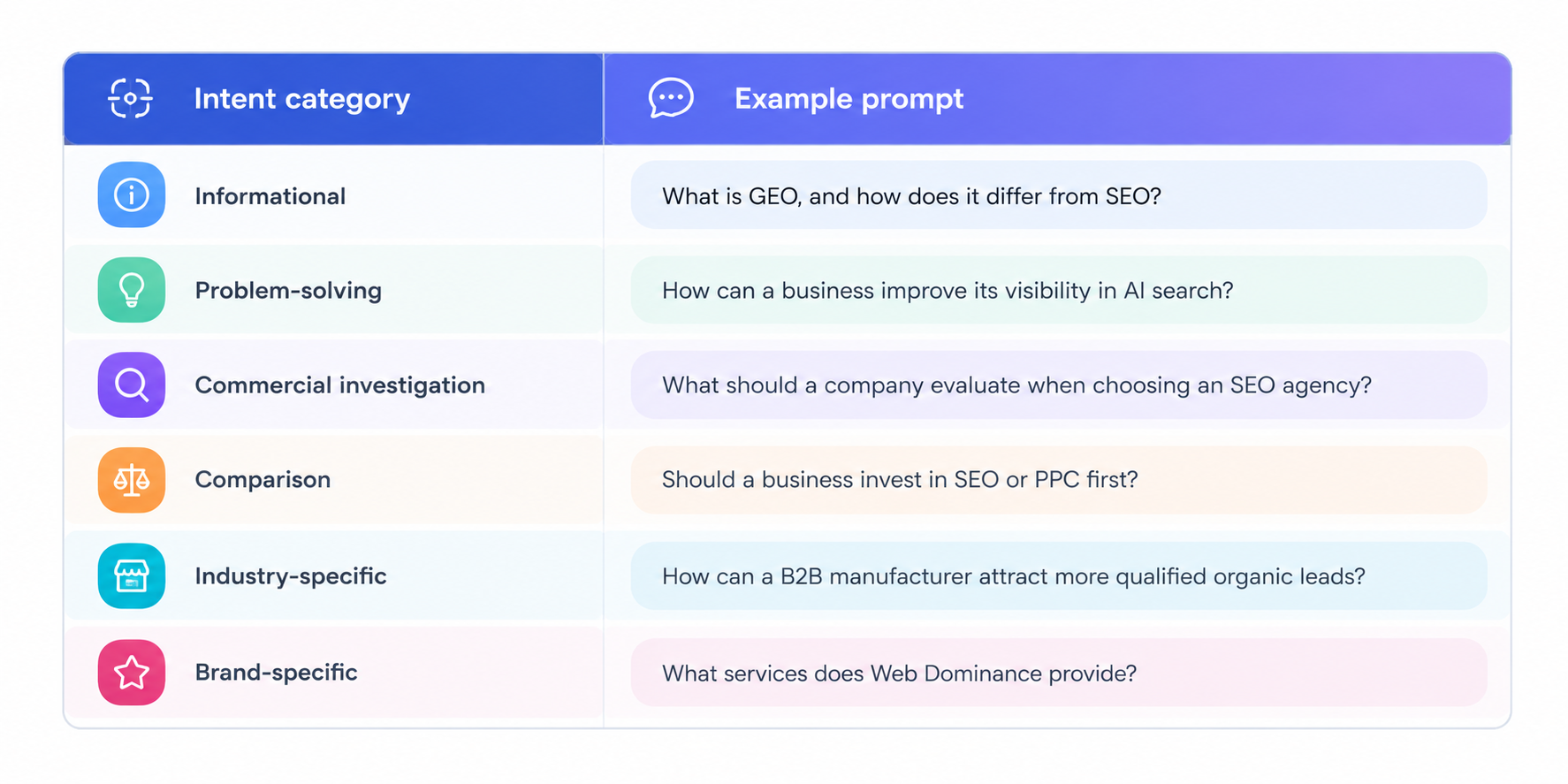
These prompts are starting examples. Build the final set around your actual target markets, services, languages, and customer questions.
Measure the percentage of prompts where your brand is mentioned or your site is cited within each topic and intent category.
This helps distinguish broad visibility from useful coverage of the subjects that influence buying decisions.
6. Competitive Citation Presence
AI-generated answers often reference several sources or present several potential providers. Tracking competitors helps you understand how your visibility compares within the specific questions you monitor.
For each relevant prompt, record:
- Which competing brands are mentioned.
- Which competing websites receive citations.
- Whether the competitor is recommended, merely listed, or referenced as a source.
- Which topic or question prompted the appearance.
- Whether your brand or website is also represented.
Where the platform provides citation-level reporting, you may be able to calculate citation share.
Citation share = Citations attributed to your domain ÷ Total citations across the measured sources × 100
For example, if a defined set of answers contains 200 citations and 20 are attributed to your website, your citation share is 10% for that particular dataset.
This calculation is meaningful only if the denominator and collection method are consistent. It should not be interpreted as a universal percentage of AI visibility or a measure of market share.
Microsoft’s AI Performance reporting in Bing Webmaster Tools includes citation reporting for supported AI experiences, with additional preview capabilities for understanding query intent, topic groups, and citation share.
Use competitive analysis to identify specific opportunities. If competitors consistently appear in answers about a subject relevant to your services, examine the pages being cited and assess whether your own content offers a useful, well-supported alternative.
7. Visibility Trends Over Time
A single test is a snapshot. It cannot reliably establish whether your AI visibility strategy is improving.
Track results across consistent reporting periods and compare the same prompts, platforms, markets, and scoring definitions.
Your trend report should show:
- Changes in brand mention rate.
- Changes in website citation rate.
- Changes in accuracy and recommendation scores.
- Topic groups gaining or losing visibility.
- Pages appearing more or less frequently as cited sources.
- Changes in competitor presence.
- Any relevant content updates, technical changes, or major campaigns.
AI-generated responses can change even when your website remains unchanged. A shift in one month’s results may reflect response variability rather than an improvement or decline caused by your work.
For that reason, combine repeated observations with other evidence, such as indexing data, content changes, search performance, and referral activity.
The goal is to identify meaningful patterns rather than react to every fluctuation.
The Practical GEO/AEO Scorecard: A 100-Point Framework
The following scorecard brings the seven metrics together into a simple internal reporting framework.
It is a proposed Web Dominance-style measurement model, not an official industry standard or a score used by Google, OpenAI, Microsoft, or another AI platform.
Rate each category from 0 to 5, then convert that rating into points according to the assigned weight.
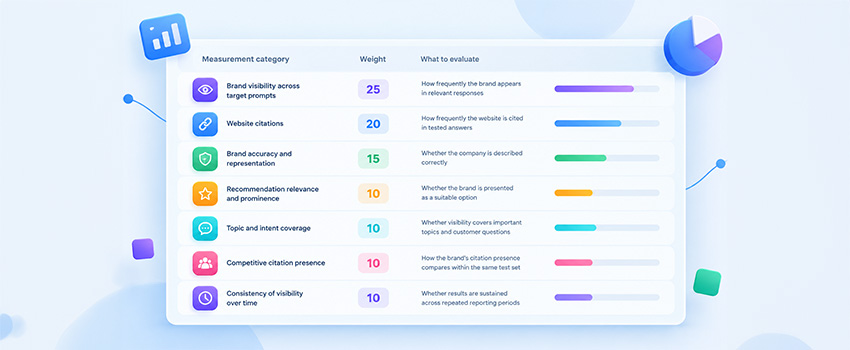
To calculate a category’s score, divide its rating by five and multiply by its weight.
For example, a rating of 4 out of 5 in the website citation category contributes 16 points out of the available 20.
Add the points across all categories to obtain an overall score out of 100.
For consistency, establish a written scoring guide for each category. Keep the same prompt set and evaluation rules between reporting periods, and label the score with the platforms, date range, markets, and number of responses tested.
Important: Do not treat this score as an objective measure of how visible your business is across the entire AI ecosystem. It summarizes results from your chosen test set. A score of 70 does not mean your brand owns 70% of AI search visibility, and it should not be compared with another company’s score unless both used the same methodology and comparable data.
Keep referral traffic, qualified leads, and revenue in a separate business-performance section. These are essential outcomes, but they measure a different part of the customer journey.
How to Build a Reliable AI Search Testing Process
The usefulness of a scorecard depends on how the data is collected. Inconsistent testing can create misleading conclusions, even when the metrics themselves are sensible.
Step 1: Define Your Target Questions
Start with a manageable set of prompts that reflects how your customers discover, research, compare, and choose solutions.
A reasonable starting point is 20–40 prompts distributed across your most important topics and search intents. This is a practical starting recommendation, not a statistically guaranteed sample size.
For each prompt, document:
- Its topic and intended audience.
- The search intent it represents.
- The market and language.
- Why the question matters to your business.
- Which products, services, or competitors are relevant.
Avoid focusing only on branded prompts such as “What is Web Dominance?” These are useful for checking brand accuracy but do not reveal whether people can discover the business when asking broader questions about a problem or category.
Step 2: Select the AI Platforms You Want to Measure
Choose platforms based on your target markets, audience behavior, available reporting, and business objectives.
Your test set might include ChatGPT search, Google AI Overviews and AI Mode, Microsoft Copilot, and other relevant AI-powered search experiences.
Do not assume that performance on one platform represents performance everywhere. Different systems can produce different answers, retrieve different sources, and provide different ways to measure citations or impressions.
Record which surfaces you test and keep that scope consistent over time.
Step 3: Standardize the Conditions
Run tests under conditions that are as consistent as practical.
Keep the wording of your core prompts unchanged between reporting periods. Record the platform, date, language, market or location, and relevant settings. Where possible, use fresh conversations to reduce the influence of prior context.
If you want to test alternative phrasings, treat them as separate prompts rather than silently replacing the original.
For important prompts, repeat observations on different days. This helps you understand whether an appearance is consistent or occurred only in a particular response.
Do not combine results from different platforms into a single rate without documenting the method. Platform-specific results should remain available for analysis.
Step 4: Record the Full Response, Not Just the Brand Name
For each valid test, capture the result in a spreadsheet or measurement tool.
A useful log includes:
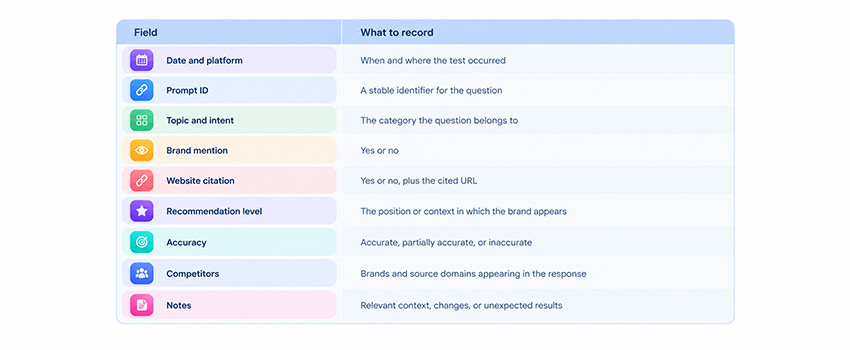
Save the response or a screenshot where permitted and appropriate. This creates a record that can be reviewed later and reduces the risk of relying on memory.
The data should be sufficient to explain why a score changed, not merely show that it changed.
Step 5: Calculate the Metrics and Review Patterns
Once the responses are recorded, calculate mention rate, citation rate, topic coverage, accuracy, and competitive presence.
Review the results at three levels:
- Platform level: Which AI experiences include the brand or cite its website?
- Topic level: Which subjects generate the strongest or weakest visibility?
- Page level: Which URLs are being cited, and what purpose do they serve?
This separation is important because an overall increase may hide weaknesses in commercially valuable topics. Similarly, one highly cited educational article may account for much of the website’s visibility while important service pages remain absent.
The goal is to find actionable patterns that can guide the next round of SEO and content improvements.
Which Tools Can You Use to Measure AI Search Visibility?
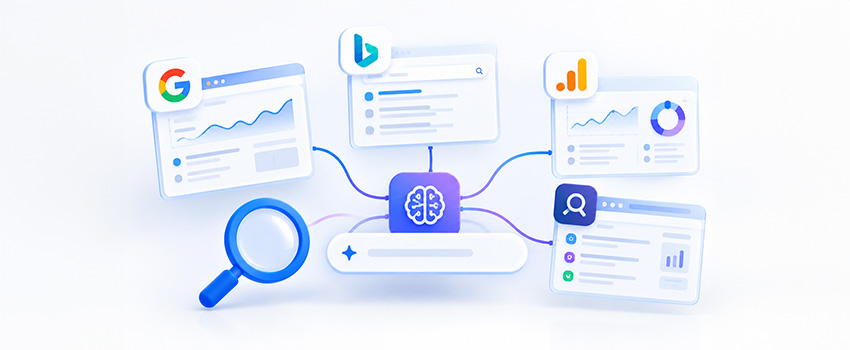
No single tool provides a complete view of brand mentions, citations, traffic, conversions, and competitive representation across every AI platform. A reliable measurement process combines platform-specific reporting, analytics, and controlled testing.
Google Search Console: Generative AI Performance
Google Search Console now includes a Generative AI performance report, which reports impressions associated with supported generative AI features in Google Search, including AI Overviews and AI Mode.
The report can help you understand:
- How impressions change over time.
- Which pages receive impressions in generative AI experiences.
- Where impressions originate by country.
- How results differ by device.
- Which pages have relatively stronger or weaker performance.
Availability and displayed data depend on the report’s requirements and whether the site has sufficient eligible impressions.
These are impression metrics, not a universal count of every mention of your brand across AI assistants. Use them alongside manual prompt tests and other relevant reporting rather than treating them as a complete GEO score.
Bing Webmaster Tools: AI Performance
Microsoft’s AI Performance report provides insight into how a site’s content is cited in supported AI-generated answers.
Its reporting includes citation activity, cited pages, grounding queries, and visibility trends. Additional capabilities introduced in preview include topic and intent insights and citation share.
This makes the tool useful for identifying which pages appear as sources, what query contexts are associated with those citations, and how citation patterns change over time.
However, its coverage is limited to the AI experiences supported by the reporting system. It should not be treated as a complete measurement of all ChatGPT, Google, or other AI-generated answers.
Google Analytics 4: AI Referral Traffic
Google Analytics 4 helps you understand what happens when visitors arrive at your website from identifiable AI platforms.
Depending on referral data and how visits are recorded, you may be able to identify sessions associated with AI sources and evaluate their behavior.
Track:
- AI-referred sessions.
- Landing pages receiving those visits.
- Engagement and important conversion events.
- Enquiries or sales attributed to those visits.
- Lead quality, where CRM data is available.
Referral traffic only captures visits that can be attributed through the available tracking data. It does not count people who saw your brand in an AI answer but never clicked, and it may not capture every AI-influenced journey.
Do not equate an increase in referral sessions with an equivalent increase in brand visibility.
Manual Prompt Testing and Specialist Monitoring Tools
Manual tests remain useful for prompts that matter commercially, especially when you need to evaluate recommendation context, factual accuracy, or visibility on platforms without sufficiently detailed reporting.
Specialist AI visibility tools may automate parts of prompt tracking and competitor monitoring. Before choosing one, check which platforms it covers, how it records citations, how often it runs prompts, and whether its reporting reflects actual responses or modeled estimates.
The most useful toolset is one that helps answer specific business questions, fits your reporting resources, and makes the underlying data understandable.
How to Turn Your Scorecard Into an SEO and Content Marketing Action Plan

Measurement becomes valuable when it informs what you do next.
The appropriate action depends on the gap you identify. More articles are not necessarily the answer, and not every missing citation indicates a content problem.
If Your Brand Is Rarely Mentioned in Relevant Answers
Start by reviewing whether your website clearly explains who you are, what you offer, which audiences you serve, and what problems you solve.
Audit your important service pages, About page, industry pages, and content clusters. Use consistent descriptions of your expertise and make key information easy for visitors to locate.
Next, examine the prompts where competitors appear. Determine whether their visibility comes from more relevant pages, stronger evidence, specialist resources, useful comparisons, or references from credible external sources.
Use those findings to identify specific opportunities rather than trying to copy competitors’ content.
If Your Brand Is Rarely Mentioned in Relevant Answers
A mention without a citation does not necessarily mean your website has a technical or content weakness. An AI system may draw on other sources or mention a brand without linking to its domain.
Nevertheless, review whether your website provides useful, well-supported information related to the prompts where the brand appears.
Consider creating or improving pages that answer important questions directly, explain your services precisely, include relevant evidence, and provide depth beyond generic definitions.
Also check technical accessibility, indexing, internal linking, and whether relevant pages can be discovered by the search systems you are targeting.
OpenAI’s publisher guidance explains how website discovery and crawler access relate to visibility in ChatGPT search. Platform-specific eligibility and access controls should be checked where relevant; no access configuration guarantees that a page will be cited.
If Your Website Receives Citations but the Brand Is Misrepresented
Review the cited page and the wider information available about the business.
The source may be outdated, incomplete, ambiguous, or inconsistent with your current service offering.
Improve the relevant page with accurate descriptions, clear dates where useful, evidence for important claims, and explicit explanations of the business’s role, expertise, products, or services.
Check whether other important pages and credible external profiles provide consistent information.
If the incorrect claim originates from a third-party source, investigate whether that source can be corrected. Do not assume that changing a single website paragraph will immediately change every AI-generated response.
If You Have Strong Visibility but Little Referral Traffic
This does not automatically mean the strategy is failing. Many AI-generated answers can provide users with information without requiring them to visit the cited website.
However, it is worth examining whether the prompts being tested relate to actual buying needs, whether the cited pages offer useful next steps, and whether the website communicates a clear value proposition.
If the objective is lead generation, distinguish between informational visibility and visibility associated with commercial evaluation.
Track the pages receiving identifiable AI referrals, the actions visitors take, and whether the resulting enquiries become qualified opportunities.
If Competitors Consistently Receive More Citations
Compare the specific pages and topics involved.
Look for differences in relevance, content depth, original evidence, clear expertise, source quality, and technical accessibility.
A competitor may have a specialized guide, detailed documentation, an original study, or a stronger page for a particular query. Your response should be to close relevant gaps and create genuinely useful content—not simply increase publication volume.
This is where SEO and content marketing work together. Technical foundations help important pages become accessible, while a focused content strategy develops useful resources around the topics your business is qualified to address.
How Often Should You Measure GEO/AEO Performance?

For most businesses, a monthly review is a reasonable starting point for a manually tested scorecard. Automated or platform-specific reporting may be monitored more frequently, depending on the available data.
A practical schedule might include:
- Weekly: Review available dashboards and investigate unusual changes in citations, impressions, or referrals.
- Monthly: Repeat the core prompt set, calculate the scorecard, and identify topic-level gaps.
- Quarterly: Reassess prompt relevance, competitor selection, content priorities, and the relationship between visibility and business outcomes.
This cadence is a recommendation, not an industry standard. A small website with limited AI visibility may need a lighter process, while a large brand operating in several markets may require more extensive monitoring.
Keep a record of important website changes, new content, redirects, technical fixes, and major campaigns. These annotations provide context when results change.
Do not change the prompt set every month simply because the results are disappointing. Maintain a stable core set for comparison, and introduce new prompts separately when customer behavior or business priorities justify them.
Measure What Matters. Improve What You Can Prove.
AI search visibility is easier to manage when it is treated as a measurable part of a broader search and content strategy rather than a collection of isolated mentions.
Start with the questions your customers actually ask. Test them consistently, identify where your brand appears, verify how it is represented, and examine which sources are being cited. Then use those findings to prioritize improvements to technical SEO, service pages, educational content, and supporting resources.
Over time, a well-maintained scorecard can help your team distinguish meaningful changes from response variability and connect AI visibility observations with website activity and business outcomes.
At Web Dominance, our SEO services help businesses improve organic discoverability through keyword research, technical SEO, and on-page and content optimization. Our Content Marketing services focus on strategy, useful content creation, distribution, and performance analysis.
If you are building an AI search visibility strategy, start by understanding your current position, identifying the topics that matter to your audience, and developing a measurement process that connects visibility with business priorities.
Contact Web Dominance to discuss an SEO and content marketing strategy for your business.